The Pentagon's UAP Videos Show Something Real — Just Not What You Think
The infrared footage is authentic, the pilots were credible, and the phenomena are genuinely unresolved — but the sensors recording them have limits most analysts never mention.
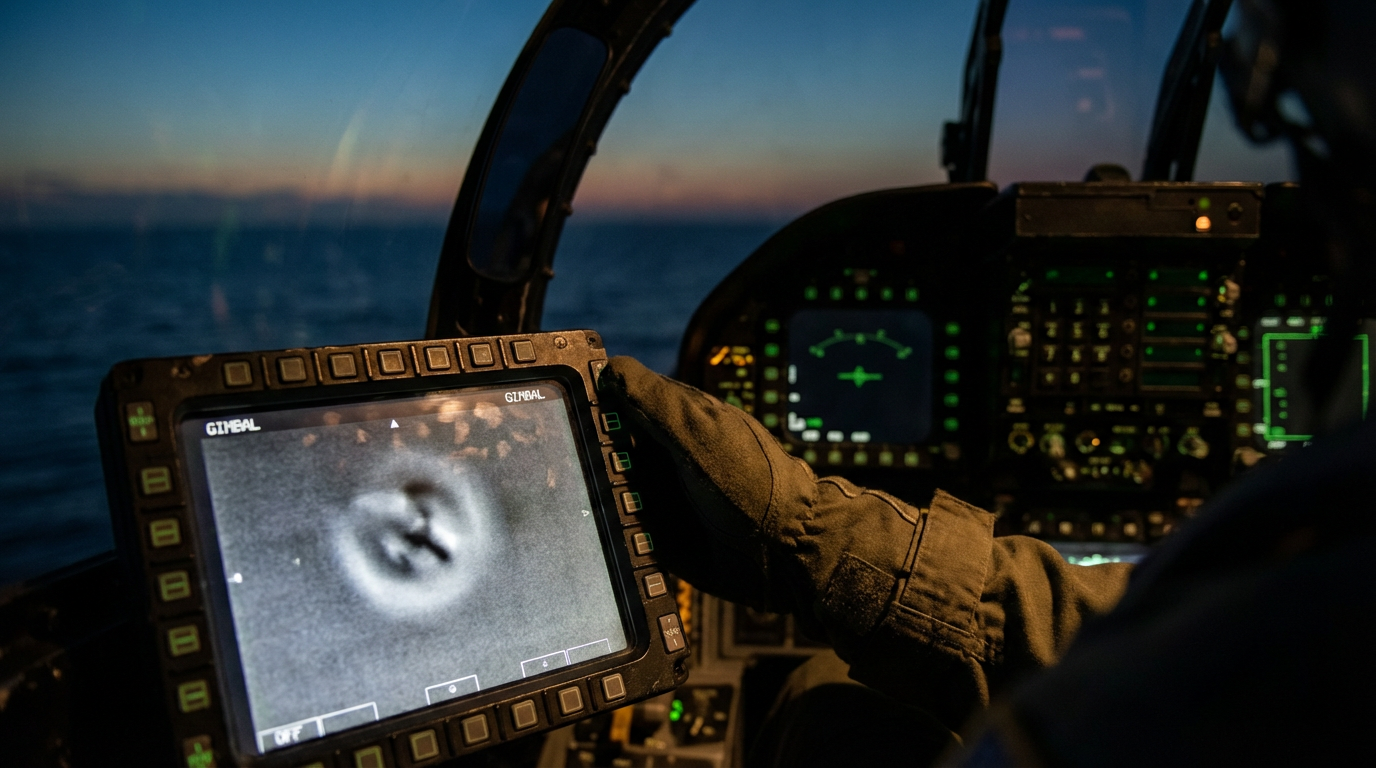
In late 2017, the New York Times published three videos alongside a story about a secret Pentagon program. The footage was real — authenticated, officially released, no chain-of-custody dispute. Two naval aviators described in firsthand accounts seeing objects that moved in ways they could not explain. A rotating object glowing in infrared. A small fast-moving shape with no visible exhaust plume. An elongated blip behaving strangely in a cluttered radar environment. If you were trying to design the most credible UFO disclosure possible, you would probably design something like this: military hardware, experienced observers, authenticated telemetry, and no easy explanation in reach.
What followed was predictable in both directions. One camp treated the footage as near-confirmation of non-human technology. The other camp waved it off as misidentified aircraft or atmospheric clutter. Both camps skipped the part that actually matters: reading the footage against what the sensors can and cannot detect, under the conditions in which they were operating. That analysis is slower, less satisfying, and considerably more interesting than either the true-believer or the debunker version. It is also the only version that preserves the genuine strangeness of what is actually unresolved.
The three videos — referred to as FLIR1, Gimbal, and GoFast — were captured by the Raytheon AN/AAQ-28 LITENING targeting pod and the ATFLIR system aboard F/A-18 Super Hornets[4]. These are sophisticated instruments by any reasonable standard. They are also instruments with documented constraints: fixed aperture sizes, parallax sensitivity, thermal bloom, gyroscopic stabilization artifacts, and a series of automatic behaviors that change how a tracked object appears on screen without any change in the object itself. The gap between what those sensors captured and what is being claimed about that footage is where this story actually lives.
None of this means nothing happened. Something was there. The question of what it was is genuinely open. But you cannot read that footage accurately without understanding the instrument, and most people discussing these videos — including many who should know better — have never worked through what the instrument does.
What Infrared Cameras Actually See
An infrared targeting pod does not see shape the way a camera sees shape. It detects differential thermal emission — surfaces and objects that radiate heat at different rates than their background. At altitude, in a cold atmospheric layer, almost anything that generates heat becomes a high-contrast target. An aircraft engine seen from the rear, a balloon skin warmed by friction, an upper atmospheric feature creating a thermal boundary — all of these can produce a distinct infrared signature. The sensor does not know what it is looking at. It reports what is hot relative to what surrounds it, and the ATFLIR system then attempts to lock on and track whatever it has flagged.
This matters because several key features of the three videos — features that drove the most dramatic interpretations — are direct consequences of how infrared tracking systems behave under specific conditions. The Gimbal video, for instance, shows an object that appears to rotate smoothly as the jet banks and the sensor tracks. This rotation was interpreted by many as the object itself maneuvering. The more prosaic explanation, supported by aerospace engineers who examined the footage[3], is that what appears to rotate is a glare artifact produced by the sensor's gimbal mechanism reaching its azimuth limit and attempting to compensate. The pod's internal stabilization system generates a rotation signature in the output under exactly these circumstances. The object may not have moved at all.
“The rotation that launched a thousand headlines may be the sensor talking to itself.”
This is not a trivial point. The Gimbal video's most dramatic feature — the reason it was named Gimbal — is the one feature most directly explained by instrument behavior. That does not mean there is nothing there. Something generated a thermal return. But the rotation, the detail that made it look like a craft performing an impossible maneuver, is a strong candidate for an artifact of the tracking system rather than a property of the target.
GoFast and the Parallax Problem
The GoFast video is the one that seems most viscerally convincing. The object appears to move at extraordinary speed across the ocean surface, low and fast, with no obvious propulsion signature. Pilots described it as racing. The visual impression is striking.
The problem is parallax. When a jet moving at high speed tracks an object with a long-range infrared sensor, the apparent velocity of a small, slow object can be dramatically amplified by the geometry of the observation. If the object is closer to the camera than it appears — altitude being notoriously difficult to judge by infrared sensor against a featureless ocean background — and the jet itself is the primary source of motion in the frame, the target can look many times faster than it actually is. Investigators who have reconstructed the GoFast geometry using the jet's known speed, bank angle, and altitude data embedded in the video itself[1] have produced estimates suggesting the object may have been moving at speeds consistent with a weather balloon or similar free-floating body. The apparent speed is a geometric artifact, not a measurement.
This kind of analysis is not exotic. It is the same parallax correction applied routinely in air traffic control, orbital mechanics, and optical astronomy. The brain — and unguided video analysis — does not automatically perform it. The sensor does not perform it. What gets recorded is apparent motion, not true velocity. That distinction collapses under the pressure of narrative, which wants a fast thing to be genuinely fast.
The FLIR1 Video and the Classification Problem
FLIR1, sometimes called the Tic Tac video, involves a longer, better-documented incident — the 2004 USS Nimitz encounter — and has the most supporting testimony from multiple pilots, radar operators, and personnel aboard the Princeton, the guided-missile cruiser running air defense for the carrier group. Something was tracked on SPY-1 radar over several days, maneuvering in ways the radar operators described as inconsistent with any aircraft they had catalogued. The infrared footage captured a white object with no visible propulsion signature moving in a manner that the pilots struggled to explain.
This is the case where sensor limitations become most important to understand precisely because the evidence is most substantive. The SPY-1 radar is powerful and well-calibrated, but radar tracking at extended range produces detection and classification problems that are not always obvious in incident reports. A target that maneuvers unpredictably may be maneuvering, or it may be the radar intermittently losing and reacquiring a target that has drifted — each reacquisition logged as a new position, creating apparent trajectory changes that do not reflect continuous movement. The radar operators were experienced. They were also working with a signal-processing system that can produce positional ambiguity under certain atmospheric conditions and at certain ranges.
“Radar reacquires a drifting target and logs a new position — and on the readout, physics appears to have been violated.”
None of this resolves the Nimitz case. Multiple witnesses, correlated across different sensor types, in daylight, at closer range than the other incidents, describe something genuinely anomalous. The infrared footage is not the strongest element of this case — the witness accounts and multi-sensor correlation are — and they remain unresolved. The point is not that the instruments were wrong. The point is that the instruments were operating at the edge of their reliable performance envelope, and the data needs to be read with that edge in view.
Why Both Sides Keep Getting This Wrong
The declassified videos became cultural events before they became analytical puzzles. By the time sensor engineers and physics-literate analysts began working through the footage systematically, the narrative was already locked: either these were genuine non-human craft or the whole thing was a hoax or misidentification. Both framings are wrong in nearly the same way. They treat the footage as self-interpreting, as if the camera were a neutral witness rather than a complex instrument with documented failure modes operating under specific and challenging conditions.
The true-believer reading of the footage tends to focus on what cannot immediately be explained and treat that gap as confirmation. The skeptic reading tends to reach for the nearest mundane explanation and stop there. Neither approach actually engages with what a targeting pod does in auto-tracking mode when it loses lock, or what happens to apparent object shape when the aperture is small relative to the target's actual size, or how atmospheric layers at specific altitudes can produce refractive distortions that make stationary objects appear to jink. These are not exotic claims. They are documented behaviors in the engineering literature.
What makes this frustrating is that the genuine uncertainty — the part that cannot be explained away — is actually more interesting than either camp's version. Something was tracked in the Nimitz case across multiple sensor types and observers over several days. The GoFast and Gimbal objects may be far more prosaic, but the Nimitz incident carries weight precisely because it resists easy closure. The instrument analysis does not kill that mystery. It clears the underbrush so you can see what the mystery actually is.
What Remains Genuinely Unresolved
“Unexplained is not a synonym for inexplicable — but it is also not a synonym for explained.”
The Pentagon's All-domain Anomaly Resolution Office[2] has been collecting and classifying UAP reports since 2022. The classification problem they face is the same one confronting anyone who tries to read the three videos honestly: you need to separate sensor artifact from genuine unknown, atmospheric phenomenon from structured object, instrument drift from actual trajectory. That is hard with good data. The UAP data is frequently incomplete — missing radar telemetry, limited to a single sensor angle, undocumented atmospheric conditions, short observation windows. Many reports that come in genuinely cannot be resolved, not because the phenomenon is extraordinary, but because the data is insufficient to rule anything in or out.
That insufficient data is itself a finding. A military with the world's most sophisticated sensor infrastructure is still regularly unable to characterize objects in its own airspace. Some of those objects are almost certainly identified by classified programs not shared in declassified reports — foreign unmanned systems, black programs, test assets. Some are probably atmospheric. Some are probably instrument artifacts. And some remain, after every reasonable explanation has been tested, genuinely unresolved. That residue — not the rotation in the Gimbal video, not the apparent speed in GoFast, but the multi-sensor, multi-witness cases that do not collapse under scrutiny — is where the actual investigation needs to live.
The Instrument Is Not the Enemy of the Mystery
Understanding what a sensor does well and what it distorts does not make the UAP question boring. It makes it legible. If you want to know whether something real and unclassified was moving through restricted airspace off the coast of San Diego in 2004, you need to know which parts of the evidence are load-bearing and which parts are sensor noise. The gimbal rotation is probably noise. The multi-day SPY-1 tracking, correlated with pilot visual contact at close range, carries more weight. Treating those two things as equivalent because both feel mysterious is not curiosity. It is just an undifferentiated appetite for strangeness.
The declassified videos showed something. They showed it through instruments with real constraints, in conditions that were not ideal, captured by observers under the cognitive pressure of a fast-moving intercept. What those videos do not show — and cannot show — is a conclusion. The footage is a starting point, not an answer. The investigation that should follow it requires the same patience and instrument literacy that any ambiguous detection demands: careful separation of what the sensor recorded, what the sensor's documented behaviors can account for, and what, after all of that, still does not have a clean home. That last category remains genuinely worth taking seriously. The rest of it is the instrument, talking.
References
- AARO GoFast Case Resolution Card Methodology Final (aaro.mil)
Supplies altitude data embedded in GoFast video enabling parallax-corrected velocity estimates suggesting weather balloon speeds. - All-domain Anomaly Resolution Office (aaro.mil)
Provides altitude data embedded in the GoFast video used to reconstruct object geometry and estimate actual speed consistent with weather balloons. - Reconstruction of Potential Flight Paths for the January 2015 Gimbal UAP (arxiv.org)
Provides aerospace engineer analysis supporting the article's claim that Gimbal's rotation is a gimbal mechanism artifact, not object movement. - AN/ASQ-228 ATFLIR (en.wikipedia.org)
Describes the ATFLIR targeting pod's technical capabilities as a multi-sensor electro-optical system used aboard F/A-18 Super Hornets.
About Rowan Ellery
Rowan Ellery writes about anomalies, unexplained sightings, strange signals, and the uneasy border between observation, misinterpretation, and genuine mystery. Their work focuses on keeping curiosity alive without letting evidence dissolve into folklore.
More like this
The Declassified UAP Files Are Real. They're Also a Classification Problem.
The National Archives' 2025 UAP release is the most transparent disclosure in decades — and it exposes a problem that has nothing to do with aliens.
The Pentagon Released 162 UAP Files. The Unresolved Ones Are the Interesting Part.
The May 2025 file release is historic, but the official language used to explain every unresolved case quietly reveals something more useful than any alien hypothesis.
The Government Said UAPs Aren't a Threat. It Also Can't Explain 3% of Them.
AARO's 2025 report resolves the vast majority of UAP sightings with ordinary explanations — but the cases that survive that process expose a structural gap in how the U.S. tracks anything moving through its airspace.