Epistemic Uncertainty
Uncertainty caused by the limits of human knowledge, not by randomness. It describes the gap between what can be known and what is actually known.
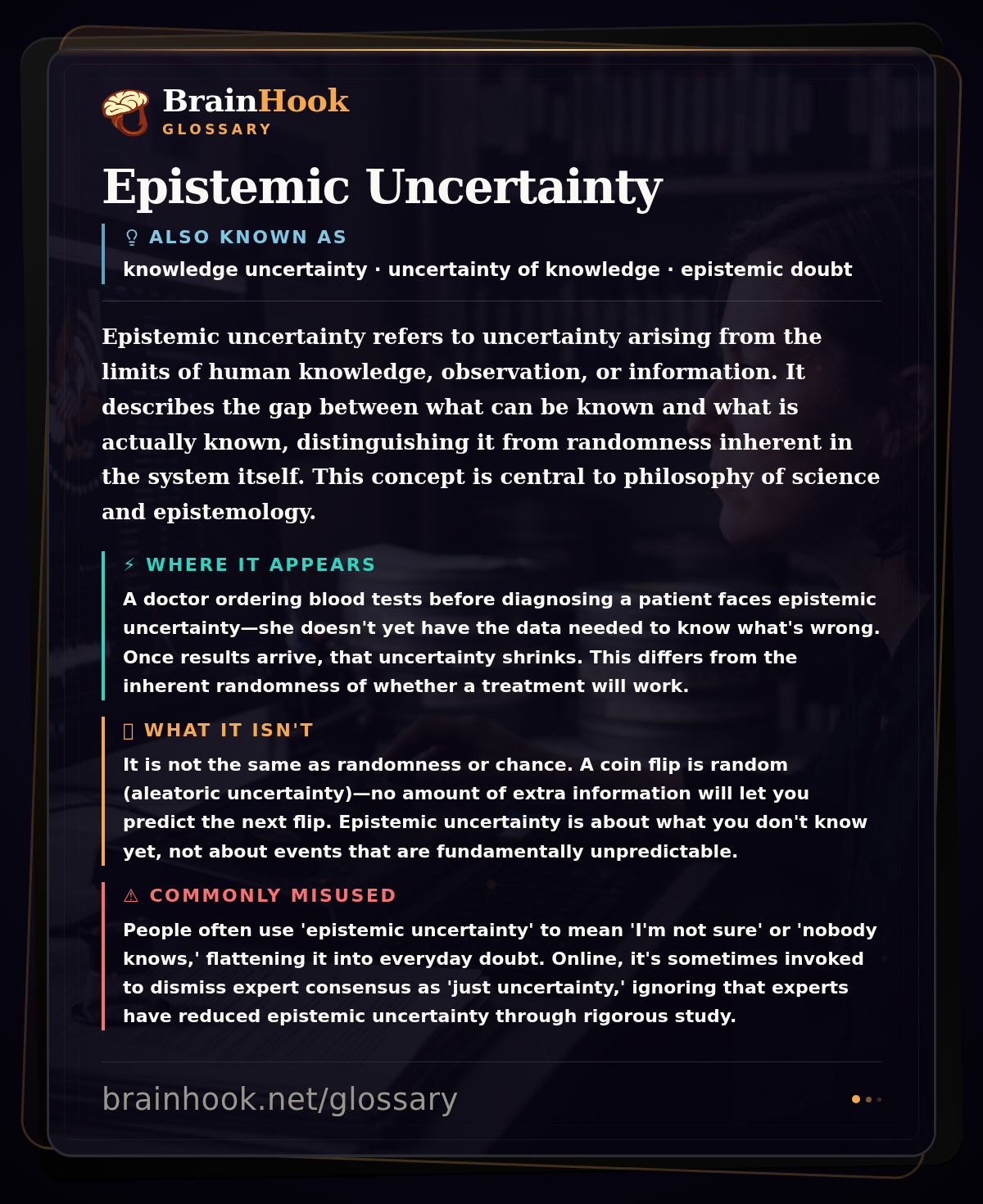
Epistemic uncertainty refers to uncertainty arising from the limits of human knowledge, observation, or information. It describes the gap between what can be known and what is actually known, distinguishing it from randomness inherent in the system itself. This concept is central to philosophy of science and epistemology.
What this means in real life
A doctor ordering blood tests before diagnosing a patient faces epistemic uncertainty—she doesn't yet have the data needed to know what's wrong. Once results arrive, that uncertainty shrinks. This differs from the inherent randomness of whether a treatment will work.
What it isn’t
It is not the same as randomness or chance. A coin flip is random (aleatoric uncertainty)—no amount of extra information will let you predict the next flip. Epistemic uncertainty is about what you don't know yet, not about events that are fundamentally unpredictable.
Commonly misused online
People often use 'epistemic uncertainty' to mean 'I'm not sure' or 'nobody knows,' flattening it into everyday doubt. Online, it's sometimes invoked to dismiss expert consensus as 'just uncertainty,' ignoring that experts have reduced epistemic uncertainty through rigorous study.