Deepfakes Didn't Break Trust. They Broke the Act of Verifying.
Deepfakes rarely fool experts — but they've given anyone caught on camera a new defense, and that's quietly dismantling the evidentiary logic that holds institutions together.
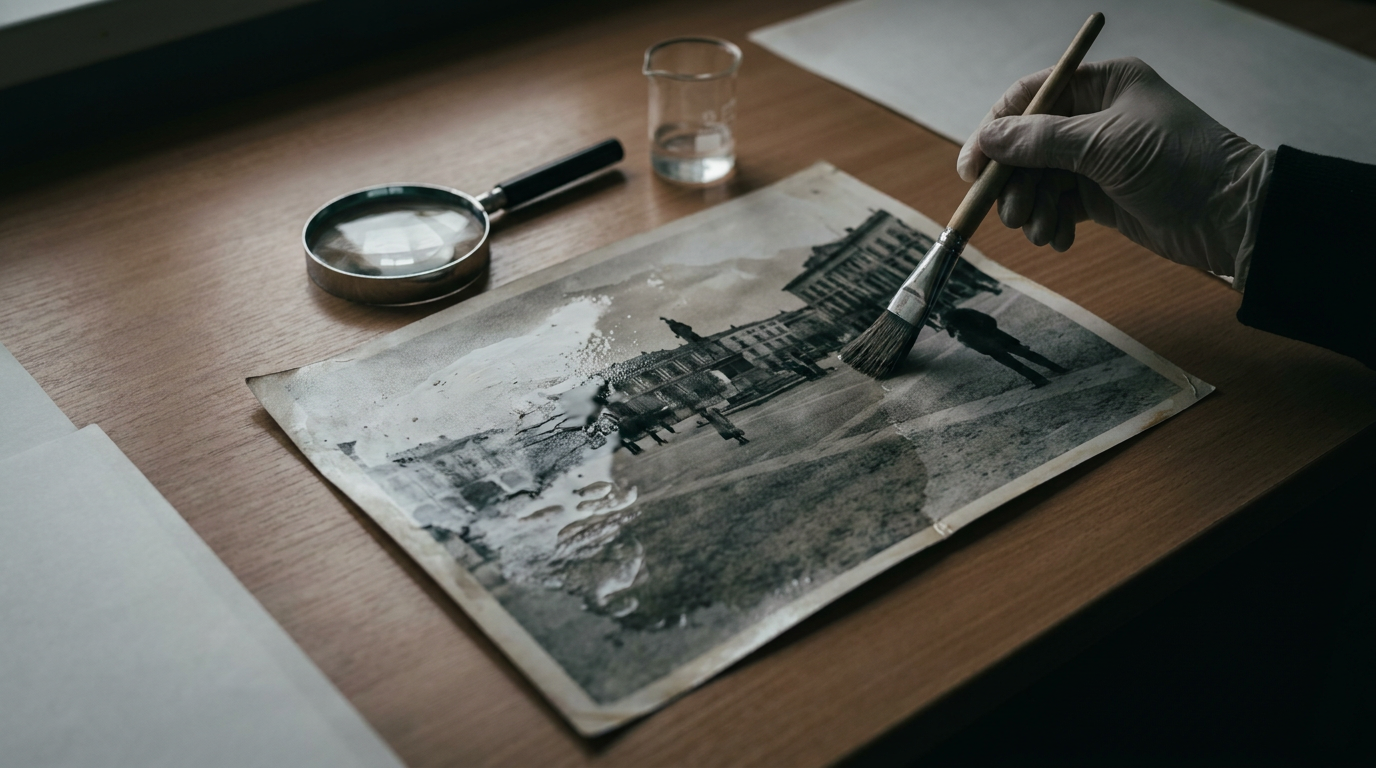
In 2023, a politician in an Eastern European country released a statement calling a leaked audio clip of his voice — one in which he appeared to discuss a bribery arrangement — a fabrication. His technical advisers pointed to compression artifacts, unusual tonal flatness, subtle timing irregularities that they said were signatures of AI synthesis. Independent audio analysts who later examined the clip disagreed. Most assessed it as genuine. It didn't matter. By the time the assessments circulated, the denial had already done its work: the story was no longer about what he said, but about whether anyone could know what he had said. The political crisis dissolved not because the recording was disproven but because its status as evidence became permanently unstable.
This is the part of the deepfake story that gets underreported, partly because it lacks drama. There are no viral face-swaps in it, no celebrities degraded, no obviously false speeches going around. The dangerous part is quieter: a structural shift in how recordings function as evidence, in how institutions use them, in how the person being recorded can respond to them. The crisis is not that synthetic media is convincing. Most of it isn't, at high scrutiny. The crisis is that its existence gives every subject of a real recording a plausible line of defense.
Researchers have a name for this. The liar's dividend is the advantage that accrues to someone caught on camera or audio doing something damaging, when the mere existence of deepfake technology provides a credible basis for denial — regardless of whether any synthesis actually occurred. It is an externality of the technology itself. You don't have to make a deepfake to benefit from the fact that deepfakes exist. You just have to be the kind of person who would benefit from doubt[1].
UNESCO's 2025 analysis of synthetic media gives this dynamic a wider frame. The report argues that the primary threat from AI-generated content is not disinformation in the conventional sense — not fake news spreading false beliefs — but what it calls a crisis of knowing itself[4]. The epistemic architecture that allows institutions, journalists, courts, and ordinary people to treat recordings as reliable anchors to what actually happened is being quietly corroded, not by the fakes that fool people but by the possibility that any recording might be fake. When verification becomes prohibitively expensive or publicly inconclusive, the benefit of the doubt migrates away from the record and toward whoever is contesting it.
The Verification Gap Deepfakes Actually Exploit
Detection technology is real and improving. Academic labs, platform safety teams, and forensics companies have developed tools that look for unnatural blinking rates, lighting inconsistencies, physiological signals like blood-flow patterns in skin pixels[2], spectral analysis of audio waveforms. Some of these methods are genuinely good. The problem is that they are technical, contested, and slow — and they operate in a world where the public has no common framework for interpreting their conclusions. When one group of analysts says a clip is authentic and another says it's synthetic, there is no trusted arbiter, no neutral institution with the public credibility to settle the question and have that settlement accepted.
This gap between detection capability and institutional credibility is where the liar's dividend lives. It is not primarily a technical problem. It is a trust problem, and technology has been eroding the conditions for that kind of trust for years through separate but related mechanisms — platform fragmentation, algorithmic sorting into incompatible information environments, the slow collapse of institutions that once served as shared epistemic authorities. Deepfakes did not create that erosion. They arrived into it, and they exploit it with particular efficiency.
“You don't have to make a deepfake to benefit from the fact that deepfakes exist.”
There is also a subtler erosion happening at the level of habit. When people know that images and audio can be fabricated convincingly, they begin to apply prior skepticism differently. Research in epistemic psychology suggests that pre-existing belief is one of the strongest predictors of whether someone accepts or rejects a piece of media as authentic. A convincing real recording of someone your community already distrusts will now face skepticism it would not have encountered a decade ago. Meanwhile, a convincing fabrication confirming something you already believe may receive less scrutiny than it deserves. The deepfake phenomenon has not made people evenly skeptical. It has given motivated skepticism a new technical vocabulary.
Courts, Cameras, and Evidence That Can Now Be Argued Away
The legal dimension is where the stakes become concrete. Courts in multiple jurisdictions have already encountered cases in which defendants challenged the authenticity of video or audio evidence by raising the possibility — not demonstrating the fact — that synthetic media was involved. Legal scholars who study digital evidence describe this as a novel defense strategy with low threshold requirements: you do not have to prove a recording is fake, only introduce sufficient doubt about its provenance to complicate its evidentiary weight. The burden of authentication, which previously rested on a fairly stable technical foundation, is shifting.
Prosecutors and civil litigators are beginning to adapt. Some jurisdictions are moving toward requiring cryptographic provenance chains for digital evidence — essentially, an unbroken chain of metadata that ties a recording to a specific device, time, and location, with tamper-evident signatures at each step. The Content Authenticity Initiative[3], a coalition of media organizations and technology companies, has developed open standards for provenance attestation that embed verifiable information into media files at the moment of capture. This is a real engineering response to a real problem. But it depends on adoption at scale, and it creates a new asymmetry: media with provenance will be trusted, media without it will face default suspicion, and most of what ordinary people record on ordinary phones today carries none of it.
There is also a class dimension here that is easy to miss. Wealthy defendants, corporations, and governments can hire technical experts to challenge recordings. They can sustain the doubt long enough to outlast a news cycle or complicate a verdict. Ordinary accusers — a whistleblower, a domestic violence survivor, a worker documenting wage theft — typically cannot. The liar's dividend is not distributed equally. It flows most powerfully toward those with the resources to amplify doubt and the institutional standing to have their denials taken seriously.
The Environment Deepfakes Are Already Changing
“The liar's dividend is not distributed equally — it flows most powerfully toward those with the resources to amplify doubt.”
The behavioral changes are already underway, and they don't require deepfakes to be common. They require only that people know deepfakes exist. Journalists in conflict zones and in political reporting describe a new friction in their work: sources are increasingly reluctant to appear on camera or audio, not because they fear being misquoted in text, but because they fear their recorded voice or image being questioned in ways that could expose them without protecting them. The recording, once a form of protection — you said this, here is the proof — is losing some of that function.
Something similar is happening in accountability journalism. Video evidence of police use of force, corporate misconduct, or political behavior used to carry significant presumptive weight in public discourse. That presumption is now thinner. In some cases this is appropriate — video has always been a partial record, a frame around an event that excludes context — but the new skepticism is not necessarily more epistemically sophisticated. It is often more convenient, more selectively applied, and more effective at protecting the people most likely to be caught doing something they should not have been doing.
The attention economy adds its own distortion. Synthetic media floods content pipelines not primarily as disinformation but as noise — AI-generated images, cloned voices, algorithmically assembled video collages, satire that doesn't identify itself as satire. The sheer volume changes the cognitive environment in which real information circulates. When users encounter dozens of synthetic or semi-synthetic items in a feed each day, the baseline suspicion about any item of uncertain provenance rises. Platforms that have optimized for engagement have limited structural incentive to reduce that volume, because uncertainty and novelty both drive interaction.
What It Means When Knowing Becomes Expensive
The UNESCO framing — a crisis of knowing itself — is useful because it locates the damage in process rather than in specific false beliefs. Democratic accountability, legal process, journalism, and science all depend not just on facts being theoretically available but on shared procedures for resolving disputes about what is real. When those procedures become contested, expensive, or publicly illegible, power concentrates in whoever can most effectively sustain ambiguity. Deepfakes are one accelerant in that process. They are not the cause of the underlying erosion, but they are well-suited to exploiting it.
The technical mitigations under development are necessary but not sufficient. Provenance standards help with the media produced going forward by organizations and manufacturers who adopt them; they do not help retroactively, and they do not address the informal, person-to-person recording that makes up most of what gets captured about how power actually behaves in the world. Watermarking schemes help identify synthetic outputs from known model providers but don't constrain open-source tools that can generate convincing audio and video without any watermark infrastructure. Detection keeps improving but remains a specialist skill whose outputs require trusted translation for public use, and we have not rebuilt the trusted institutions capable of providing that translation.
The Asymmetry That Persists After the Fake Is Debunked
“When verification becomes prohibitively expensive or publicly inconclusive, the benefit of the doubt migrates away from the record and toward whoever is contesting it.”
There is a classic asymmetry in how corrections work in media: a debunking rarely reaches the same audience as the original claim, and even when it does, the original often leaves a stickier impression. Deepfake denials work on a related but slightly different logic. The denial does not need to be believed to do its work. It only needs to reach enough people to make the recording feel contested, and contested is often enough. A politician whose damaging audio is widely reported and widely doubted has succeeded in neutralizing much of the accountability force of that audio even if no thoughtful analyst considers their denial credible. The goal is not persuasion. It is saturation of a contested status.
What the deepfake era is changing, then, is less what people believe and more how expensive it is to establish a shared baseline of what is real. Every meaningful recording now carries an invisible question mark — not necessarily raised, but available to be raised when useful. Institutions that depended on recordings to anchor shared reality — newsrooms, courts, regulatory bodies, historical archives — are managing that cost without a clear map. The technology keeps advancing. The verification gap keeps shifting. And the people most likely to benefit from unresolvable doubt remain, almost by definition, the people with the most to hide.
References
- benefit from doubt (papers.ssrn.com)
Defines the liar's dividend concept—the advantage gained from denying recorded evidence by citing deepfake technology's mere existence. - Deepfake Media Forensics: Status and Future Challenges (pmc.ncbi.nlm.nih.gov)
Describes detection methods including blood-flow pattern analysis in skin pixels used to identify synthetic media in forensic analysis. - Content Authenticity Initiative (contentauthenticity.org)
Presents open standards for cryptographic provenance chains and metadata verification to authenticate digital media at capture. - Deepfakes and the crisis of knowing (unesco.org)
UNESCO's 2025 analysis frames deepfakes' primary threat as a crisis of epistemic authority rather than conventional disinformation.
About Julian Cross
Julian Cross writes about AI, automation, surveillance, digital identity, labor, human relationships with each other and automation, complex systems and attention — less about what new tools, studies and observations can do in theory than what they're already doing to how we work, spend, relate, and get measured. His work follows leads to the point where it stops being a product and starts being a condition.
More like this
The Liar's Dividend Is Already Here. Your Brain Is the Exploit.
New data on human detection rates reveals that deepfake technology's most dangerous output isn't convincing fakes — it's a world where anyone can credibly call real evidence a lie.
To Fix a Deepfake, YouTube Wants Your Face. That's the Trap.
YouTube's new likeness detection tool promises to shield creators from deepfakes — but using it means submitting your face to a platform with every incentive to find that data useful.
Democracies Don't Warn You Before They Stop Being One
Political scientists have spent two decades mapping exactly how democracies die without a coup — and the indicators they built now point at the United States.