The Dust on Your Windowsill Contains Debris From Dead Solar Systems
Buried inside ordinary interstellar dust are microscopic grains that formed in dying stars before our Sun existed — and the isotope ratios locked inside them are a chemical diary of explosions billions of years old.

Run a finger along a windowsill and you collect something unremarkable: a gray smear, domestic and dull, mostly skin cells and fiber and the residue of ordinary life. But mixed into that residue, in quantities too small to see and too significant to ignore, are grains of material that traveled here from dying stars. Not metaphorically. Not poetically. They arrived as physical objects, specks of silicon carbide and graphite and aluminum oxide manufactured inside stellar atmospheres billions of years before the Earth formed, then launched into interstellar space by supernova blast waves and stellar winds, then swept into the young solar system as the Sun's disk was still accreting, and then — after all of that — gradually settling onto every surface on a planet they had no reason to find.
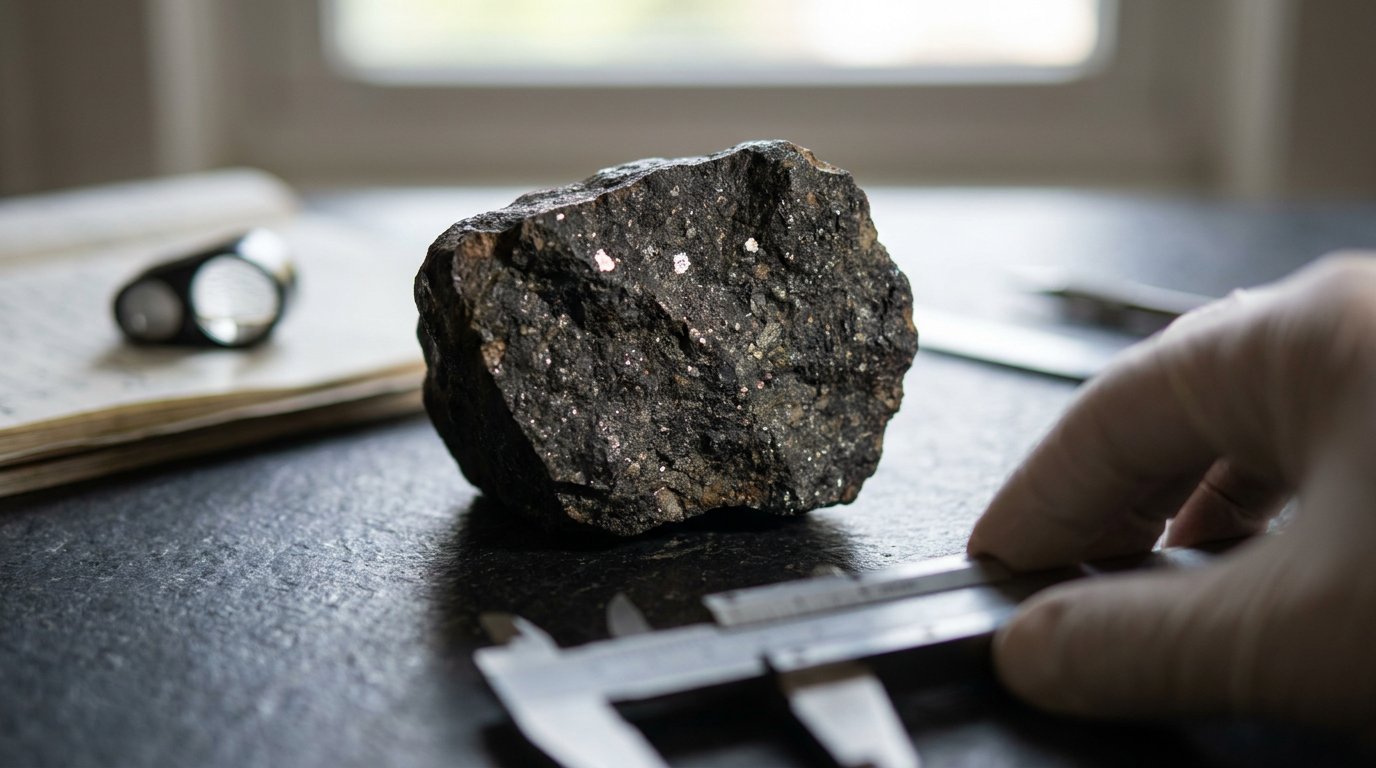
These are called presolar grains, and they are among the strangest objects in planetary science. The word presolar is precise: these grains formed before the solar system existed. They predate the Sun, the Earth, the Moon, the asteroid belt, every planet, and every geological period with a name. Some of them are older than our Sun by several billion years. When you hold a meteorite that contains them, which most primitive carbonaceous chondrites do, you are holding a sample container that has preserved alien stellar material through the formation of an entire solar system.
The detective work that identifies them is isotope geochemistry, and it is about as elegant as science gets. Every star burns through its nuclear fuel at its own rate, fusing hydrogen into helium, helium into carbon, carbon into heavier elements, all the way up through the periodic table in stars massive enough to reach the end of that chain. The specific mix of isotopes a star produces depends on its mass, its temperature, its age, and the nuclear reactions dominant in its interior during the phase it was in when it shed or exploded its outer layers. That mixture is chemically stamped into the grains that condense as the material cools. When those grains eventually fall into a laboratory and scientists measure their isotope ratios, the numbers are wildly, unmistakably wrong for anything that formed inside our solar system. The Sun's disk averaged out contributions from many stellar sources, producing a relatively uniform isotopic baseline. Presolar grains did not get averaged. They kept the signature of their specific parent star, frozen in mineral form, intact across billions of years.
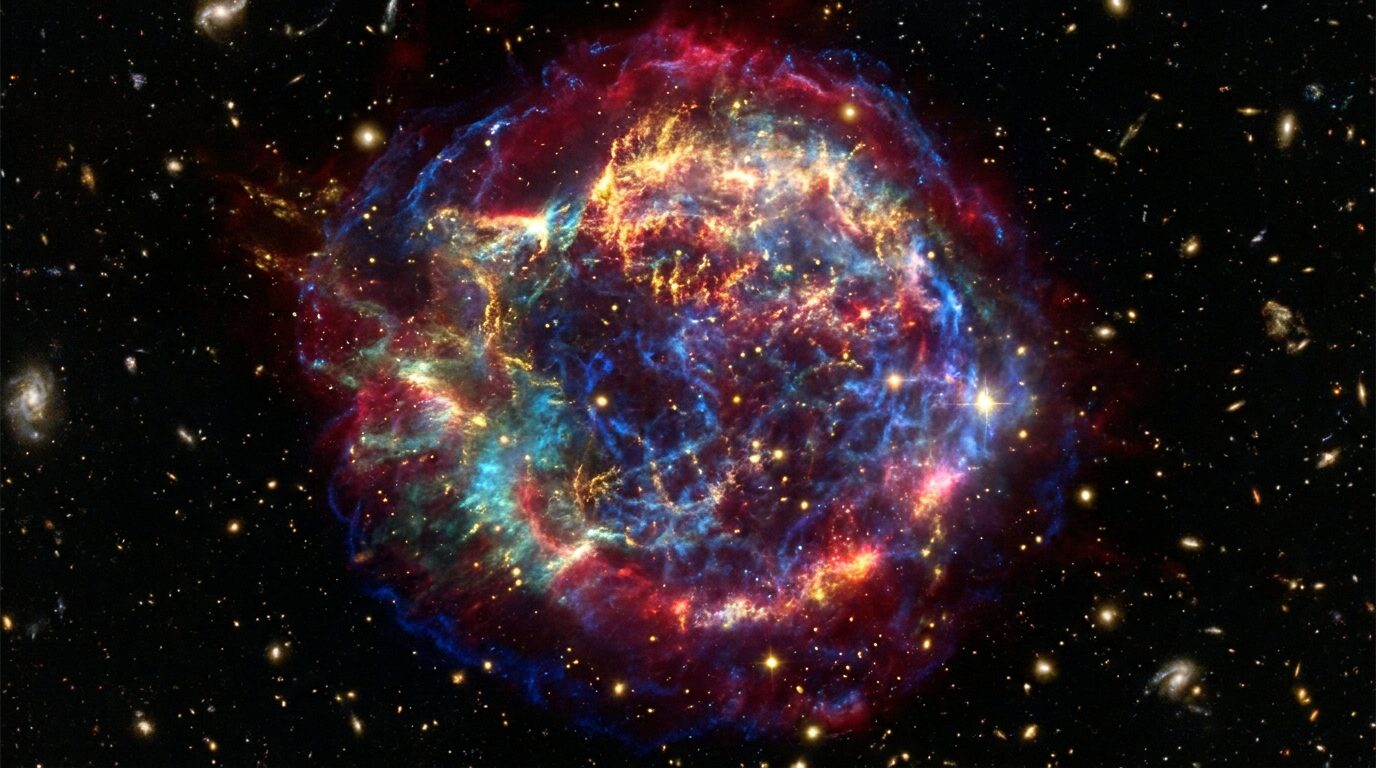
The grains are small. Most are measured in micrometers — a few are nanometers across. In a gram of the most pristine carbonaceous chondrite, you might find perhaps a few parts per million of presolar material, sometimes less. Extracting them requires dissolving the surrounding rock in harsh acids until only the most chemically stubborn residue survives, then sorting through what remains with secondary ion mass spectrometry[4] to find the grains whose isotopic fingerprint flags them as interlopers from another stellar era. It is laborious, occasionally destructive, and produces results that are genuinely startling. Some silicon carbide grains carry carbon isotope ratios that can only be explained by material processed in the interior of an asymptotic giant branch star — a red giant in its final pulsing phase, shedding its outer layers in slow winds before collapsing. Other grains carry signatures consistent with material expelled by a Type II supernova, a core collapse so violent that the shock wave can travel across a molecular cloud and compress neighboring gas into new star formation. The grain in the laboratory is a relic of that detonation.
What a Grain Remembers
Silicon carbide grains are the presolar workhorses, the most studied and most informative. They form efficiently in the cooling outflows of carbon-rich asymptotic giant branch stars, and they are chemically tough enough to survive the chaos of being launched across interstellar space, swept into a forming solar system, incorporated into a planetesimal, broken apart, reassembled in a parent body, and eventually delivered to Earth inside a meteorite. That is not a simple itinerary. The fact that the grains survive it with their isotopic record intact is a consequence of their crystal structure. Silicon carbide is hard and chemically resistant. Whatever isotopes were built into the lattice when the grain condensed around a dying star several billion light-years away are still there. The crystal is the record. The record is physical.
What the isotopes reveal is specific enough to be disorienting. Nitrogen isotope ratios in certain grains indicate nucleosynthesis environments that no process in our solar system could produce. Neon and xenon isotopes in other grains match predicted outputs from specific types of supernova nucleosynthesis in ways that allow researchers to broadly classify a grain's parent star by type and sometimes by approximate mass range. Aluminum oxide grains carry oxygen isotope signatures pointing to red giant stars of different generations, some of them apparently formed when the Milky Way was younger and had a different overall metallicity — a lower abundance of elements heavier than hydrogen and helium — than it does now. Each grain is a single data point from a star that no longer exists and that no telescope has ever seen. Together, they are beginning to sketch a population of ancient, vanished stellar sources.
“The grain in the laboratory is a relic of a detonation that happened before our Sun ignited.”
The Journey From a Star to Your Street
To understand how material from stars that died billions of years before the Sun formed ended up distributed across Earth's surface requires tracking one of the longer itineraries in the known universe. When a massive star reaches the end of its nuclear fuel and its core collapses, the rebound explosion drives a shock wave outward through the star's outer layers and into surrounding space at thousands of kilometers per second. That wave carries with it material forged in the star's interior. As this ejecta cools over years and centuries, some of it condenses into solid grains: silicon carbide, graphite, spinel, corundum, titanium carbide. These grains then travel through the interstellar medium for potentially millions or billions of years, gradually drifting, accumulating radiation damage, surviving or not surviving encounters with subsequent shock fronts from other supernovae.
About 4.6 billion years ago, the molecular cloud that would become our solar system began to collapse, probably triggered in part by one or more nearby supernova shock waves. As the disk of gas and dust collapsed inward, it incorporated interstellar grains from all the stellar generations that had contributed material to that region of the galaxy. Most of that material was processed, vaporized, chemically mixed into the new chemistry of the forming solar system. But in the cooler, outer regions of the disk, some fraction of the most chemically durable grains survived intact, accreted into primitive planetesimals, and were eventually incorporated into asteroids and comets. Carbonaceous chondrite meteorites — the most chemically unaltered class of stony meteorites — are fragments of those early bodies, delivered to Earth by orbital dynamics over billions of years. When one falls and is recovered and analyzed, it carries presolar grains that have been in storage since before the Sun was born.
Beyond meteorites, interstellar dust is a continuous incoming stream. The solar system moves through the interstellar medium, and the heliopause is not a hard barrier to submicron particles. Instruments aboard spacecraft have detected[1] interstellar dust grains passing through the inner solar system, characterized by trajectories inconsistent with solar system origin and by compositions that diverge from the local baseline. Some of this material reaches Earth's upper atmosphere, where it is collected by high-altitude research aircraft sampling the stratosphere, mixed in with interplanetary dust from comets and asteroids and the general micrometeorite flux that delivers tens of thousands of metric tons of extraterrestrial material to Earth each year. Most of that flux is solar-system material. A measurable fraction is not.
Reading the Archive in the Acid Bath
“When you measure an isotope ratio so anomalous it cannot belong to our solar system, you are reading a chemical diary written inside a star that no longer exists.”
The process of isolating and identifying presolar grains took decades to develop and remains technically demanding. Primitive meteorite samples are crushed and then treated sequentially with acids — hydrofluoric, hydrochloric, nitric — that dissolve silicates, carbonates, and sulfides while leaving behind the most chemically refractory phases. What survives this process is a dark, sooty residue. That residue, examined grain by grain under secondary ion mass spectrometry[4], reveals isotopic compositions across a range of elements: carbon, nitrogen, oxygen, silicon, titanium, strontium, barium, neodymium. The outliers are unmistakable. Normal solar system material clusters tightly around the known isotopic ratios of our Sun. Presolar grains appear as extreme outliers, sometimes by factors of ten or more, in distributions that cluster into distinct populations corresponding to different stellar source types.
The technique has become refined enough that researchers can classify presolar silicon carbide grains into multiple sub-populations based on their carbon and nitrogen and silicon isotope ratios, each population pointing toward a different category of source star. The mainstream population, which is the largest, is attributed to low-mass asymptotic giant branch stars. Smaller populations carry signatures attributed to supernovae, novae, and in some cases stellar sources whose exact nature is still debated. There are grains whose isotopic compositions do not cleanly match any nucleosynthesis model currently available, which means they carry information about stellar processes that existing theory has not fully accounted for. They are not anomalies to be explained away. They are constraints that models must eventually satisfy.
The Oldest Solids Ever Dated
In 2020, analysis of silicon carbide grains extracted from the Murchison meteorite[2], a carbonaceous chondrite that fell in Australia in 1969, produced radiometric age estimates using a decay system that tracks the accumulation of neon from cosmic-ray exposure. Some of those grains returned ages of roughly 7 billion years, making them the oldest solid material ever identified on Earth. Seven billion years old. The Sun is 4.6 billion years old. These grains were already ancient by the time the disk that formed our solar system began to collapse. They condensed in the atmosphere of a star whose life cycle was complete before our own star ignited, and they then drifted through interstellar space for billions of years before being incorporated into the early solar system, and then they spent another 4.6 billion years locked inside an asteroid parent body, and then they arrived on Earth inside a meteorite, and then they survived acid dissolution in a laboratory.
That age estimate carries its own uncertainties and has generated scientific discussion about the assumptions built into the exposure dating model. But even with conservative error bars, grains older than the Sun by a billion years or more are not in dispute. What remains under active investigation is the size distribution of the age peak — a cluster of old grains in the Murchison data suggests the solar neighborhood may have experienced an elevated rate of star formation several billion years before the Sun formed, a burst of stellar activity that produced a cohort of long-lived silicon carbide grains that then drifted through the galaxy until they wound up in our solar system. That interpretation is plausible but not settled. The grains are the evidence. The story they tell is still being worked out.
What the Windowsill Holds
“The solar system is not a closed container. It has always been accumulating debris from the stars that came before it.”
Most of the presolar material that reaches Earth's surface is chemically undetectable without mass spectrometry — mixed into the micrometeorite flux, diluted by terrestrial sediment, degraded by weathering into chemically ordinary oxides. The fraction of your windowsill dust that is genuinely presolar is vanishingly small. But the fraction is not zero. The Earth is continuously bathed in extraterrestrial material, some of it interplanetary, some of it interstellar, all of it arriving from a solar system that formed inside a galaxy with billions of years of prior stellar history. The material beneath your finger when you wipe a sill has been on a longer journey than the distance between here and the edge of the observable universe can easily suggest. Distance and age are different things.
What presolar grains represent, at their deepest level, is the galaxy's recycling process made visible in a laboratory. Stars form, burn, explode or shed their envelopes, and their material returns to the interstellar medium to become feedstock for the next generation of stars and planets. Our solar system is not a first-generation object. It is built largely from the processed remains of earlier stars, and those earlier stars built on the remains of stars before them. Presolar grains are the fragments that skipped the recycling step, the material that survived intact from one stellar generation to the next, carrying their parent star's chemical signature like a postmark. They are the exception in a solar system built from blended, reprocessed stellar debris. That exception is exactly what makes them readable.
Somewhere in the collection of primitive meteorites curated in laboratories around the world is a grain of silicon carbide that condensed in a cooling stellar wind seven billion years ago, crossed interstellar space, survived the birth of our solar system, orbited the Sun inside an asteroid for four and a half billion years, fell to Earth, was dissolved out of its host rock by acid, and now sits in a mass spectrometer emitting secondary ions that allow a scientist to determine what kind of star made it. That itinerary is not a story. It is a physical fact. It is what the isotope ratios say. And the question that follows is not cosmic or philosophical but strictly scientific: how many stars contributed to the population of grains we have so far recovered, how many more are in the samples we have not yet fully analyzed, and what do the outlier grains with unexplained signatures know about stellar nucleosynthesis that current models do not yet account for. The archive is still being read.
References
- Cassini between Venus and Earth: Detection of interstellar dust (agupubs.onlinelibrary.wiley.com)
Documents spacecraft detection of interstellar dust grains passing through the inner solar system with non-solar-system compositions and trajectories. - Lifetimes of interstellar dust from cosmic ray exposure ages of presolar silicon carbide (doi.org)
Provides isotopic and exposure data on presolar silicon carbide grains from the Murchison meteorite used as a case study example. - Presolar Grains as Probes of Supernova Nucleosynthesis (link.springer.com)
Provides isotopic signatures of presolar supernova grains that allow researchers to classify a grain's parent star by type and mass range. - Recent Progress in Presolar Grain Studies (pmc.ncbi.nlm.nih.gov)
Explains secondary ion mass spectrometry as the instrumental technique used to identify presolar grains by their isotopic signatures.
About Mira Solen
Mira Solen writes about deep time, cosmic history, extinct stars, ancient impacts, and the long memory stored in rock, dust, and light. Her work specializes in making the oldest stories in the universe feel vivid, physical, and strangely near.
More like this
Dead Stars Seeded Your Bones — Here's the Exact Chain of Events
Isotope ratios locked inside ancient meteorites let scientists trace the calcium in your skeleton back through a chain of stellar collapse, shockwave dispersal, and slow planetary assembly — link by precise link.
The Universe's First Stars Were 10,000 Times the Size of the Sun. We Just Found the Ash.
A nitrogen fingerprint in an ancient galaxy suggests the universe's first stars were so massive that no modern physics textbook accounted for them — and their collapse seeded everything that came after.
Ghosts of the First Stars: What Ancient, Metal-Poor Suns Are Telling Us About the Universe's Earliest Chemistry
A small population of stars in the Milky Way's outer halo carries chemical signatures from before the universe knew how to make iron — and what spectrometers are finding in them is forcing a rethink of how fast the early cosmos grew complex.