Temporal Discounting
People tend to value immediate rewards or risks much more than those in the future, often ignoring distant consequences like climate risks or loan costs.
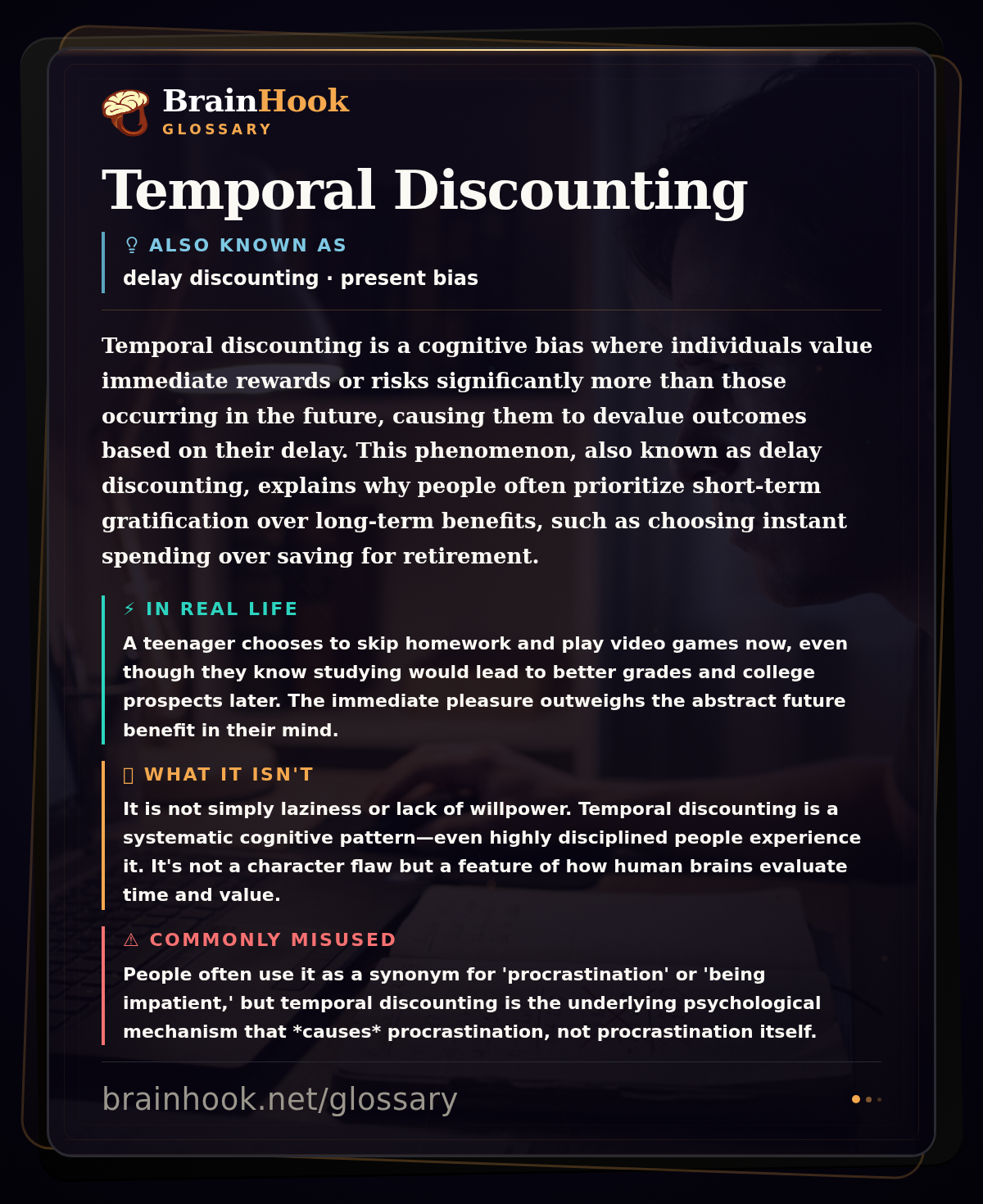
Temporal discounting is a cognitive bias where individuals value immediate rewards or risks significantly more than those occurring in the future, causing them to devalue outcomes based on their delay. This phenomenon, also known as delay discounting, explains why people often prioritize short-term gratification over long-term benefits, such as choosing instant spending over saving for retirement.
What this means in real life
A teenager chooses to skip homework and play video games now, even though they know studying would lead to better grades and college prospects later. The immediate pleasure outweighs the abstract future benefit in their mind.
What it isn’t
It is not simply laziness or lack of willpower. Temporal discounting is a systematic cognitive pattern—even highly disciplined people experience it. It's not a character flaw but a feature of how human brains evaluate time and value.
Commonly misused online
People often use it as a synonym for 'procrastination' or 'being impatient,' but temporal discounting is the underlying psychological mechanism that *causes* procrastination, not procrastination itself.