Why Leaving the LDS Church Breaks People in Ways Other Faiths Don't
Research on former LDS members reveals not a clean departure, but a years-long psychological unraveling — one that other Western faiths rarely inflict at the same depth.
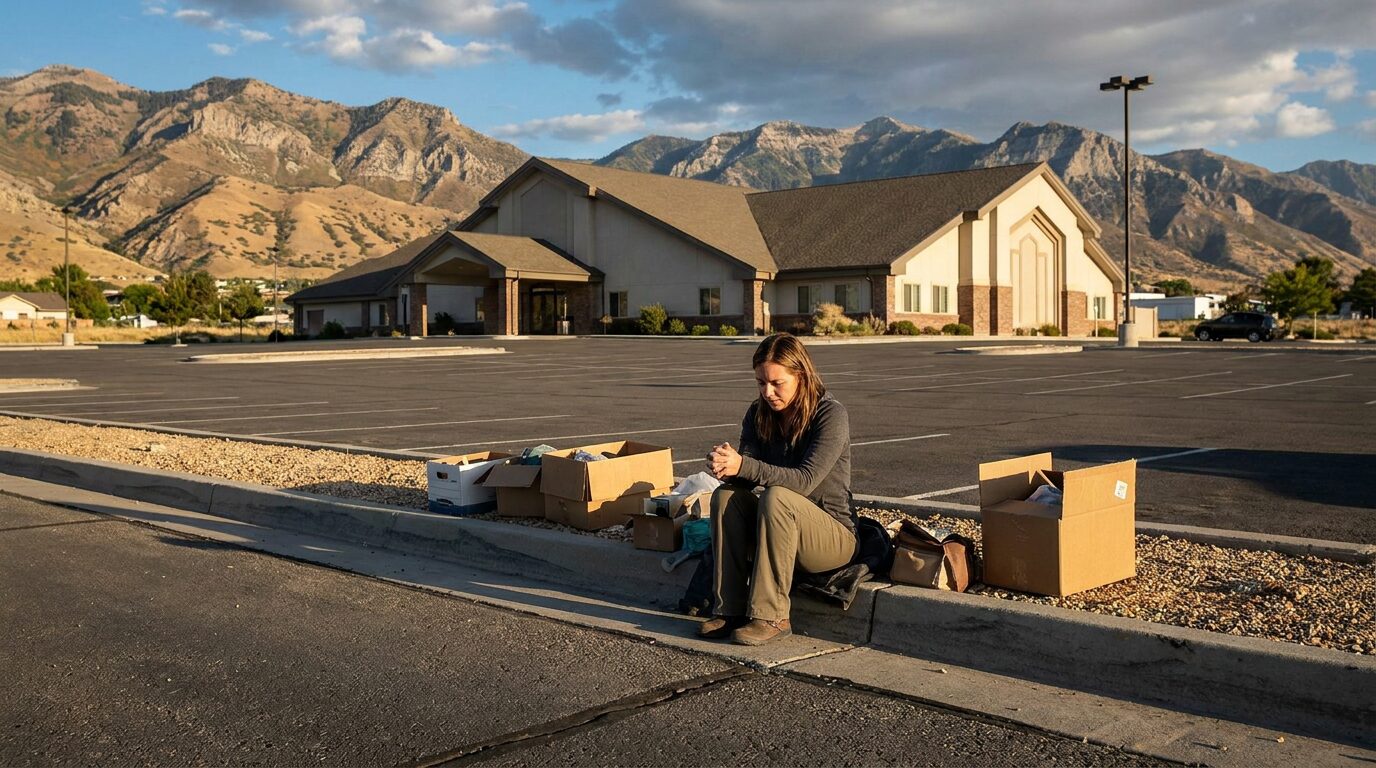
Imagine you are thirty-four years old, sitting alone in a parking lot outside a church building in Utah, having just handed a letter across a desk to a man who will read it aloud to a council of men who will then vote on your standing before God. Your marriage is over. Your parents aren't speaking to you. Your entire social world — every friendship, every Sunday dinner, every neighbor who waved from the driveway — was built inside this institution. You have not left a religion. You have left a country.
Leaving the Church of Jesus Christ of Latter-day Saints is not, researchers are finding, a decision. It is a protracted psychological event — one that can span years, that restructures identity at its foundations, and that leaves behind a residue that looks, in clinical terms, a great deal like trauma. The question of why this departure cuts so much deeper than walking away from other Western denominations has started to attract serious scholarly attention, and the answers say something uncomfortable about how total a totalizing institution can be.
Not an Exit. A Dismantling.
In a 2020 study published in Critical Research on Religion, sociologist J. Todd Ormsbee of San Jose State University set out to map what leaving actually involves for devout LDS members. Using a grounded theory approach[1] — meaning he built his framework from the data rather than testing a pre-existing hypothesis — Ormsbee found that departure was never a singular event. It was, as he put it, "the cultural, cognitive, social, and emotional work that once-devout members of the LDS Church must engage in to leave the church and divest themselves of Mormon culture."[1] The phrasing is precise. Divest implies that what has to be shed was first deeply acquired — woven into how a person thinks, speaks, relates, and understands their own history.
This is what makes the LDS exit experience categorically different from, say, quietly stopping attendance at a Methodist church. Mormonism is not merely a set of doctrinal beliefs held privately alongside the rest of one's life. For devout members, it is the architecture of the life itself. It governs diet, dress, sexual behavior, marriage, finances (through tithing), friendship (wards are geographically assigned congregations that function as social ecosystems), family roles, and cosmology — a literal narrative about who you were before birth, who you are now, and where you are headed after death. When the architecture cracks, everything built on it becomes unstable at once.
The Hidden History and the Crisis It Triggers
For many former members, the unraveling begins not with a moral disagreement but with a discovery. Mormon podcaster and researcher John Dehlin[3], who was eventually summoned to a disciplinary council on charges of apostasy in January 2015[3], described his own trajectory as one driven by learning historical facts the institution had kept obscured — and then discovering that the institution continued to hide those facts and punish those who discussed them openly. He wrote of spending "several depressed years trying to reconcile these facts with the church that I loved," and of realizing, when he looked around at LDS colleagues at Microsoft, that many of them were experiencing severe depression and distress over the same discoveries, with marriages in jeopardy because of their doubt or disbelief.
The psychological mechanism here is recognizable: it is the collision of an established internal model with contradicting evidence, what psychologists call cognitive dissonance. But in high-cost, high-demand religious institutions, that dissonance carries a special charge. The belief system has been encoded not just intellectually but emotionally and socially — reinforced through ritual, through community, through the daily texture of life. Contradicting it doesn't feel like updating a fact. It feels like losing the ground beneath one's feet. And critically, the institution's response to doubt — punishing openness rather than permitting it — means the person in crisis has nowhere inside the community to process what they are experiencing.
“Leaving the Mormon Church doesn't feel like updating a belief. It feels like losing the ground beneath one's feet.”
The Compound Wound: Shame, Surveillance, and the Gendered Toll
A 2025 Walden University dissertation examined[2] the experiences of formerly active LDS members who identify as sexual minorities, and its findings are difficult to read. Through semi-structured interviews, the researcher documented patterns of social isolation, cognitive dissonance, and loss of autonomy[2] that together constitute what the literature calls religious trauma. The cumulative toll, as the dissertation documents, includes "long-term consequences such as feelings of unworthiness, isolation, and diminished self-esteem." For LGBTQ members, the wound is compounded by the fact that the identity the church condemns is not a behavior they can modify. They are being asked to experience themselves as essentially defective — an instruction that, absorbed during childhood and adolescence in a community that leaves no social space outside the church, becomes structurally incorporated into the self-concept.
The rates of suicide among LDS LGBTQ youth are not a footnote. They are one of the reasons Dehlin's Mormon Stories project was built — to create a space where the damage could at least be named. The church's response, historically, was not to engage with that damage but to discipline those who named it. That dynamic — speak, be punished — is itself a trauma vector. It teaches the person in pain that their pain is dangerous, that surfacing it will cost them the only community they have. Shame, as the psychology literature shows, doesn't just feel bad; it structurally rewires how people engage with relationships and self-disclosure, making authentic connection harder long after the original source of shame is gone.
For women, Ormsbee found an additional layer. "Devout women who left Mormonism bore an added burden of overcoming internalized misogyny" — meaning the church's teachings about gender roles and female subordination had not merely been rules they followed, but beliefs they had come to hold about themselves. The process of leaving required not just walking out a door but actively dismantling self-conceptions that had been years in the building. This is psychologically grueling work, the kind that cannot be completed in the first flush of departure and that tends to surface in therapy, in new relationships, in moments when an old reflex fires and the person realizes they are still operating on old code.
Why Leaving Costs More Here Than Elsewhere
Religious disaffiliation is common in America. One in four adults now identifies as religiously unaffiliated, and many of them grew up in churches of one stripe or another. But most people who drift away from mainline Protestantism or Catholicism do not describe what happens to them as trauma. They describe it as a quiet change of habit. The difference is not just doctrinal; it is structural. In high-demand religions — groups that require significant behavioral sacrifice, social insulation, and doctrinal conformity — leaving carries catastrophic social costs that lower-demand groups do not impose. The LDS church excommunication process is formalized, conducted by a council of male leaders, and can result in the severing of temple ordinances that, in Mormon theology, bind a family together for eternity. The threat is not merely social. It is cosmological.
Family estrangement for former LDS members is not an incidental outcome. It is often structurally produced. A believing family that understands eternal families as conditional on shared membership has a theological framework that frames the departing member as a threat to the family's eternal unit — not just a person making a different choice, but someone pulling away from a shared destiny. The grief and rejection that follow are therefore not merely interpersonal; they are experienced, by the believing family, as existentially necessary. The former member finds themselves holding both their own loss and the awareness that the people who love them have been given a theological script that makes love conditional on return. That kind of relational double bind is well-documented as a source of lasting psychological harm — the wound isn't just abandonment, it's the confusion of being loved and rejected simultaneously by the same people for the same reason.
After the Break
What researchers like Ormsbee describe as "the necessary reconstruction of post-Mormon emotionalities" is worth sitting with as a phrase. Emotionalities — not just beliefs or habits, but the emotional grammar through which a person makes sense of the world. Former members often report that they do not know how to experience certain feelings outside a Mormon frame. Guilt without a confessional structure. Grief without a resurrection narrative. Joy without the language of blessings. The exit doesn't just remove an institution. It removes the interpretive scaffolding through which experience was being processed, and that scaffolding has to be rebuilt from scratch, often without a community, often while the people who once formed that community are grieving or angry or refusing contact.
What the research accumulating around LDS disaffiliation is beginning to make clear is that millions of people are navigating religious departures that their secular peers — and sometimes their therapists — don't have adequate frameworks to understand. The person who walked away from Mormonism at thirty-four is not simply someone who changed their mind about God. They are someone who lost a country, rebuilt a self, and is trying to figure out whether the parts of them that were shaped inside that institution can be kept or must be discarded — and which is which. That is not a small problem. It is, as the research keeps finding, one of the most psychologically demanding things a human being can do.
References
- ‘Like a Cord Snapping’: Toward a grounded theory of how devout Mormons leave the LDS Church (scholarworks.sjsu.edu)
Establishes that LDS departure is a gradual process of cultural, cognitive, social, and emotional work, not a singular event. - Exploring the Perceptions of Religious Trauma Among Former Members of the Church of Jesus Christ of Latter-Day Saints Who Identify as a Sexual Minority (scholarworks.waldenu.edu)
Identifies social isolation, cognitive dissonance, and loss of autonomy as patterns of religious trauma in former LDS members who are sexual minorities. - Disciplinary Council - Mormon Stories (mormonstories.org)
Documents John Dehlin's January 2015 disciplinary council summons on apostasy charges, illustrating institutional punishment of doubt.
About Sarah Jenkins
Sarah Jenkins writes about the stranger mechanics of the human mind — how memory actually forms and why some moments calcify into permanent record while others vanish, how grief operates as a prediction error, and why the brain's threat systems keep running long after the threat is gone. Her work brings neuroscience to experiences people recognize but couldn't explain.
More like this

Why Belief Works When Nobody's Watching—But Punishment Doesn't
Punishment shapes behavior when someone is watching. Religious moral frameworks do something stranger and harder to explain — they work when nobody is.
When a Political Earthquake Rewires Your Entire Identity
Political ruptures don't just change who people vote for — they restructure the psychological scaffolding that holds a whole identity together.

Millions Left Their Faith. Now They're Naming What It Cost.
Millions describe their exit from faith using the language of survival — and researchers and clinicians are slowly realizing that language isn't metaphor.