Stars Twinkle. Planets Don't. The Difference Is Your Atmosphere.
The shimmer you see on a clear night has nothing to do with the stars themselves — it's a live readout of the turbulent air column sitting between you and the cosmos.
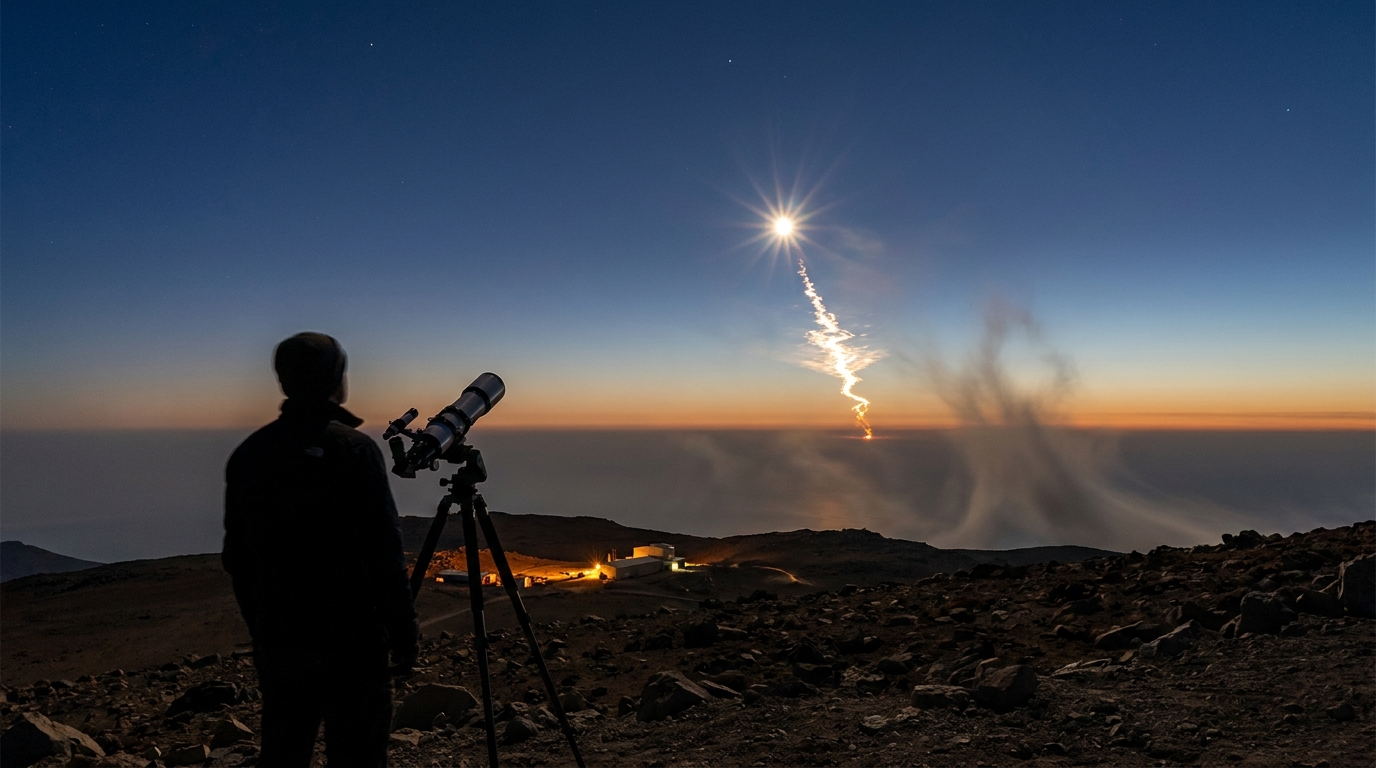
Pick a clear night and find a star low on the horizon — Sirius works well, or Betelgeuse in winter. Watch it for ten or fifteen seconds and you will notice something that looks almost electrical: the light flickers, shifts color at the edges, pulses between blue-white and a warm amber, never quite holding still. It looks like the star itself is doing something, broadcasting its own restlessness from across the light-years. The instinct is to read that shimmer as a property of the object — old stars twinkle, you might vaguely remember being told, and that feels right, because old things tremble. It is not right. The star is perfectly steady. What you are watching is your own atmosphere, writing its turbulence in borrowed light.
The technical name is astronomical scintillation, and it has been quietly revealing the structure of the air above your head every time you looked at the night sky without knowing it. Astronomers have studied it for centuries, first as an irritant to be worked around, then as a signal to be decoded. Adaptive optics systems aboard modern telescopes spend enormous effort canceling it out. Atmospheric scientists use it to measure wind shear at altitude. And the basic physics behind it — why some objects twinkle and others sit smooth and unwavering — turns out to be one of the cleaner, more satisfying explanations in all of optics.
The short version is this: a star is so distant that it arrives at your eye as a single, infinitely thin ray of light — what opticians call a point source. A planet, despite being hundreds of millions of kilometers away, subtends a measurable angle in the sky, small but not zero. That difference in angular size — measured in fractions of an arcsecond — is the whole story. The atmosphere scrambles a point source completely. It scrambles a disk too, but the scrambling averages out across many slightly different paths, and what you perceive is steady light. The twinkling is not about distance or age or stellar personality. It is about geometry.
Getting from that summary to a real understanding of what is happening requires a short trip through the atmosphere itself — which, seen from the right angle, is considerably stranger and more active than the clear nothing it appears to be when you look up through it.
The Air Is Not Still
The column of atmosphere sitting above your head on a clear night is not a uniform, quiet medium. It is a layered, churning system of air masses at different temperatures and pressures, moving against each other at different speeds and directions. Jet streams cut through the upper troposphere at altitudes between eight and twelve kilometers, sometimes exceeding 300 kilometers per hour. Below them, convective cells bubble upward where the ground has retained daytime heat. Thermal inversions trap dense cold air under warmer layers, creating sharp boundaries where the refractive index of the air changes abruptly. The whole system is dynamic down to the meter scale, continuously reorganizing.
Light bends when it moves from one medium to another — or from one density of the same medium to another. This is refraction, and air temperature governs it precisely because temperature determines density. Cold air is denser and has a slightly higher refractive index than warm air. When light crosses the boundary between a warm pocket and a cold pocket, it bends by a small angle. In the atmosphere, where those pockets are constantly moving, merging, and dissolving, the bending is continuous and irregular. Light traveling through that column does not move in a straight line. It follows a subtly meandering path, deflected by each density gradient it crosses.
The structures responsible for most of the bending are called refractive index turbulence cells — small volumes of air, sometimes no larger than a few centimeters across, where temperature gradients are especially steep. As these cells move and evolve, they act like tiny, irregular lenses, focusing and defocusing the light passing through them. The parameter astronomers use to quantify how badly a given night will scramble incoming light is called Cn², the refractive index structure parameter[1]. High Cn² means a lot of turbulence and severe scintillation. Low Cn² means steadier air and sharper images. Observatory sites are chosen partly by their historical Cn² profiles, which is why so many major telescopes sit on high mountains above the densest, wettest layers of the atmosphere.
What a Point Source Does to Turbulence
Now consider what happens to starlight specifically. A star like Sirius is roughly 8.6 light-years away, and even though it is physically enormous — about twice the diameter of the Sun — its angular diameter as seen from Earth is approximately 6 milliarcseconds. A milliarcsecond is one thousandth of one arcsecond, which is itself one 3600th of a degree. That number is so small it is effectively zero for the purposes of what the eye and lower atmosphere can resolve. The star is, to all practical optical purposes, a geometric point source: a single ray, not a bundle.
“The twinkling is not about distance or age or stellar personality. It is about geometry.”
That single ray passes through the entire depth of the atmosphere along one path. Every turbulence cell it crosses bends it. The bending accumulates. By the time the light reaches your eye, it has been redirected many times by the column of moving air above you, and the exact direction of those redirections is changing continuously as the cells themselves drift and evolve. What this produces at ground level is an interference pattern — technically a speckle pattern — in which the amplitude and phase of the light fluctuate rapidly. The fluctuations are fast enough, typically between ten and a few hundred times per second, to register as a flicker. Your eye, which integrates light over roughly 50 milliseconds, catches the edges of those fluctuations rather than fully averaging them. The star appears to dance.
The color shifts you notice — that rapid cycling from blue-white to amber — are a related but distinct phenomenon. Different wavelengths of light refract by slightly different amounts, a property called chromatic dispersion. As the turbulent air bends the light, it bends the blue end of the spectrum more than the red end. The result is that the brief moments when a turbulence cell has bent the light slightly away from your eye will preferentially dim the blue component, making the star appear momentarily warmer. Then it shifts back. Then a different cell catches it. What your eye reads as a color change is actually a real-time display of the wavelength-dependent refraction happening in the air column above you, cycling through at the speed of atmospheric turbulence.
Why Planets Hold Still
Jupiter, on a typical clear night, sits at something like 4 to 6 arcseconds in angular diameter depending on where it falls in its orbit. Saturn ranges from 15 to 20 arcseconds including its rings. Even Mars at its closest approach subtends around 25 arcseconds. These are not large numbers in any absolute sense — you cannot see Jupiter's disk with the naked eye — but they are enormous compared to the effective zero of a star's point source. That difference is everything.
A planet does not arrive at your eye as a single ray. It arrives as a bundle of rays, each coming from a slightly different point on the planet's disk, each having traveled through a slightly different column of the atmosphere. Each individual ray is being scrambled by turbulence just as the starlight is. But the scintillation patterns produced by adjacent rays are not correlated with each other — they are independent fluctuations from neighboring patches of atmosphere. When you add many independent, uncorrelated fluctuations together, they average. Statistically, the peaks of one cancel the troughs of another, the bright moments of one ray overlap the dim moments of the next, and the total intensity arriving at your eye remains relatively constant. This averaging process is called aperture smoothing or, more precisely, spatial coherence reduction — the planet's angular extent spans many separate coherence patches in the atmosphere, and the incoherent sum of their contributions stabilizes.
“Each individual ray is being scrambled by turbulence just as the starlight is — but the scintillation patterns produced by adjacent rays are not correlated with each other, and when you add many independent fluctuations together, they average.”
The spatial coherence of light through the atmosphere is characterized by something called the Fried parameter, denoted r₀[2], which describes the diameter of a circular aperture over which the atmosphere can be treated as optically uniform. On a moderately turbulent night at a good observing site, r₀ might be around 10 centimeters. That tells you something precise: any light source that subtends an angle larger than about λ/r₀ — where λ is the wavelength of the light — will have its scintillation washed out by the averaging effect. Stars are far smaller than that threshold. Planets exceed it. The math is elegant and the physical consequence is direct: below the threshold you get a point source that scintillates; above it you get an extended source that does not.
The View From Below, and What It Takes to See Through
This is why professional astronomical observatories go to such lengths to get above the atmosphere, or at least above the worst of it. The Atacama Desert in northern Chile sits at around 5,000 meters elevation. The summit of Mauna Kea in Hawaii puts telescopes above roughly 40 percent of the atmosphere by mass and above most of the water vapor. The Hubble Space Telescope, orbiting at 540 kilometers[3], sits above all of it — no scintillation at all, which is a large part of why its images changed what the field thought was possible. For ground-based observatories that cannot be moved, the modern answer is adaptive optics: a deformable mirror inside the telescope that reshapes itself hundreds of times per second, driven by a real-time measurement of the wavefront distortion the atmosphere has introduced. The measurement usually comes from a nearby bright star — sometimes a natural one, sometimes an artificial one created by firing a laser into the sodium layer of the upper atmosphere to produce a glowing spot that serves as a reference point.
What adaptive optics systems are doing, at root, is measuring the twinkling and then physically correcting for it faster than it can accumulate. The system reads the atmosphere's turbulence map continuously and writes an equal and opposite correction onto the mirror. In effect, it is using the scintillation signal — the very thing that blurs images — as the input to a feedback loop that cancels it. The irony is that the twinkling you see on a clear night, which looks like pure visual noise, carries enough information about the structure of the atmosphere to engineer a correction for it. The signal and the solution are the same phenomenon viewed from different angles.
Elevation, Horizon, and Why Sirius Flickers Most
If you have spent time watching the night sky, you have probably noticed that stars near the horizon twinkle far more dramatically than stars overhead. This is not a coincidence or a trick of perception. A star sitting ten degrees above the horizon has its light traveling through a much longer diagonal path through the atmosphere than a star directly overhead — roughly five to six times more air mass, depending on the exact geometry. More air mass means more turbulence cells traversed, more cumulative bending, and more dramatic scintillation. Sirius is notorious for this because it is bright, sits relatively low in the sky for observers in the northern hemisphere, and is the closest bright star for which the effect is especially pronounced. On a winter night, Sirius near the horizon can cycle through colors and brightness variations so quickly and vividly that it has been mistaken for a low-flying aircraft or, occasionally, something stranger.
The air mass effect also explains why the seeing — the astronomer's term for atmospheric steadiness — is always best when you point a telescope straight up. The zenith offers the shortest possible path through the atmosphere and thus the lowest integrated turbulence. Observations near the horizon, even with perfect equipment, are fighting the geometry of the column itself. This is why transit timing and careful scheduling matter enormously to serious observers, and why the best window for photographing any object is the brief period when it sits highest in the sky.
Reading the Air in Real Time
“The shimmer has been there every clear night of your life, silently printing a portrait of the atmosphere in borrowed starlight.”
There is a branch of atmospheric science called scintillometry that uses the twinkling of stars — or artificial light sources — to probe the structure of the lower atmosphere without sending anything into the air. A scintillometer is essentially a detector that measures the intensity fluctuations of a light beam sent across a horizontal path, then uses those fluctuations to calculate the turbulent heat flux[4] above the surface — how vigorously the ground is exchanging energy with the air above it. Farmers use them over crops. Meteorologists use them to characterize urban heat islands. Airport engineers use them to assess runway conditions. The same physics that makes Sirius flicker on a winter night is being put to work in the service of boundary layer meteorology, crop science, and aviation safety. The twinkling was always information. The question was who was reading it.
Next time the sky is clear, go outside late enough that your eyes have adjusted, and look for a star close to the horizon. Give it a minute. Watch the light do what it does — the rapid cycling, the color shifts, the instability that seems intrinsic to the object but is in fact entirely a property of the air between you and it. Then find Jupiter or Saturn and compare. The planet sits steady, a small bright point that does not dance. The same atmosphere is above both of them. The difference is purely a matter of angle, of how many independent paths of light are arriving at your eye and how thoroughly their individual turbulence signatures cancel each other out. The shimmer has been there every clear night of your life, silently printing a portrait of the atmosphere in borrowed starlight, and now you know what you are actually looking at when you watch a star flicker — not the object, but the air, alive and churning and full of its own restless geometry, inscribed in light.
References
- Combining Cn2 models to forecast the optical turbulence at Paranal (academic.oup.com)
Defines the refractive index structure parameter (Cn²) that astronomers use to quantify atmospheric turbulence severity on observing nights. - Fried parameter (en.wikipedia.org)
Explains the Fried parameter (r₀), which measures the diameter of atmospheric aperture over which air acts as optically uniform for light transmission. - Hubble Space Telescope (en.wikipedia.org)
- Wetter und Klima - Deutscher Wetterdienst - Boundary layer processes (dwd.de)
About Aris Thorne
Aris Thorne is a microbiologist who writes about the hidden mechanics of ordinary life: the microbes running your home, the chemistry unfolding in food and water, the physics built into familiar objects, and the biological systems quietly keeping the human body alive. His work follows science from kitchens, bathrooms, dust, soil, and city air into wounds, immune responses, infections, medicines, cells, and other worlds. He is most interested in the moment something familiar stops looking simple and reveals the living machinery underneath.
More like this
ESA Built a Machine That Creates Solar Eclipses on Demand
ESA's Proba-3 mission flies two spacecraft in lockstep formation to block the sun on demand — unlocking a continuous view of the solar corona that has defeated astronomers for a century.
We've Found Over 5,000 Exoplanets. Almost None of Them Are Like Earth.
The most common world in the galaxy sits in a size range our solar system completely skipped — and planetary scientists aren't sure whether that's physics or blind spot.
JWST Found a Planet That Shouldn't Exist — Orbiting a Dead Star, Raining Diamonds
A Jupiter-mass planet orbiting a millisecond pulsar carries a helium-and-carbon atmosphere that no known formation pathway can produce — and the physics of what falls from its sky is stranger still.