Why Is Jezero Crater's Bedrock Standing Nearly Vertical? NASA's Rover Found Evidence of Two Planet-altering Asteroid Strikes.
Perseverance found bedrock tilted at nearly 90 degrees on the rim of Jezero Crater — and the only explanation requires two planet-reshaping asteroid strikes, billions of years apart.
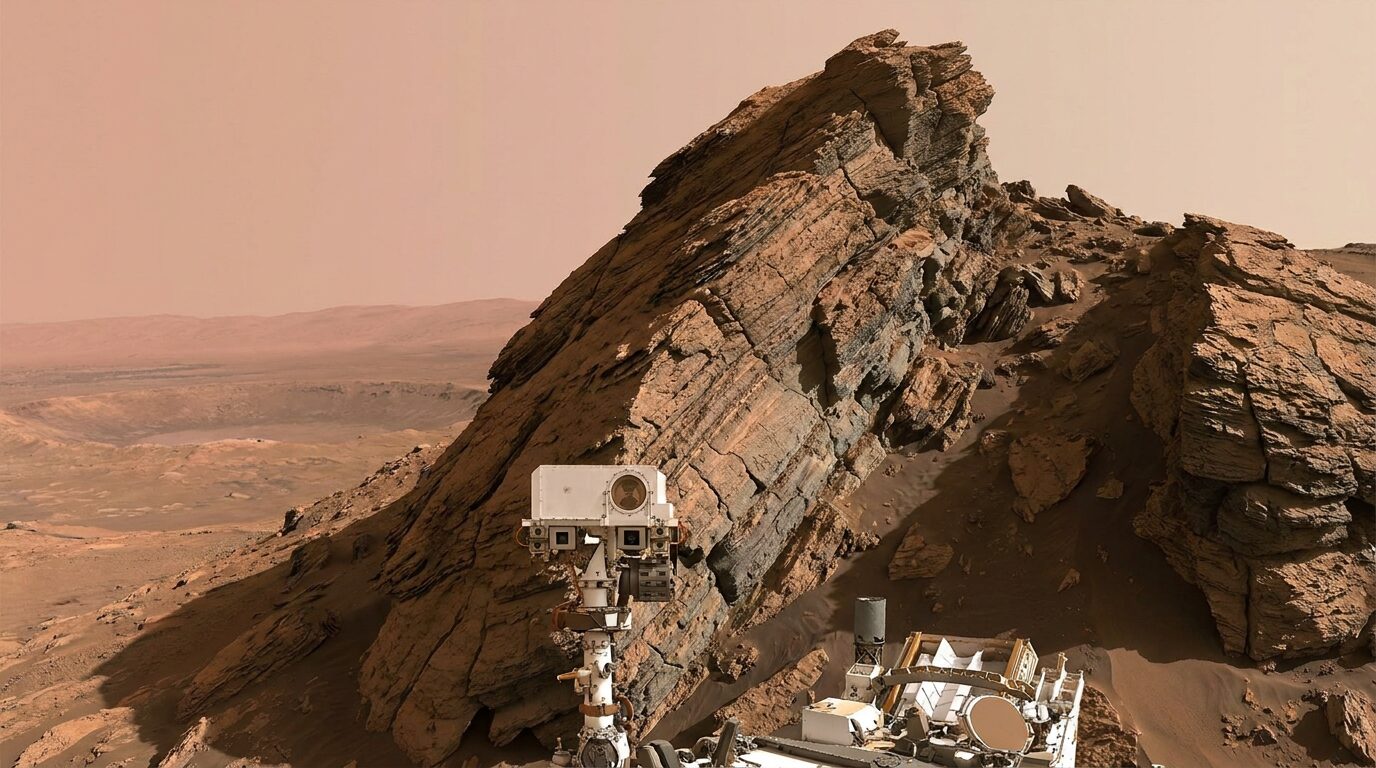
On the rim of Jezero Crater, Perseverance has been reading a stack of rock that doesn't behave the way it should. The layers tilt at angles exceeding 80 degrees — nearly vertical — standing almost on end in a landscape where flat-lying sediment would be the obvious expectation. The steepness alone is a clue that something extraordinary happened here, because no single impact could have done this. The crater that Perseverance has been exploring for years simply isn't violent enough to have torqued bedrock to near-vertical. To explain what the rover is seeing, scientists have had to reach further back in time than Jezero itself.
The rock formation in question — called the "Broom Point member" by the rover's science team — is a 245-foot-thick (75-meter-thick) sequence of layered bedrock[2], and it is likely more than 3.9 billion years old. That places its formation in the Late Heavy Bombardment, the period when the inner solar system was still absorbing the catastrophic leftovers of planetary formation: a relentless incoming fire of asteroids and comets that pocked every surface in the system. The findings were published in the Journal of Geophysical Research: Planets[2], and they offer what NASA is describing as a window into one of the most tumultuous chapters in the history of the solar system.
What you can do
- Follow the Journal of Geophysical Research: Planets for open-access Mars geology findings as Perseverance continues its traverse beyond Jezero.
- Use NASA's publicly available Perseverance mission updates at nasa.gov to track where the rover is now and what terrain it is currently reading.
- When you see crater images from any Mars mission, look at rock layer angles — steep tilts are a direct readout of ancient violence, not erosion.
A One-Two Punch Across Deep Time
To understand what Broom Point is recording, you have to zoom out — far out. The leading explanation involves not one impact but two, separated by an unknown span of deep time and operating at very different scales. The first strike was colossal: an asteroid collision that excavated the Isidis Basin, one of the largest impact basins on Mars, roughly 1,200 miles (1,900 kilometers) wide. An impact of that scale doesn't just leave a hole. It sends shockwaves through thousands of miles of crust, upending and tilting rock layers across a vast surrounding region. The once-flat bedrock that would eventually become Broom Point was wrenched from horizontal during that first event.
“The nearly vertical layers aren't a mystery to be solved by Jezero's own impact. They're a scar from something far older and far larger.”
Then, later, a second impact carved Jezero Crater itself — the 28-mile-wide basin that Perseverance has been exploring. This second strike hit already-disturbed terrain, and the geological evidence Perseverance is reading reflects both events, layered on top of each other across billions of years. Scientists describe this as a cosmic "one-two punch," and the Broom Point member is the readable record of both blows. Some of the layers that Perseverance examined also show signs consistent with ground-hugging debris flows — powerful, fluid-like surges of material. On Earth, similar flows can occur when molten rock meets water or ice that flash-vaporizes into steam. Whether that same mechanism was at work on ancient Mars remains an open question, but the morphology of the layers suggests energetic emplacement, not slow deposition.
Reading a Planet's Oldest Pages
What makes Broom Point significant beyond its dramatic tilt is its age. At more than 3.9 billion years old[1], it represents some of the oldest terrain any Mars rover has ever examined directly — not from orbit, where mineralogy and topography can be inferred through spectrometry and elevation models, but from the surface, where a rover can drive alongside an outcrop, image its layers in sequence, and infer the forces that built each one. Orbital data can suggest ancient terrain. A rover standing next to it is something else. The Perseverance science team has been methodically working its way across Jezero and beyond since landing in February 2021, and Broom Point represents the kind of target the mission was always designed for: a site where rock preserved before Mars became the cold, desiccated world we see today might still be legible.
The distinction between what was observed and what is inferred matters here. What Perseverance actually detected is a thick sequence of steeply tilted, layered bedrock on the crater rim — a physical measurement of angle, thickness, and layer structure. What scientists infer from that geometry is the two-impact hypothesis: Isidis Basin first, Jezero second, with the Broom Point layers as a kind of geological witness to both. That inference is consistent with what's known about the region's impact history from orbital mapping, but the full picture of exactly how the layers were emplaced, and whether ancient water played any role in the debris flows, remains an open area of investigation. As Perseverance continues to traverse terrain that may predate Jezero Crater itself, each new outcrop is another page in a record that Mars has been keeping since before Earth had continents. For a planet we've long treated as a static, frozen archive, that record keeps turning out to be far more violently complicated than expected — and the seismic evidence from InSight suggests that some of that internal dynamism hasn't fully stopped.
References
- NASA’s Perseverance Rover Provides Sweeping View of Broom Point - NASA Science (science.nasa.gov)
Confirms Broom Point member is more than 3.9 billion years old, among the oldest terrain examined by a Mars rover. - NASA’s Perseverance Rover Reads Record of Ancient Mars Impacts - NASA (nasa.gov)
Provides the 245-foot-thick bedrock measurement and confirms publication in Journal of Geophysical Research: Planets.
About Brenna Vance
Brenna Vance writes about the cosmos — stars that predate the universe's own chemistry, spacecraft flying close enough to the sun to catch it misbehaving, the physics of what the universe is still getting wrong. Her work focuses on the moments when an observation breaks a model, and what that break actually means.
More like this
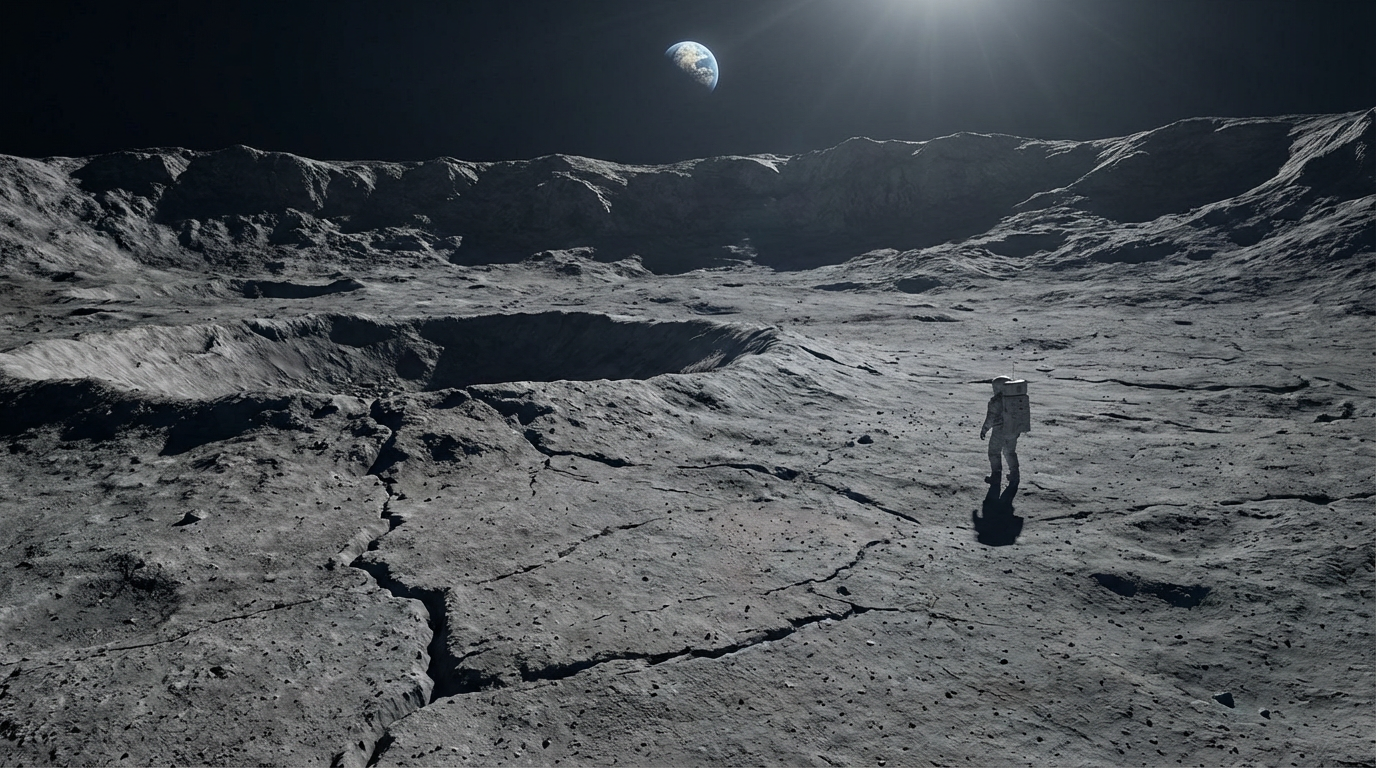
The Moon Has a Scar the Size of a Continent — And We've Never Explained It
The South Pole–Aitken Basin is 2,500 kilometers wide, ancient beyond easy reckoning, and quietly resisting every model scientists have built to explain it.
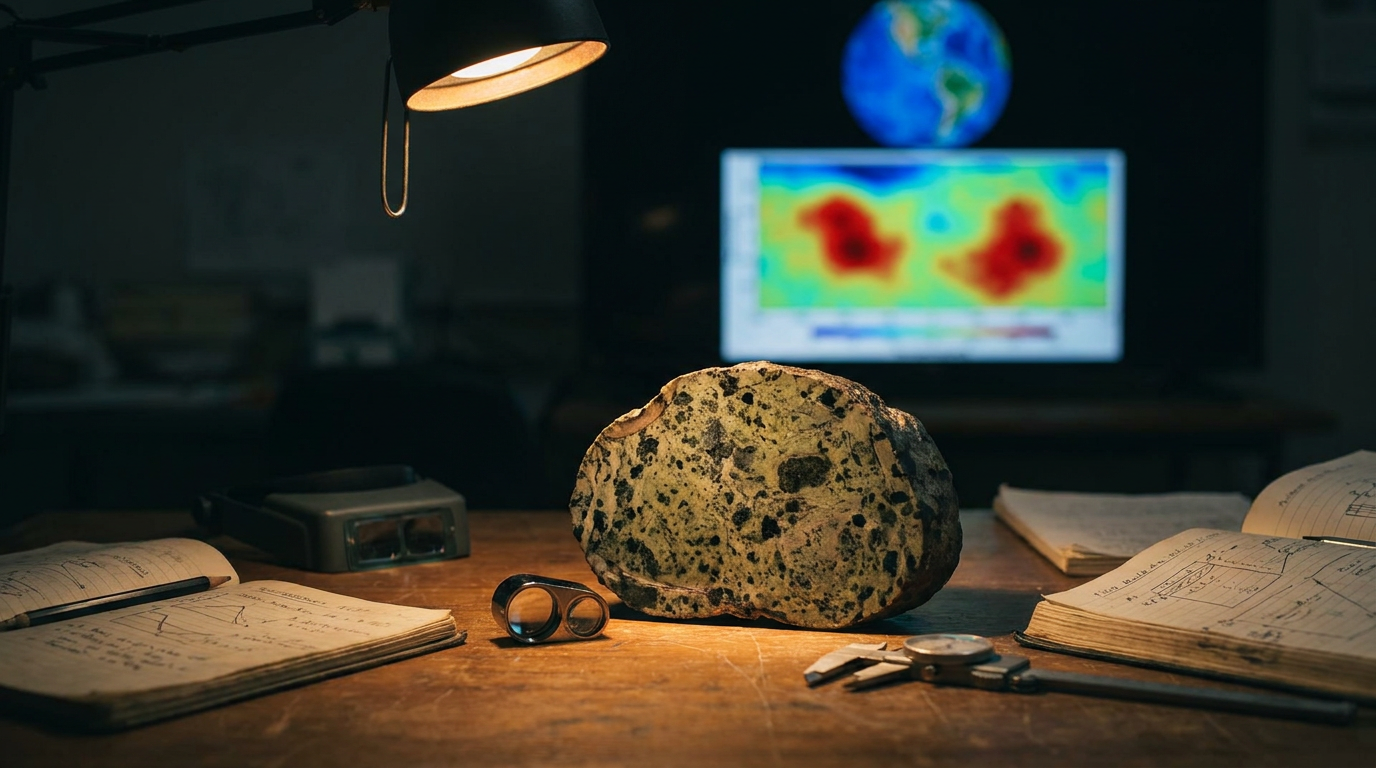
Two Continent-Sized Blobs Have Been Sitting at Earth's Core for Four Billion Years
Buried at the base of Earth's mantle, two continent-sized masses of anomalous rock have resisted four billion years of planetary churning — and a new study argues they are fossilized relics of Earth's primordial interior that may have quietly shaped the conditions for life.
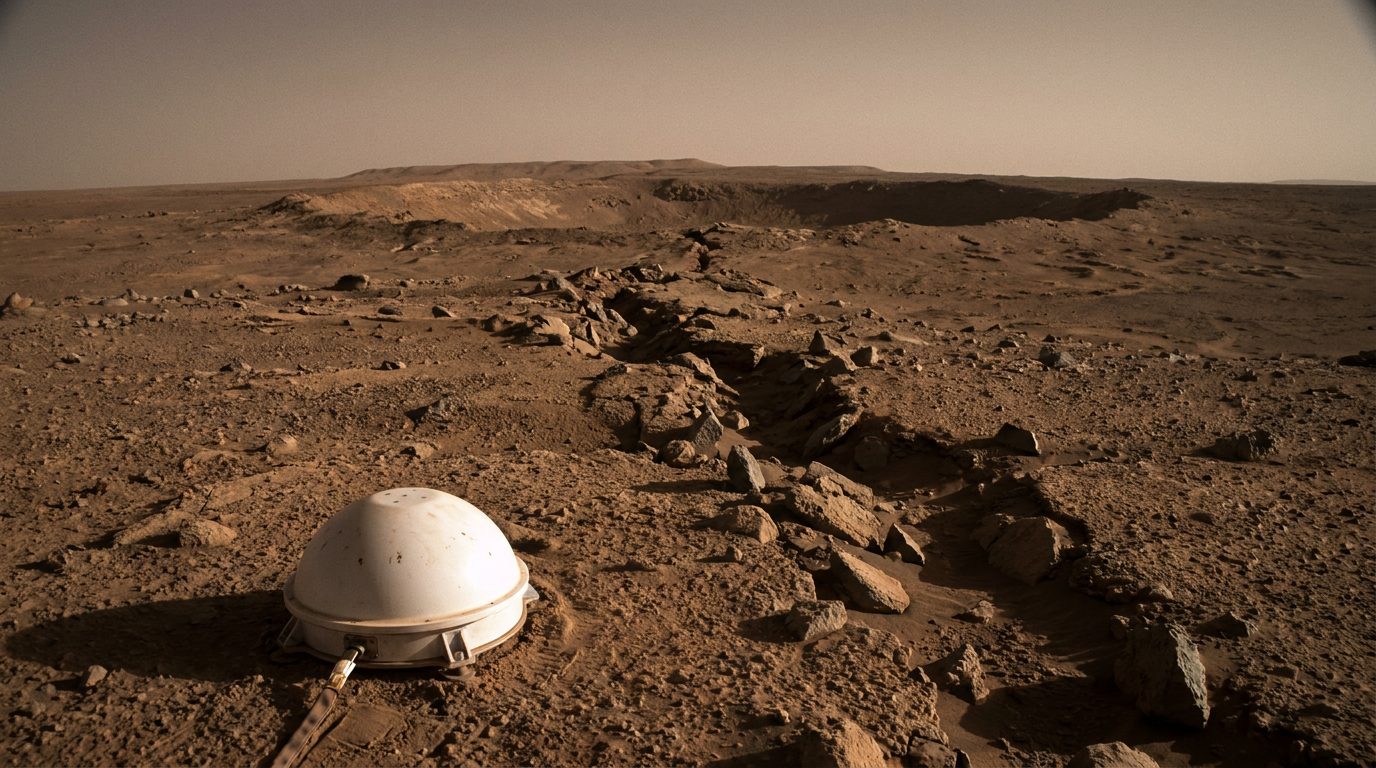
Mars Is Still Cracking Apart — And InSight Heard It Happen
NASA's InSight lander spent four years listening to the interior of Mars, and what it found suggests rocky planets don't die quietly — they contract, fracture, and quake for billions of years after their engines cool.