Why a Tiny Cut Can Trigger Your Immune System to Attack Itself
Infection isn't just invasion — it's a molecular negotiation where pathogens rewrite your cells' operating instructions and the body's defenses sometimes make things catastrophically worse.
Picture a cut on your hand — a shallow one, barely worth a bandage. The skin opens for a second, closes again, and the whole event seems finished before it registers. But for the microbes that were already living on that surface, the breach is an invitation. Most of them lack the tools to go anywhere useful. A few do not. And the difference between a nick that heals in three days and one that ends in an intensive care unit is almost entirely a question of what those few carry inside them.
Infection is not a simple matter of germs getting in. It is a contest between biological systems — one trying to persist and reproduce, one trying to detect and eliminate the intruder. What makes certain pathogens so effective, and so disturbing to think about clearly, is not their brute strength. It is their precision. Bacteria, viruses, and parasites have each evolved strategies to subvert the body's machinery so thoroughly that the cells doing the defending can end up doing the damage. To understand why infection can escalate from a warm red line to a life-threatening emergency, you have to follow the mechanism, not just the name.
Getting In: The Art of Uninvited Entry
Microbial communities are already everywhere in ordinary life, including on skin, in throats, and on every surface hands routinely touch. What separates colonization from infection is usually a change in context: a break in the epithelial barrier, a shift in immune status, or the presence of a strain carrying the right virulence factors. When a pathogen reaches tissue, getting inside a host cell is often its first objective. This is an intricate process — an invading pathogen has to manipulate the host cell's biochemical machinery to induce its own internalization, using specialized molecules on its surface that attach to specific receptor molecules on the host cell, which act as molecular switches that react to specific molecules and induce metabolic changes within the cell. By pressing the right buttons, sending the right signals, the pathogen can start the necessary events in the host cell's interior.
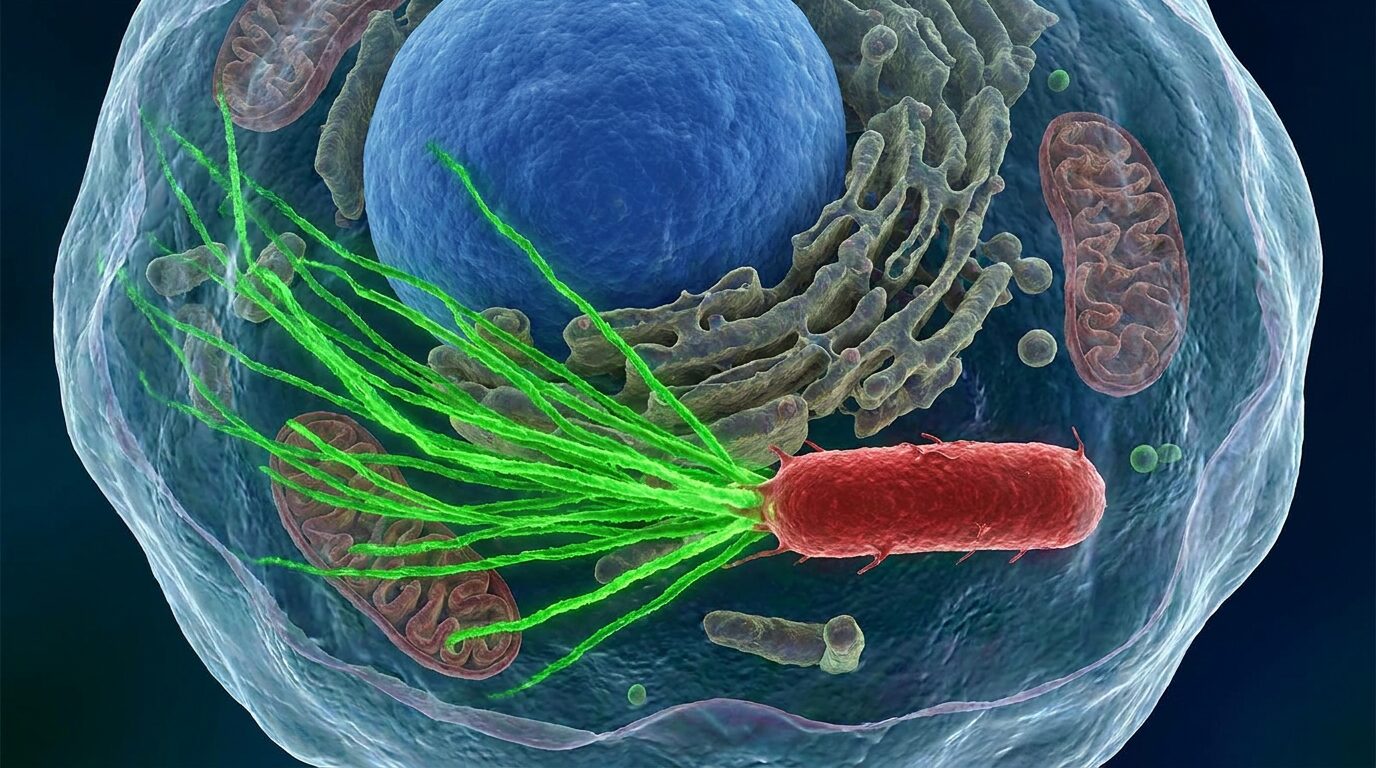
Once inside the cell, some pathogens escape the endocytic or phagocytic compartment while others remain in membrane compartments to establish a replicative niche — intracellular events that involve complex signaling cascades and cytoskeletal rearrangements. The bacterium Shigella flexneri, for instance, doesn't just survive inside intestinal cells — it invades intestinal host cells, escapes from the phagocytic vacuole, and gains intracellular motility by actively assembling host cell actin filaments, resulting in so-called bacterial rocketing. The bacterium essentially commandeers the cell's own structural scaffolding to propel itself through the cytoplasm and into neighboring cells, spreading the infection without ever fully exposing itself to the immune system outside.
All viruses are intracellular pathogens that, upon release of their genetic material inside the host cell, hijack the cell replication machinery in their favor and can inhibit several antiviral mechanisms. A virus has no metabolism of its own. It is, at its core, a set of instructions wrapped in a protein shell, and its entire strategy for existing is to get those instructions read by someone else's cellular machinery. The cell's ribosomes, its energy supply, its protein synthesis pathways — all of these become the virus's production line. The host is not a victim in the passive sense. It is a factory that has been temporarily retooled.
The Toxin Factories: When Bacteria Dissolve What They Find
Some bacteria skip the slow work of intracellular takeover entirely. They stay in the tissue, multiply, and release molecules that do the destruction at a distance. The mechanism behind necrotizing fasciitis — commonly called flesh-eating disease, a name that turns out to be both viscerally accurate and technically wrong — is the clearest illustration of what this looks like at full speed. Despite being called a "flesh-eating disease," bacteria do not eat human tissue. Rather, they release toxins that cause tissue death.
Bacterial virulence factors include toxins as well as other secreted bacterial enzymes — proteases, lipases, hyaluronidases, and others — that contribute to the breakdown of fat and connective tissues. These enzymes dissolve the structural proteins that hold tissue together. Hyaluronidase breaks down hyaluronic acid in the connective matrix. Proteases cleave collagen. The result is not digestion in any familiar sense — it is more like the careful disassembly of scaffolding while people are still inside the building. The bacteria produce toxins that limit blood flow to the fascia and the tissues around it, leading to tissue death — necrosis.
“Once blood flow is cut off, the immune system can't reach the site. Antibiotics can't reach it either. The infection has effectively rendered its own territory unreachable.”
The infection typically travels along the fascial plane, which has a poor blood supply, leaving the overlying tissues initially unaffected and potentially delaying diagnosis and surgical intervention. This is the feature that makes necrotizing fasciitis so lethal — it moves deep, invisibly, through layers that don't bleed or swell obviously. Due to a lack of blood supply to the tissues, the body's immune system cannot fight the infection. Antibiotics alone cannot fight it either. The infection has effectively rendered its own territory unreachable, cutting off the very mechanisms that would ordinarily clear it. By the time the skin surface shows the purplish or blackened discoloration associated with advanced disease, the tissue underneath has often been destroyed across a much wider area than the skin suggests.
Clostridial species that cause gas gangrene produce at least 20 characterized exotoxins, the most important of which appears to be the alpha toxin, a potent, lethal toxin with phospholipase activity. Phospholipase attacks the lipid membranes of cells, punching holes in structures that were built to be impermeable. When a bacterium carries enough of these tools, the surrounding tissue doesn't just die — it liquefies, losing its structural integrity as the molecular architecture that held it together is systematically dismantled.
The Disappearing Act: How Pathogens Hide in Plain Sight
By hiding inside host cells, pathogens make themselves invisible to the immune system, which destroys most invading organisms immediately. The infecting pathogen can take over the host cell's biochemical machinery and use its nutrients to grow and multiply before the pathogen's progeny are released to infect neighboring cells. This is the logic of intracellular infection: a cell that has been colonized looks, from the outside, like a normal cell. The immune system's first responders — antibodies, complement proteins — can't reach what's inside. The only way the immune system learns something is wrong is when infected cells display fragments of the invader on their surface through a process called antigen presentation.
Viruses have developed sophisticated strategies to evade the immune system, particularly by interfering with antigen presentation in infected cells. In healthy cells, intracellular antigens are presented on the cell surface through MHC class I molecules — a process crucial for alerting cytotoxic T cells, which can induce apoptosis in infected cells. But certain viruses have evolved mechanisms to inhibit the transport of MHC class I molecules to the cell surface, preventing the immune system from recognizing and responding to infected cells. The cell becomes a sealed room. The immune system circles the perimeter without knowing what's inside.
The counter-countermeasure is elegant: natural killer cells are programmed to identify and destroy cells that lack MHC class I molecules — a defense mechanism against viruses that attempt to hide. In response, some viruses produce deceptive, or "fake," MHC class I molecules. This is molecular mimicry taken to its logical extreme: the virus fabricates a credential the immune system is trained to trust. A recent study published in Cell Host & Microbe[1] by researchers at the Innovative Genomics Institute found that viruses have evolved a surprisingly large and diverse set of enzymes specifically designed to destroy immune alarm signals[1], helping them hide from or disable the host's antiviral defenses — enzymes called 2H phosphodiesterases that act like molecular scissors, cutting nucleotide messengers to prevent them from being recognized by the host.
Bacteria deploy their own disappearing acts. Pathogenic intracellular bacteria, parasites, and viruses have evolved sophisticated mechanisms to manipulate mammalian host cells to serve as niches for persistence and proliferation, involving the manipulation of membrane-bound organellar compartments. Mycobacterium tuberculosis, the bacterium behind tuberculosis, survives inside macrophages — the very immune cells whose entire function is to engulf and destroy invaders. It does this by blocking the normal fusion of the phagosome with the lysosome: a macrophage swallows the bacterium, but the acidic, enzyme-filled compartment that should digest it never arrives. Various pathogens rearrange phagosomes into compartments that promote proliferation, or hijack endosomal transport to reach specific subcellular targets. The result is a bacterium living inside its predator, metabolizing quietly, reproducing, and occasionally spreading when the host's immune suppression tips the balance.
Hijacking the Epigenome: Rewriting the Host's Own Rulebook
The deepest layer of pathogen manipulation operates at the level of gene expression. Recent studies highlight the importance of host chromatin and other epigenetic regulators as targets of pathogens. Host gene regulatory mechanisms may be targeted through cytoplasmic signaling, directly by pathogen effector proteins, and possibly by pathogen RNA. This means the infection is not merely consuming the cell's resources — it is editing the instructions that govern which of the cell's own genes get turned on or off. Some pathogens silence the genes that would produce the alarm signals calling immune cells to the site. Others activate genes that suppress inflammation, giving the microbe more time inside the tissue before the immune system mobilizes fully.
Mammalian hosts employ two critical cell-autonomous defense mechanisms — regulated cell death and xenophagy — to combat invading pathogens. Regulated cell death eliminates infected cells through programmed self-destruction, removing bacterial replication niches. Concurrently, xenophagy sequesters intracellular bacteria within autophagosomes for lysosomal degradation. To subvert these host defenses, bacterial pathogens have evolved sophisticated effector proteins that mimic eukaryotic functional domains, enabling them to catalyze diverse post-translational modifications of host targets. The cell's own quality-control systems, designed to clear damaged or infected tissue, get reprogrammed into tools for the pathogen's survival.
“The most effective pathogens don't simply resist the immune system. They use it — redirecting its signals, borrowing its credentials, hiding inside the cells sent to destroy them.”
Mitochondria play an important role in the defense against pathogens — they can initiate immune responses and deprive pathogens of the nutrients they need to grow. But research led by Lena Pernas at the Max Planck Institute for Biology of Ageing has shown that pathogens can turn off mitochondrial defense mechanisms by hijacking a normal cellular response to stress. The organelle that produces the cell's energy and signals its immune readiness becomes a silenced witness. The pathogen doesn't just evade; it reaches into the machinery of defense and removes the parts it finds inconvenient.
When the Response Becomes the Damage
There is a final turn that makes the worst infections so devastating, and it has nothing to do with what the pathogen does directly. Some pathogens trigger immune responses so overwhelming that the collateral damage — to tissue, to vessels, to organs — exceeds what the microbe itself could have caused. Interferons have been implicated in inflammatory diseases and immunopathology in addition to their protective role in infection, and antagonizing the immune response may have an ambiguous effect on the clinical outcome of viral disease. A delayed immune response can let the virus replicate unimpeded; a massive immune response can send cytokine signals cascading through every organ system, producing a septic crisis that has more in common with an autoimmune attack than a targeted defense.
This is the mechanism behind sepsis — not the bacteria winning, exactly, but the immune system's amplification loop running beyond what any tissue can sustain. Infection spreads rapidly through subcutaneous tissue planes but is often less readily apparent on the skin surface; tissue necrosis and release of organisms and bacterial toxins into the bloodstream contribute to development of sepsis syndrome. The same cytokines that signal macrophages to the wound site begin recruiting inflammatory cells elsewhere, vasodilating vessels, dropping blood pressure, and eventually damaging the kidneys, lungs, and heart — not because those organs are infected, but because they are downstream of a signaling storm the immune system set in motion and cannot stop.
None of this makes pathogens seem less threatening. If anything, understanding the mechanism makes the threat feel more specific, more physical, more real. A virus that steals your cell's antigen-presenting machinery is not behaving randomly — it has been shaped by evolutionary pressure over millions of cycles of infection to be better, this cycle, at surviving inside tissue exactly like yours. Pathogens have evolved sophisticated strategies to hijack host cellular machinery to establish productive infection and promote disease. The body has countered, layer by layer, and the pathogens have countered again. What looks from the outside like a fever and a sore throat is, at the molecular level, an arms race conducted in the dark, inside your own cells, at a speed no instrument can fully watch in real time. The ordinary body turns out to be, at every moment, a contested landscape.
References
- How Viruses Evade Immune Responses And How We Might Fight Back (innovativegenomics.org)
Provides evidence that viruses produce enzymes called 2H phosphodiesterases that destroy immune alarm signals to evade host antiviral defenses.
About Aris Thorne
Aris Thorne is a microbiologist who writes about the hidden mechanics of ordinary life: the microbes running your home, the chemistry unfolding in food and water, the physics built into familiar objects, and the biological systems quietly keeping the human body alive. His work follows science from kitchens, bathrooms, dust, soil, and city air into wounds, immune responses, infections, medicines, cells, and other worlds. He is most interested in the moment something familiar stops looking simple and reveals the living machinery underneath.
More like this
Your Bruise Is Changing Color for the Same Reason Leaves Do
That purple mark spreading under your skin isn't damage lingering — it's a molecular demolition crew working through a precise, color-coded sequence to erase the evidence.
When You Cut Yourself, Your Gut Microbiome Changes. Here's the Exact Mechanism.
Researchers traced a single molecular signal from broken skin all the way to the colon, and what it does to gut bacteria there is not what anyone expected.
The Slime You Scrubbed Off the Drain Came Back. That's the Point.
New research shows that household cleaning kills the bacteria inside a biofilm while leaving its scaffold intact — which means the colony doesn't die, it just takes a short nap.