Innocent People Confess to Crimes They Didn't Commit. Here's the Exact Mechanism.
A sweeping analysis of 230 false confession studies has finally mapped the exact sequence of interrogation tactics that don't just pressure innocent people into confessing — they make them internalize it.
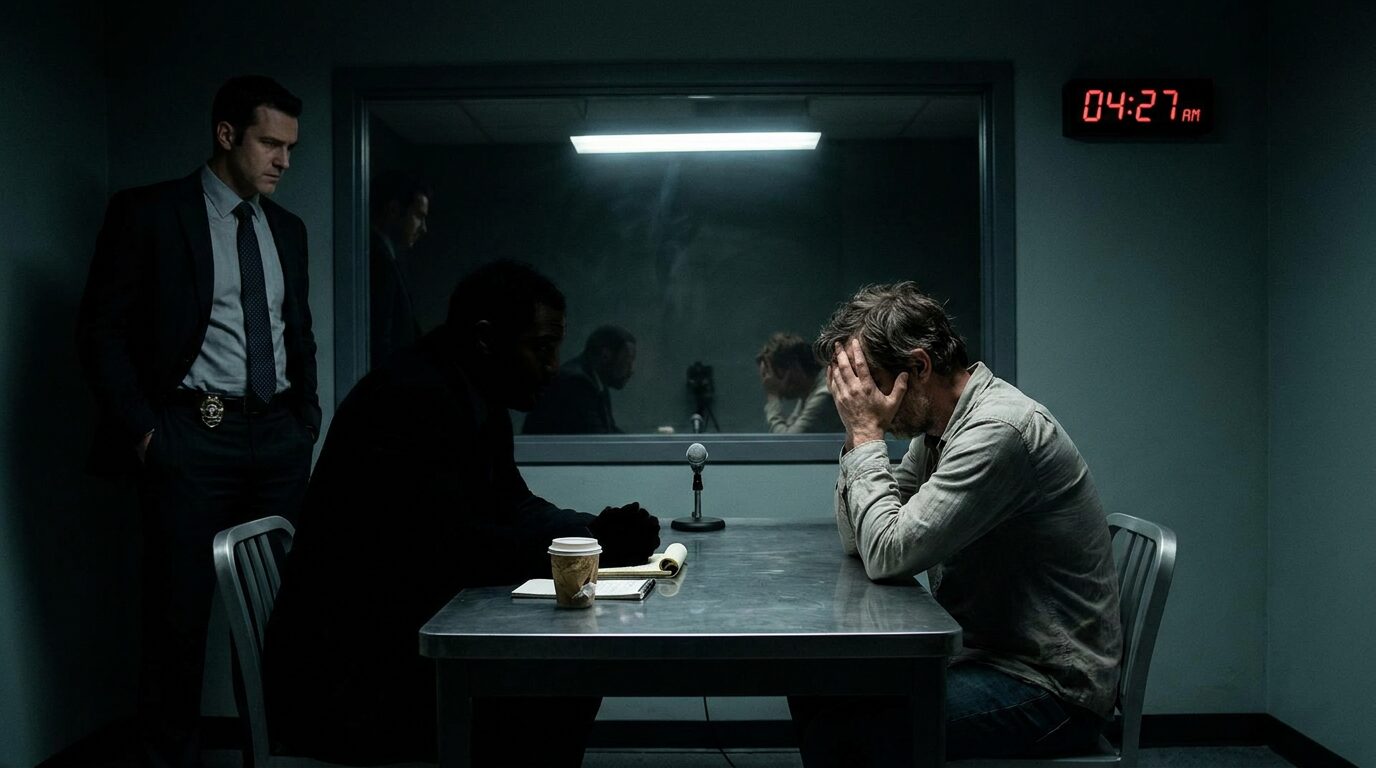
The confession is supposed to be the end of the uncertainty. A person says the words, signs the document, and the case closes around the admission like a fist. Courts have historically treated confessions as the closest thing to bedrock evidence available — a defendant's own account of their own actions. The problem, documented across decades of wrongful conviction research, is that confessions are not always what they appear to be. Some of them are lies told under pressure, which is uncomfortable but at least legible. The stranger category is the one that keeps researchers up at night: confessions by people who, by the time they are done, no longer experience themselves as innocent.
This is not a fringe occurrence. The Innocence Project[3], which uses post-conviction DNA testing to exonerate wrongfully convicted people, has found that in roughly 30 percent of its overturned cases, the defendant had made a false confession or incriminating statement. These are cases where the biology of the crime scene contradicted the person who said they did it. The confession existed. The guilt did not. And in many of those cases, the person who confessed could not cleanly explain, even afterward, why they said what they said — or why, for a period of time inside that room, they had almost believed it themselves.
A recent analysis published in Behavioral Sciences & the Law[1] attempted something unusually systematic: mapping the entire research landscape on false confessions across 230 studies and 25 distinct variables, in order to identify not just whether interrogation tactics produce false confessions, but which specific conditions produce which specific types. The distinction matters more than it might seem. There is a significant difference between a person who confesses to make something stop and a person who confesses because the interrogation environment has, at least temporarily, destabilized their own memory and sense of culpability. The first is coercion. The second is something closer to manufactured belief.
The analysis does not deal in abstractions. It names conditions, sequences, durations, and psychological mechanisms. Laid out in sequence, the findings read less like a research summary and more like a set of instructions someone wrote by accident.
Three Types of False Confession, and Why Only One Involves Lying
Researchers in this field generally distinguish between three categories of false confession. Voluntary false confessions happen without any external pressure — a person comes forward to claim a crime for reasons ranging from notoriety-seeking to protecting someone else. Compliant false confessions happen when a person knows they are innocent but confesses anyway to escape an unbearable situation: end the interrogation, avoid a threatened charge, get home to their children. These two categories are disturbing but mechanically understandable. The third category — internalized false confessions — is the one that strains intuition. An internalized false confessor comes to genuinely believe, at least temporarily, that they may have committed the crime they are being accused of. They are not performing guilt. They are experiencing something that functions like it.
The 230-study analysis found that internalized false confessions cluster heavily around a specific combination of conditions: prolonged isolation, high-pressure guilt-presumptive interviewing, and minimization tactics delivered in a particular order. Remove any one element and the rate of internalized false confession drops. Stack all three, and the psychological ground shifts in ways that subjects often cannot detect in real time. The researchers describe this as a process of "memory distrust" — a condition in which a person's confidence in their own recall is systematically eroded until external suggestion begins to fill the gap.
“They are not performing guilt. They are experiencing something that functions like it.”
Isolation Is Not Just Discomfort. It Is the First Condition.
The analysis is specific about isolation: duration matters, but so does its structure. Being held in a room is not the same as being held in a room with no meaningful contact with anyone who affirms your existing sense of reality. Interrogation rooms are designed environments. They are typically small, windowless, and stripped of personal objects. The suspect cannot call anyone who knows them. They cannot check a phone for timestamps that might confirm or contradict claims about their whereabouts. They sit across from investigators who present themselves as already knowing the truth — who frame every response the suspect gives as further confirmation of guilt. That experience, sustained over hours, does not merely produce anxiety. It produces something closer to epistemic isolation: a state in which the person's internal account of events is the only evidence they have access to, while everyone in the room is telling them that account is wrong.
Memory, under these conditions, behaves differently than people expect it to. Human memory is reconstructive, not reproductive — it does not play back events like a recording but reassembles them from fragments each time, and that reassembly is genuinely sensitive to suggestion, leading questions, and social pressure. A person who is tired, frightened, and surrounded by authoritative figures insisting they are misremembering what happened may begin to doubt fragments of their own recall. Once that doubt takes hold, the door is open. The study found that interrogations exceeding six hours significantly elevated internalization rates, particularly when paired with interrogators trained in what is called the Reid Technique — a guilt-presumptive method that has since been widely criticized in the psychological research literature.
The Reid Technique and the Architecture of Presumed Guilt
The Reid Technique, developed in the 1950s and still used in modified form across many U.S. law enforcement agencies, is built on a foundational assumption: by the time a formal interrogation begins, investigators have already determined that the person in the room is guilty. The technique does not treat the interrogation as a search for truth. It treats it as a structured process of extracting a confession from someone whose guilt is taken as given. Investigators trained in Reid are taught to present guilt as certain, to dismiss denials as expected obstacles rather than legitimate responses, and to interpret behavioral cues — nervousness, avoiding eye contact, fidgeting — as confirmation of deception. Researchers have repeatedly demonstrated that those cues are not reliable indicators of lying; they are reliable indicators of stress, which an innocent person in an interrogation room experiences in abundance.
The 230-study analysis found that guilt-presumptive framing alone elevated false confession rates. But the escalation becomes steeper when minimization is added on top of it. Minimization tactics involve an investigator expressing sympathy, offering moral off-ramps, and implying that the consequences of confessing will be minimal — even though investigators are not legally permitted to make sentencing promises. Phrases like "I understand why this happened" and "anyone in your situation might have done the same thing" are not comfort. They are, functionally, incentive structures. They reframe confession as the path of least resistance and reframe continued denial as stubborn, suspect, and strategically unwise. In the presence of a person who has already begun to doubt their own memory, that framing can land with enormous force.
“Minimization tactics are not comfort. They are, functionally, incentive structures.”
The Point Where Compliance Becomes Belief
Researchers have been trying to pinpoint the mechanism by which a person crosses from compliant confession — saying the words to end the experience — into internalized confession, in which they begin to reconstruct a memory of committing the act. The analysis points to a convergence of factors rather than a single switch. Sleep deprivation is significant: studies consistently show that even moderate sleep loss degrades source monitoring, the cognitive function that allows us to distinguish between things we actually experienced and things we imagined, heard, or were told. An interrogation that runs through the night, or picks up after a suspect has not slept, is not just more exhausting. It is, from a neurological standpoint, more invasive.
There is also the specific mechanism of post-admission narrative building. Once a suspect makes any admission — even a minor concession like "I might have been in the area" — investigators are trained to develop it. They ask for details. They suggest details. They build a story around the concession collaboratively, in a way that feels, to the suspect, like they are remembering rather than accepting. By the time the confession is formalized, the narrative the suspect has participated in constructing feels partially native to them. Some subjects later describe this as genuinely confusing — they cannot cleanly separate the story they were guided through from the absence of memory that preceded it. This is not weakness or stupidity. It is a documented feature of how memory and social context interact under duress.
The analysis also found that younger subjects and those with certain cognitive vulnerabilities — including intellectual disabilities, high suggestibility scores, and histories of anxiety — internalized false confessions at significantly elevated rates. But the critical finding is that internalization is not limited to these groups. It occurs across the general population when the conditions are sufficiently constructed. Vulnerability accelerates the process. It does not cause it. The cause is the architecture of the interrogation itself.
What the Record Shows When the Case Reopens
Wrongful conviction cases that hinge on false confessions share a recognizable pattern in the post-exoneration record. The confession is often detailed in ways that appear damning — specific addresses, specific times, specific methods. Prosecutors and juries treat this specificity as evidence of authenticity; how would someone know these things if they hadn't been there? The answer, documented across exoneration cases, is that investigators frequently disclose crime scene details during the interrogation itself, often without realizing or recording that they have done so. The suspect absorbs the detail, incorporates it into the emerging narrative, and the confession that results contains information that looks internally generated but was, in fact, externally provided.
This is what researchers call contamination, and its presence in a confession is one of the strongest indicators of false admission. The problem is that contamination is only visible after the fact, when the original interrogation recording — if one exists — is reviewed carefully enough to map when each piece of information was introduced by investigators versus offered spontaneously by the suspect. Many jurisdictions did not require full interrogation recording until relatively recently. Some still do not. When the recording is incomplete, or begins after the early exploratory conversation has already occurred, the contamination is invisible in the file. The confession looks clean. The timeline of who knew what and when has been erased.
What Changes If You Know the Mechanism
Several countries — the United Kingdom, New Zealand, Norway — have moved toward a structured alternative called PEACE[2], an investigative interviewing model that treats the interview as information-gathering rather than confession-extraction. It is non-accusatory. It does not use minimization. It requires investigators to genuinely consider the possibility that the person in the room did not commit the crime. Studies comparing PEACE-trained investigators to Reid-trained investigators find no meaningful drop in true confession rates and a significant reduction in false ones. The evidence for PEACE is not new. It has existed long enough to have been replicated across multiple jurisdictions. The continued use of guilt-presumptive, minimization-heavy interrogation in the United States is not a knowledge gap. It is a policy choice.
“The continued use of guilt-presumptive interrogation in the United States is not a knowledge gap. It is a policy choice.”
The 230-study analysis does not argue that all confessions are false, or that investigators are uniformly acting in bad faith. The record does not support either claim. What it supports is narrower and more uncomfortable: that a specific, identifiable sequence of interrogation conditions reliably produces a specific type of psychological outcome in innocent people, and that the outcome is not simply a lie told under stress. It is, at least temporarily, a rewritten internal account of events that never happened. The person who walks out of the room having confessed to something they did not do is not, in any simple sense, lying. They have been placed inside a set of conditions designed to make doubt feel like guilt, silence feel like evasion, and someone else's narrative feel like their own buried memory rising to the surface. The mechanism is not mysterious. It has been documented, mapped, and published. What remains — the part the file cannot explain — is why that documentation keeps sitting on the shelf.
References
- False Confessions: A Study Space Analysis (doi.org)
Published the 230-study analysis mapping interrogation tactics and psychological mechanisms that produce internalized false confessions. - Interview and interrogation methods and their effects on true and false confessions: A systematic review update and extension (pmc.ncbi.nlm.nih.gov)
- DNA Exonerations in the United States (1989 – 2020) - Innocence Project (innocenceproject.org)
Documents that roughly 30 percent of Innocence Project DNA exonerations involved false confessions or incriminating statements by the defendant.
About Silas Crane
Silas Crane writes from the edges of the record: cold cases, cryptids, declassified files, strange disappearances, forensic science, fringe science, mysterious illnesses, eerie technologies, serial killers, cults, state experiments, UAPs, and claims that cannot be cleanly proved or dismissed. His work also examines crime, deviance, corruption, policing, punishment, and the institutions that decide which harms are investigated, sensationalized, ignored, or allowed to continue. A documentarian at heart, he builds unease from verifiable detail and is always drawn back to the gap the file cannot close.
More like this
Serial Killers Don't Have a Type. They Have an Imprint.
New analysis of FBI confession transcripts and the world's largest serial killer database suggests victim selection isn't a preference — it's a neurologically reinforced behavioral loop with a traceable origin.

The Homicide Brain Is Not the Psychopath Brain. Scientists Finally Know the Difference.
A study of 800+ incarcerated men found gray matter reductions specific to homicide offenders — not in the rage centers, but in the regions that govern who you think other people are.

You're Not Forgiving Too Slowly — You're Skipping a Step
Research on emotional processing suggests forgiveness doesn't stall because people won't let go — it stalls because they were never taught what has to happen first.