What Every Nobel Prize Winner Had in Common—And It Wasn't Brilliance
A sweeping new study of every Nobel Prize and major non-Nobel breakthrough in history reveals the same mechanism hiding beneath all of them — and it has almost nothing to do with genius.
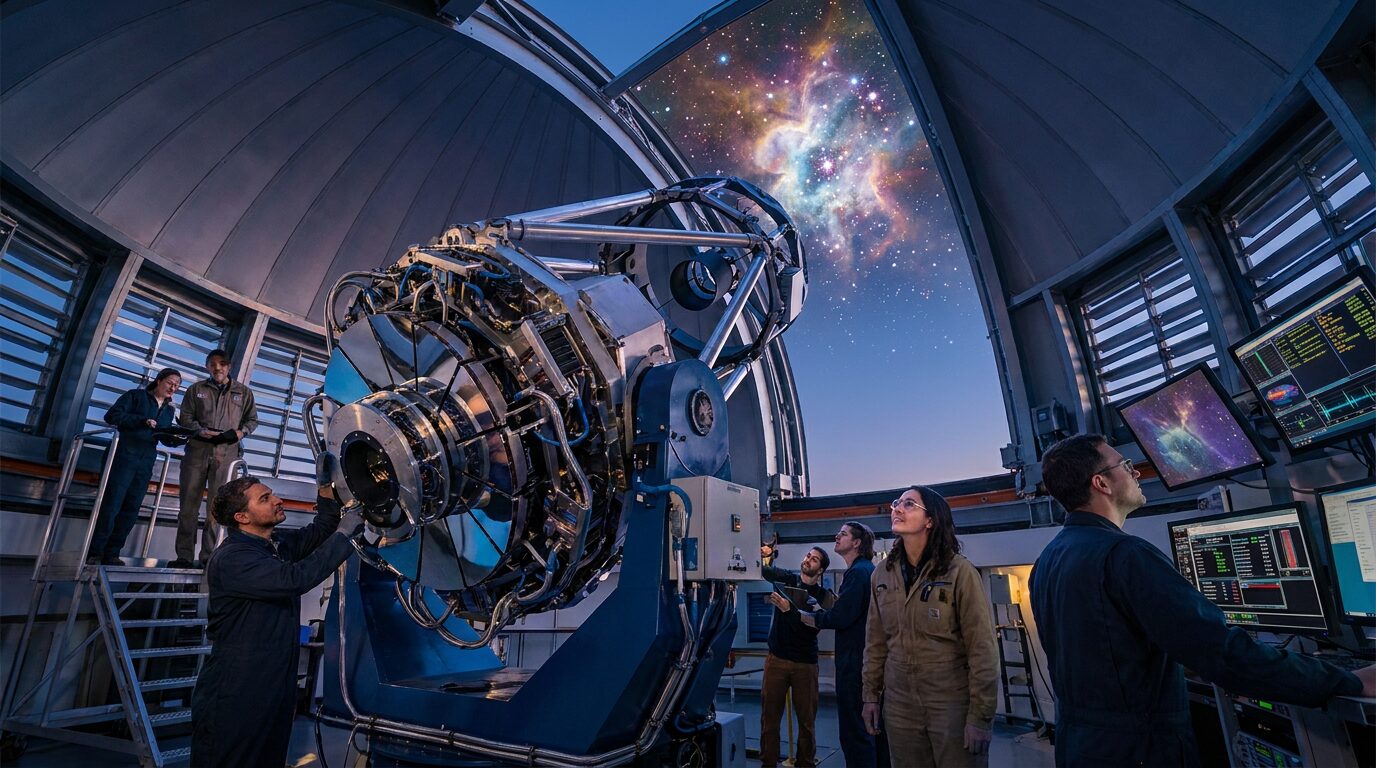
The story science tells about itself is flattering and mostly wrong. It goes like this: a sufficiently brilliant mind, staring long enough at a sufficiently stubborn problem, eventually cracks it. Newton under the apple tree. Einstein on the tram. Fleming glancing at a contaminated petri dish. The genius precedes the discovery, and the discovery follows from the genius. It is a good story. It just does not match the data.
A new study published in Humanities and Social Sciences Communications[1] — part of the Nature Portfolio — has done something that, remarkably, had never been done before: it systematically examined every major scientific discovery in history and asked what actually produced it. Not what the textbooks celebrate, and not what the Nobel citation says, but what actually preceded the breakthrough at the level of method and instrument. The answer, replicated across physics, chemistry, biology, medicine, economics, and astronomy, is disarmingly consistent. Science's major discoveries are driven by a new method or tool that enables us to study the world through new lenses and discover what we often did not even know existed — from atoms and galaxies to microorganisms.
From where I sit — covering the instruments that map the cosmos, from radio dishes tracking pulsar timing arrays to space-based infrared observatories hunting for atmospheric biosignatures — this finding reads less like a revelation and more like the obvious thing everyone in astronomy already understood, finally stated in plain empirical terms. Every astronomer knows that what you can detect determines what you can know. The rest of science, it turns out, is no different.
The Dataset No One Had Built
To date, there existed no established theory or general empirical analysis of how major discoveries across science arise. This is the first study to assess science's major discoveries that cover all Nobel Prize and major non-Nobel Prize discoveries throughout history. These over 750 discoveries are linked to the methods and tools used to make them and the traits of the discoverers, enabling an assessment of which factors are more important to catalyse new breakthroughs. That framing matters. Previous accounts of discovery have leaned heavily on individual case studies — Kuhn's paradigm shifts, or citation-network analyses that track influence through publications — but neither method looked at the full population of major discoveries across all of science at once. This study did.
The findings quietly dismantle several popular explanations for how breakthroughs happen. Existing studies have described discoveries arising from more funding, team collaborations, higher productivity among younger researchers, paradigm shifts in theories, or even flashes of insight or serendipity. All of these factors exist. None of them is the primary driver. What precedes a major discovery, again and again across fields and centuries, is a new instrument or method that makes a previously invisible phenomenon detectable for the first time.
“Discovery often comes down to which researchers get access to the new tool first.”
Assessing science's major discoveries, the study finds that major discoveries are made by developing and using a new method or instrument. The new method or tool was applied for the first time to a problem to make the discovery that otherwise would not have been possible. That is what commonly makes it a breakthrough — it reveals something we could not see, detect, develop or test before, without that method. This key pattern is consistent across science's major discoveries spanning throughout fields — from physics and chemistry to medicine and economics — and it is consistent across history, from past centuries to contemporary science.
The Theorists Had Better Tools Than They Admitted
The study anticipates the obvious objection: what about the purely theoretical breakthroughs? Quantum mechanics. Relativity. Darwin. These feel like products of pure thought, and the textbook versions of those stories tend to strip out the instrumentation. The paper examines each case and finds the same pattern underneath. Planck's quantum hypothesis did not just rely on thought, but took the first step by analysing unexplained findings from experiments on blackbody radiation, made possible with powerful tools — spectrometers and bolometers — that measured emitted light. Einstein's photoelectric effect was rooted in experiments using electroscopes and cathode ray tubes that showed how light liberated electrons from metal. Bohr's quantum model relied on spectroscopes using prisms to reveal spectral lines that pointed to quantized energy levels.
For anyone who covers astronomical detection, that list of instruments carries an almost eerie familiarity. The spectrograph is not just a historical artifact in this story — it is the instrument that, in various upgraded forms, has kept producing new science for over a century and a half. Helium was first detected in the sun's spectrum during an 1868 solar eclipse, a full 27 years before it was isolated on Earth. Cesium and rubidium were also discovered through spectroscopy. The spectroscope revolutionized astronomy by allowing scientists to determine the composition, temperature, and radial velocity of distant stars without ever collecting a physical sample. The instrument did not serve one discovery. It opened a category.
A companion paper published in the Proceedings of the Royal Society A[2] extends the argument by examining what the history of science looks like when you focus on methods rather than theories. What appears to be a new, radical idea is generally made possible by being able to measure and observe the world with new and improved tools that enable new perspectives and increasingly greater precision. What are called paradigm shifts are generally driven by new and better methods and instruments that enable studying and understanding the world in new ways. The hypothesis of grand paradigm shifts, which govern science and replace central theories with entirely new theories, applies to only about 1% of major theoretical, experimental and methodological breakthroughs. The revolutionary moment, when examined closely, almost always has an instrument at its center.
One Tool, Many Discoveries
What makes this pattern particularly striking from an observational science standpoint is not just that new tools produce new discoveries. It is that a single new tool tends to produce multiple discoveries that nobody planned for. From a new radio telescope that sparked the discovery of pulsars and quasars in the 1960s, to a new highly sensitive spectrograph that enabled the discovery of many exoplanets since the 1990s, this pattern highlights the fundamental role of a single instrument: one that sparks multiple unintended discoveries and makes it often the more foundational discovery itself. What makes them so powerful is that a single tool triggers a cascade of breakthroughs.
That sentence deserves to sit still for a moment. The radio telescope was not built to find pulsars. Jocelyn Bell and Antony Hewish were looking at quasar scintillation. The signal that turned out to be a pulsar was initially flagged as interference — "scruff" on the chart recorder — before it was identified as something rotating at extraordinary regularity. The instrument created the conditions for an encounter with a phenomenon no one had theorized. We trigger many major scientific advances not through testing a clear hypothesis, but through exploratory research using a new tool innovation. The discovery was not guided by an idea. It was guided by a receiver pointed at the right part of the sky.
The same logic applies to microscopy. Viruses were known to exist through filtration experiments but couldn't actually be seen until the electron microscope arrived in the 1930s. In 1879, Walter Flemming discovered cell mitosis and chromosomes. Shortly after, Louis Pasteur developed pasteurization, and Robert Koch identified the bacilli responsible for anthrax, tuberculosis, and cholera — a cascade of results that followed from steady improvements in optical microscopy, not from a single act of genius working in isolation. That pattern of tool-driven biological discovery continues into the present: the molecular tools that finally made previously undruggable targets accessible took decades of instrumentation advances before any insight about a specific drug could follow.
The Implication Science Funding Is Not Ready For
The study is careful to frame its empirical claim, but it does not stop there. Scientists need to shift part of their attention and research to refining the very methods and instruments they use as a central part of the scientific and discovery process. Science agencies, journals, universities and other institutions need to also strategically shift greater shares of resources and provide greater incentives to extend our scientific toolbox — they need to equally support methodological projects and not just science projects.
This is the finding that should make administrators uncomfortable. Traditionally, discoveries and theories have been viewed as the centre of science. Methods have been viewed as constituting a temporary bridge that, once we develop the given discoveries and theories, no longer receives our attention. The study argues this is exactly backwards. The method is not the bridge. It is the ground the bridge stands on. A related companion paper on the origins of scientific fields — tracking over 350 fields across all of science — found that fields consistently emerge by developing a new method or tool, from advanced telescopes to electrophoresis, as they enabled a completely new perspective to the world and without them, the fields would not have been possible.
“The method is not the bridge to discovery. It is the ground the bridge stands on.”
Getting funding, hired and promoted in science is overwhelmingly tied to the number of citations that scientists' articles receive. Scientists do not commonly cite and reference the discovery of the methods and instruments they apply, but primarily just cite other scientific studies. In other words, the infrastructure of scientific credit actively obscures the mechanism of scientific discovery. The instrument gets used, then disappears from the acknowledgment record. The theory it made possible absorbs the recognition.
What the Next Tool Might Unlock
The study offers one more implication that I find both genuinely useful and slightly vertiginous: if tools drive discoveries, then tracking the frontier of instrumentation is actually a way to anticipate where discoveries will come from next. When we invent, upgrade, combine or adopt a new method or tool, we can predict where discoveries can come from next, and when. It is about tracking the speed and direction of method innovations. The signal can come from a recently invented computational method, an upgraded particle accelerator, an advanced spectrometer combined with AI-tools, or a new experimental method adopted from another field.
That framing gives a new shape to something already underway. The James Webb Space Telescope is not interesting primarily because of the questions astronomers brought to it — it is interesting because of what its instruments can detect that no previous instrument could reach: the infrared signatures of early galaxies, the atmospheric transmission spectra of exoplanets, the thermal emissions of objects that optical telescopes rendered invisible. Instruments like the James Webb Space Telescope promise to unveil the secrets of the universe with unprecedented clarity, employing advanced optics and imaging technologies to capture distant galaxies, exoplanets, and cosmic phenomena, expanding our knowledge of the cosmos. The discoveries that follow from JWST will not be the ones we designed it to find. They will be the ones we couldn't have designed, because we couldn't see them yet.
That is the precise condition this study describes: a new instrument applied to a problem for the first time, revealing something that previous frameworks could not even formulate as a question. The history of science is not a procession of ideas. It is a procession of resolving power — each new tool extending the range of what can be asked, and therefore what can be known. The genius in the room matters a great deal less than what the room is equipped to detect.
References
- New tools drive scientific discovery: evidence from all nobel-prize and major non-nobel breakthroughs (nature.com)
Systematically examined over 750 major scientific discoveries across all fields and history to identify what actually precedes breakthroughs at the level of method and instrument. - Proceedings of the Royal Society A (royalsocietypublishing.org)
Extends the argument by examining science history through methods rather than theories, finding paradigm shifts apply to only about 1% of major breakthroughs.
About Rowan Ellery
Rowan Ellery writes about anomalies, unexplained sightings, strange signals, and the uneasy border between observation, misinterpretation, and genuine mystery. Their work focuses on keeping curiosity alive without letting evidence dissolve into folklore.
More like this
The Signal That Fooled the World's Best Radio Telescopes for a Decade
The Lorimer Burst triggered years of real astrophysics before scientists could confirm the source wasn't their own equipment — and that uncomfortable gap is the most instructive part of the story.
We've Found Over 5,000 Exoplanets. Almost None of Them Are Like Earth.
The most common world in the galaxy sits in a size range our solar system completely skipped — and planetary scientists aren't sure whether that's physics or blind spot.
The Galileo Project Watched 80,000 Objects. 144 Broke the Rulebook.
The Galileo Project's first major sky survey didn't produce a smoking gun — it produced a data problem so precise it finally tells us what kind of evidence we actually need.