Why the Drug That Finally Beat KRAS Took 40 Years to Arrive
For decades, a single mutant gene drove some of the deadliest lung cancers while resisting every drug thrown at it — now a head-to-head trial has shown that the second wave of treatments may be genuinely different, not just incrementally better.
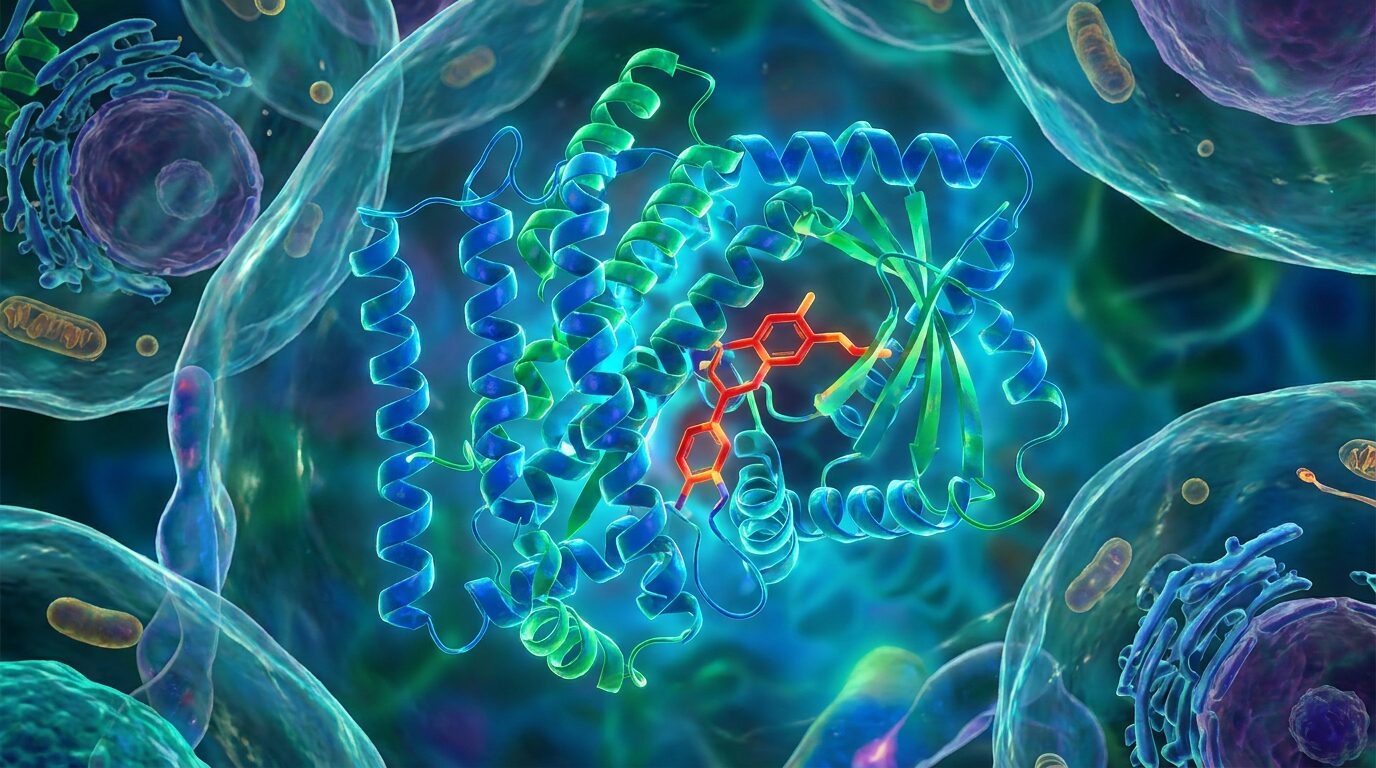
There is a useful way to think about what happens inside a tumor driven by a KRAS G12C mutation, and it does not require a biochemistry degree. Imagine a molecular switch — one that normally cycles between on and off, regulating when a cell grows and when it stops. The KRAS gene ordinarily does exactly that, helping regulate cellular growth by cycling between active and inactive states — but the G12C mutation locks the protein in a continuous "on" position, driving unregulated tumor proliferation. The cell never receives the signal to stop. It grows. It divides. It accumulates. The damage is not dramatic in its mechanism — it is almost mundane, the failure of a single molecular relay — but its consequences in a human lung are anything but.
The KRAS gene is one of the first driver oncogenes identified in human cancer, described as far back as the early 1980s — and for nearly four decades after that, it was deemed essentially "undruggable." The pocket where a small molecule would need to bind was too smooth, too featureless, too difficult for any drug to grip reliably. Cancers with KRAS mutations — including many lung, colorectal, and pancreatic tumors — were treated with blunter instruments: chemotherapy, immunotherapy, combinations of both. The mutation itself remained untouched, the switch still jammed on.
That changed in 2021, when a structural discovery about the specific G12C variant opened a new path. The KRAS G12C inhibitor class arrived in 2021 with sotorasib's accelerated approval, ending more than three decades of failed attempts to drug the RAS family. Adagrasib followed in December 2022. These were not incremental improvements on existing chemotherapy — they were a new category of intervention, the first drugs to target the mutation directly. For patients and oncologists alike, they represented a genuine shift. But genuine shifts in medicine carry a particular obligation: to ask, over time, whether the shift went far enough.
What the First Generation Could — and Couldn't — Do
Sotorasib and adagrasib worked. That much was clear from their approvals and the clinical data that followed. But while they established KRAS G12C inhibition as a therapeutic strategy, they delivered median progression-free survival of only six to seven months, with acquired resistance emerging as the principal limitation. Resistance is the chronic problem in targeted oncology — the biological equivalent of an ecosystem adapting around a pressure. You apply a constraint, and the system finds another route. A tumor under drug pressure is not static; it is a population under selection, and the variants that survive are the ones that learned to route around the block. Despite major progress, resistance remains the defining limitation of KRAS G12C inhibitors in NSCLC. In the second-line setting, median progression-free survival with sotorasib and adagrasib has generally remained around six to seven months. Molecular studies at progression have shown that resistance is heterogeneous and can occur through both on-target and off-target mechanisms.
A further limitation was the evidentiary baseline on which both drugs were approved. Both Amgen's Lumakras (sotorasib) and Bristol Myers Squibb's Krazati (adagrasib) hold only accelerated approvals in the United States, granted on the basis of response rate data from single-arm studies. Neither has successfully converted to full approval. In practical terms, this meant that neither drug had ever been directly tested against the other, or against anything except either a placebo, chemotherapy, or its own earlier results. The question of whether one was better than the other — let alone whether a next-generation inhibitor might be meaningfully superior — had never been answered with a randomized head-to-head trial. That gap has clinical consequences: without comparative data, physicians choosing between sotorasib and adagrasib were doing so largely on intuition, side-effect profile, and logistical factors. The choice between the two in clinical practice is often guided by patient-specific factors, including the presence of brain metastases and the treating physician's experience with each agent — and in the absence of head-to-head comparative data, both inhibitors remain viable and effective treatment options.
“A tumor under drug pressure is not static. It is a population under selection, and the variants that survive are the ones that learned to route around the block.”
A Different Kind of Trial
On July 2, 2026, Roche announced the top-line results of a trial designed specifically to close that gap.[1] The Krascendo 1 study is the only global head-to-head study evaluating a KRAS G12C inhibitor in direct comparison with first-generation KRAS G12C inhibitors — a phase III, randomized, open-label, multicenter study evaluating the efficacy and safety of divarasib monotherapy versus sotorasib or adagrasib in people with previously treated KRAS G12C-mutant advanced or metastatic non-small cell lung cancer, including 338 adults. The primary endpoint was progression-free survival, assessed by blinded independent central review — a methodological safeguard against the observer bias that can distort open-label trials.
Divarasib, the drug being tested, is designed differently from its predecessors.[2] It is a G12C inhibitor similar to sotorasib and adagrasib, but it is 5 to 20 times more potent and up to 50 times more selective. That combination of potency and selectivity matters: a drug that hits its target harder while touching fewer unintended proteins has, in principle, more room to suppress the tumor without triggering off-target toxicity. Whether that preclinical advantage would translate into clinical superiority was exactly what Krascendo 1 was built to find out. The trial demonstrated clinically meaningful and statistically significant improvements in both progression-free survival and overall survival. Crucially, statistical significance for overall survival was reached during the interim analysis of this historically poor-prognosis patient population.
That last detail is worth sitting with. Overall survival is the hardest endpoint to achieve in oncology, because it requires showing not just that disease slowed, but that patients lived longer — a signal that can be blurred by crossover therapies, subsequent treatments, and the sheer complexity of a human life being treated for cancer. Reaching it at an interim analysis, before the trial had fully matured, suggests the treatment effect was large enough to be visible early. OS superiority was reached at a prespecified interim analysis, an important signal in a setting where post-progression therapies and crossover can dilute survival differences.
What the Data Don't Yet Show
What Roche has not yet released is equally important. The company has not yet disclosed median survival outcomes, hazard ratios, response rates, subgroup analyses, or full safety data. The results have not yet been presented at a medical meeting or published in a peer-reviewed journal. For now, Krascendo 1 should be viewed as a positive top-line announcement, not as data ready to change clinical practice. That is not a dismissal — positive top-line results from a well-designed Phase III trial are meaningful — but it is a necessary calibration. For the KRAS G12C treatment field, the Krascendo 1 readout represents the first prospective, randomized evidence that meaningful differentiation within the inhibitor class is achievable.[3] Whether the magnitude of benefit — once quantified — is sufficient to displace adagrasib and sotorasib in clinical practice will depend on the hazard ratios and the tolerability comparison that the full dataset will provide.
The broader context is also unresolved. Roche is running divarasib through three Phase III studies covering different points in the treatment pathway. Krascendo 1 tests divarasib monotherapy against approved inhibitors in previously treated, second-line patients. Krascendo 2 pairs divarasib with pembrolizumab as a chemotherapy-free combination for untreated, first-line patients. Krascendo 3 evaluates adjuvant divarasib monotherapy against immunotherapy or observation in resected early-stage disease following standard chemoimmunotherapy. Second-line superiority matters, but it is the first-line data — where more patients are treated, for longer — that would reshape the landscape most substantially. The second-line treatment study is a boost for Roche, but the bigger market opportunity is in patients who have not yet received therapy. The science and the economics, for once, point in the same direction.
“Reaching statistical significance for overall survival at an interim analysis suggests the treatment effect was large enough to be visible early — before the data had fully matured.”
The Harder Problem
Even if divarasib earns full approval and takes its place as a standard of care, the problem of resistance will remain. Higher potency and selectivity may delay the clock on adaptation, but they are unlikely to stop it entirely. What is needed in the KRAS G12C space is not another agent equivalent to sotorasib and adagrasib, but rather a second-generation agent equivalent to osimertinib's answer to gefitinib or erlotinib for EGFR — namely, agents that are less toxic to improve the feasibility of combination therapies, with improved central nervous system penetrance, and higher efficacy in tumors that are resistant to first-generation inhibitors because of on-target secondary mutations. Whether divarasib fills that role completely, or only partially, will become clear only as resistance patterns emerge in treated patients over years rather than months. KRAS G12C inhibitors are not curative, resistance is common, and co-mutations such as STK11 and KEAP1 can substantially modify outcomes. The future of KRAS G12C inhibitors in NSCLC will depend on more than target inhibition alone — it will require molecularly informed sequencing, better resistance monitoring, and rational combinations that match the biology of each tumor.
What Krascendo 1 establishes, even in top-line form, is something rarer than another drug approval: it is direct evidence, in a randomized global trial, that a next-generation inhibitor is meaningfully superior to its predecessors in a cancer type that has long resisted meaningful progress. Divarasib now enters regulatory discussions backed by superiority data in overall survival from a randomized, active-controlled Phase III trial — a considerably stronger evidentiary foundation than either predecessor carried at the time of their approvals. For patients whose tumors carry the G12C mutation — approximately 14% of non-small cell lung cancer cases, a disease associated with poor prognosis — the question is no longer whether the switch can be flipped. The question is how long it stays off, and what happens when the tumor learns to turn it back on.
References
- [Ad hoc announcement pursuant to Art. 53 LR] Roche’s divarasib shows superiority in head-to-head phase III trial against approved KRAS G12C inhibitors in non-small cell lung cancer (roche.com)
Announced Roche's July 2, 2026 top-line results from the Krascendo 1 head-to-head trial of divarasib versus sotorasib or adagrasib. - Genentech: Press Releases | Genentech’s divarasib shows superiority in head-to-head phase III trial against approved KRAS G12C inhibitors in non-small cell lung cancer (gene.com)
Describes divarasib's design as 5 to 20 times more potent and up to 50 times more selective than first-generation KRAS G12C inhibitors. - Roche’s divarasib beats approved KRAS G12C rivals in landmark head-to-head Phase III trial (allsci.com)
Characterizes Krascendo 1 as the first prospective, randomized evidence that meaningful differentiation within the KRAS G12C inhibitor class is achievable.
About Phoebe Lark
Phoebe Lark writes about the biology and chemistry your body and home would rather you didn't examine too closely — odors, fluids, microbes, parasites, infestations, and the quietly industrious rot happening on and around you right now. She follows disgust down to the mechanism underneath, where the gross thing almost always turns out to be a system doing exactly what it evolved to do.
More like this
The T-Cell Therapy That Tells Your Immune System to Stand Down
Tregzi doesn't fight cancer — it prevents the immune system from declaring war on its new host, and its trial numbers are hard to argue with.

What Happens When a Weight-Loss Drug Works Better Than Surgery
A new class of obesity drug just posted weight-loss numbers that resemble surgery, not a shot — and that changes the financial psychology of every treatment decision people are making right now.

The Brain's Immune System Is Supposed to Protect You. With Age, It Starts Working Against You.
Microglia — the brain's resident immune cells — spend a lifetime learning to protect you, then gradually flip into a state that erodes the very circuits they were built to defend.