"Anxiety" and "Depression" Are Getting Heavier. The Words Themselves Are the Evidence.
New research on how mental health language shifts over time found a split that nobody predicted — and it explains why some people can't get taken seriously while others are afraid to speak up at all.
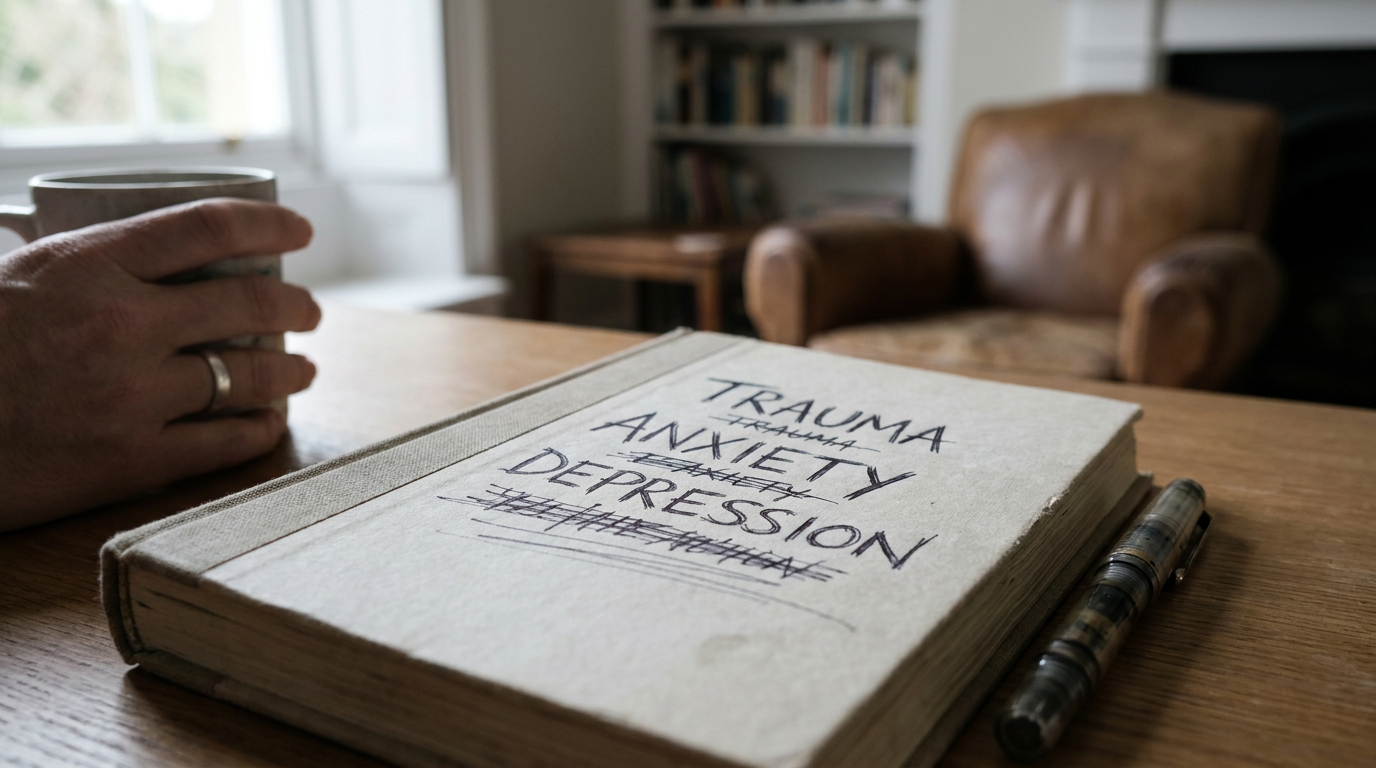
By now most people have absorbed some version of the story about therapy language going mainstream and getting ruined in the process. Words like 'trauma' and 'toxic' and 'triggered' escaped the clinic, spread across social media, and arrived in ordinary conversation so stretched and softened that they could describe almost anything. A bad haircut. A canceled reservation. A coworker who microwaves fish. The argument, usually made with a sigh, is that all this dilution makes it harder to talk seriously about serious things — that when everything is trauma, nothing is.
That argument is largely correct. But it is not the whole story. And the part that gets left out turns out to matter more than the part that gets told.
New research published in New Ideas in Psychology used computational linguistic analysis to track how the perceived severity of mental health terms has shifted across decades of text — books, news, online discourse. The finding about 'trauma' confirmed what most observers already suspected: the word has semantically diluted, its gravity worn down by casual overuse. But the finding about 'anxiety' and 'depression' pointed in the opposite direction. These words have not softened. They have intensified. In the collective linguistic imagination, they are growing heavier, not lighter — more severe, more clinical, more marked. Concept creep, it turns out, does not only flatten meaning. Sometimes it crushes it.
This is the counterintuitive split the research exposes: as one cluster of psychological language inflates toward meaninglessness, another cluster compresses toward a kind of linguistic severity that most ordinary experience cannot reach. And both movements, pulling in opposite directions, produce the same downstream problem — distorted thresholds for who seeks help, who gets heard, and who quietly decides their suffering does not qualify.
What Concept Creep Actually Does to a Word
The psychologist Nick Haslam introduced the concept of 'concept creep'[1] about a decade ago to describe a specific pattern: psychological concepts gradually expand their meaning to include milder and milder instances of what they originally named. The concept does not get replaced. It gets diluted. 'Abuse,' 'bullying,' 'trauma,' 'disorder' — all of these have shown measurable boundary expansion over time, their edges blurring outward until they can accommodate experiences that would have once fallen well outside them. Haslam's argument was not that mild experiences don't matter. It was that when you use the same word for a refugee's war trauma and for a stressful commute, you lose the ability to communicate something precise, and you risk making genuine severity invisible by surrounding it with lesser cases.
Most discussions of concept creep stop there — at the dilution end. The word gets overused, meaning erodes, clinical precision suffers. But the New Ideas in Psychology research suggests this is a partial map of a larger terrain. Language does not always creep outward. Sometimes it creeps inward, contracting around a harder, more severe core. And that contraction is its own kind of distortion.
“When a word inflates toward meaninglessness, it loses precision. When it compresses toward severity, it loses reach.”
The computational method the researchers used — analyzing semantic associations across large text corpora over time — captures something that surveys and clinical observation often miss. It is not asking people to define words. It is watching how words behave in language: what concepts they cluster with, how they are modified, what emotional weight surrounds them, how their neighborhood in meaning-space changes. Tracking 'anxiety' this way revealed a word that has been drifting steadily closer to severe clinical language and further from the ordinary language of mild nervousness or everyday worry. Not because more people are experiencing clinical anxiety — though they may be — but because the word itself is changing its implied floor.
The Paradox of a Word That Gets Too Heavy to Use
Here is the practical problem. If 'anxiety' now semantically implies something closer to panic disorder or generalized anxiety disorder than to ordinary nervousness, then a person with persistent, functionally impairing anxiety that falls short of a formal diagnosis is going to have a complicated relationship with the word. They may reach for it and immediately hedge — 'I mean, not like real anxiety' — or avoid it entirely and describe their experience in smaller, flatter terms. They may not recognize their own experience in a word that has come to sound like a clinical severity they don't think they've earned.
This is not a trivial linguistic concern. One of the earliest barriers to help-seeking is the belief that your symptoms are not bad enough to justify attention. Research on treatment delay[2] consistently finds that people downgrade their own distress, waiting for it to become serious enough to 'count.' When the available language for that distress carries embedded assumptions about severity, those assumptions push the threshold higher. You are not just deciding whether you feel bad enough to need help. You are also reckoning with whether you feel bad enough to use the word.
The same logic applies to 'depression.' A word that has drifted toward higher implied severity stops being a natural first-reach for someone experiencing persistent low mood, flat affect, and lost motivation that has not crossed into suicidal ideation or complete functional collapse. That person may be experiencing something clinically significant and enormously disruptive to their life. But if the word 'depression' now lives, semantically, closer to the severe end of the spectrum, they may not feel entitled to it — and may not feel entitled, by extension, to the care it implies.
“You are not just deciding whether you feel bad enough to need help. You are also reckoning with whether you feel bad enough to use the word.”
Why Trauma Went the Other Way
The divergence between 'trauma' and 'anxiety/depression' in the research is worth sitting with, because the two patterns feel like they should be symmetric but are not. Trauma diluted. Anxiety and depression intensified. Why did the same cultural moment — a genuine expansion of mental health awareness and vocabulary — pull these words in opposite directions?
One plausible explanation is the mechanism of social transmission. 'Trauma' became a framework for interpreting personal history and shared grievance. It was adopted enthusiastically in activist spaces, memoir culture, and identity discourse, where its value was often precisely its breadth — the ability to name structural harm, inherited wound, and collective injury using a single legible word. That breadth was not accidental. It served real communicative and political functions. But it also meant the word migrated away from its clinical specificity at speed. By the time 'trauma' was being used to describe a mean comment or a disappointing outcome, it had lost most of its implied severity.
'Anxiety' and 'depression' followed a different path. These words were adopted into mainstream mental health discourse not as frameworks for interpreting the world but as diagnostic categories people claimed for themselves — first haltingly, then openly, then as something adjacent to identity. But somewhere in that adoption, the clinical framing around them intensified rather than relaxed. This may partly reflect the way they appear in public conversation: news stories about the mental health crisis, discussions of rising clinical rates, campaigns that emphasize severity to drive awareness and reduce stigma. All of that framing does legitimate work. It takes mental illness seriously and pushes back against the old dismissiveness. But it may also be pulling the semantic floor upward as a side effect, making the words feel increasingly like they belong to formal diagnosis rather than to the broad, untidy middle of ordinary suffering.
Stigma Reduction Has a Hidden Trade-off
Anti-stigma campaigns around mental health have operated under a fairly consistent theory: the more normalized and visible mental health language becomes, the lower the barrier to help-seeking. If people can say 'I have anxiety' without shame, they will say it sooner, seek help sooner, and suffer less. This is a reasonable theory and there is real evidence supporting parts of it. Stigma genuinely does delay care. Normalization genuinely does help some people.
But the linguistic data introduces a complication the theory does not account for. Normalization and severity-escalation can happen at the same time, in the same word, with contradictory effects. It may now be more socially acceptable to say 'I have anxiety.' But if what 'anxiety' now implies — in the semantic neighborhood the word actually occupies — is something more severe than what the speaker is experiencing, the normalization gain may be partly offset by a severity gap. The person hears that it is okay to have anxiety. They also hear, in the weight of the word, that anxiety is a serious clinical matter. And they wonder whether they qualify.
This is not an argument against stigma reduction. It is an argument for thinking more carefully about how the language of stigma reduction works — and what it does to the words it touches. Talking openly about severe depression helps people with severe depression feel less alone. But it may also inadvertently raise the implied bar for what 'depression' means, leaving people with moderate, persistent, life-disrupting depression wondering if they are just sad, just tired, just too sensitive to handle ordinary life. That wondering is not neutral. It delays care. It compounds distress. It is a harm that comes dressed as progress.
“Normalization and severity-escalation can happen at the same time, in the same word, with contradictory effects.”
What Gets Lost in the Middle
The most consistent finding in psychological epidemiology is that mild-to-moderate symptoms account for a large share of the global burden of mental illness — often more, in aggregate, than severe illness. This is the prevention argument in its clearest form: if you can reach people in the moderate range, before conditions become entrenched, the benefits to individuals and to public health are substantial. The problem is that the moderate range is exactly where linguistic distortion does the most damage. When 'trauma' means anything from mass violence to social discomfort, mild trauma gets lost in the noise. When 'anxiety' has crept toward clinical severity, moderate anxiety gets left without a comfortable word.
There is a version of this problem that has been named but not quite solved in clinical communication: the gap between subsyndromal experience and formal diagnosis. Subsyndromal simply means below the threshold for a diagnosable disorder — but not absent, not trivial, and often clinically significant in terms of function and suffering. The people in this gap often receive less care, not because care is unavailable, but because the language available to them does not map cleanly to either 'I'm fine' or 'I have a disorder.' The semantic drift in words like 'anxiety' and 'depression' may be making this gap wider, pushing the diagnostic language further from where many people actually live.
Precision Is Not Coldness
None of this resolves cleanly. Language is not engineered. It drifts because people use it, and people use it the way it is most available to them — shaped by the conversations they have inherited, the media they consume, the frameworks they find most emotionally legible. Asking people to be more precise about words like 'anxiety' and 'depression' sounds like asking them to audit their pain before expressing it, which is both unkind and unrealistic.
But precision is not coldness, and it is not gatekeeping. It is a tool for communication that actually works. The clinical distinctions within anxiety and depression — generalized, social, situational; major, persistent, subclinical — exist not to rank suffering or assign worthiness, but to point toward what tends to help whom, under what circumstances, at what level of intensity. When the words we use to describe these experiences carry inflated or compressed implications about severity, the connection between language and appropriate response gets disrupted. People don't reach for help. Or they reach for a level of help that doesn't match their need. Or they reach and are not recognized, because the word they used implied something more severe than what their provider is seeing.
The research finding is a small but unusually specific piece of evidence for something worth taking seriously: that the words available to describe mental distress are not neutral containers. They carry assumptions about severity, belonging, and who counts as suffering enough. When those assumptions drift — through cultural overuse, anti-stigma campaigns, social media amplification, or the slow accretion of clinical framing — they do not just change how people talk. They change who feels permitted to ask for help, and from that point forward, they change everything.
References
- Concept Creep: Psychology's Expanding Concepts of Harm and Pathology (tandfonline.com)
Introduces the concept of 'concept creep' — the pattern of psychological terms gradually expanding to include milder instances of their original meaning. - Delay and failure in treatment seeking after first onset of mental disorders in the World Health Organization's World Mental Health Survey Initiative (pubmed.ncbi.nlm.nih.gov)
Provides evidence that people consistently downgrade their own distress and delay seeking treatment, waiting for symptoms to become severe enough to 'count. - Have the concepts of ‘anxiety’ and ‘depression’ been normalized or pathologized? A corpus study of historical semantic change (journals.plos.org)
Presents the computational linguistic analysis showing 'anxiety' and 'depression' have intensified semantically toward clinical severity, while 'trauma' has diluted.
About Owen Mercer
Owen Mercer writes about therapy concepts, emotional language, and the ways good psychological ideas get distorted once they hit self-help culture, social media, and ordinary conflict. His work focuses on separating useful insight from recycled jargon, false certainty, and emotionally sophisticated nonsense.
More like this

Burnout Doesn't Know It's Burnout. That's the Whole Problem.
After 50 years of research, scientists still can't agree on what burnout actually is — and that definitional fog lives inside the people trying to recognize it in themselves.

"Emotional Labor" Has Been Stretched Until It Means Almost Nothing
Arlie Hochschild coined 'emotional labor' to describe something specific and fixable — and somewhere between the sociology department and your group chat, it became a word for any feeling that goes unnoticed.

BPD Is Not a Personality Disorder. Some Researchers Think It Never Was.
A landmark 2025 paper argues that borderline personality disorder isn't a personality problem at all — and the evidence for where it really lives in the brain has been hiding in plain sight.