30 Years for Moving a Box: What the Estrada Case Reveals About Protest and Power
The Daniel Sanchez Estrada case isn't about what he did with a box of zines — it's about what prosecutors needed those zines to mean.
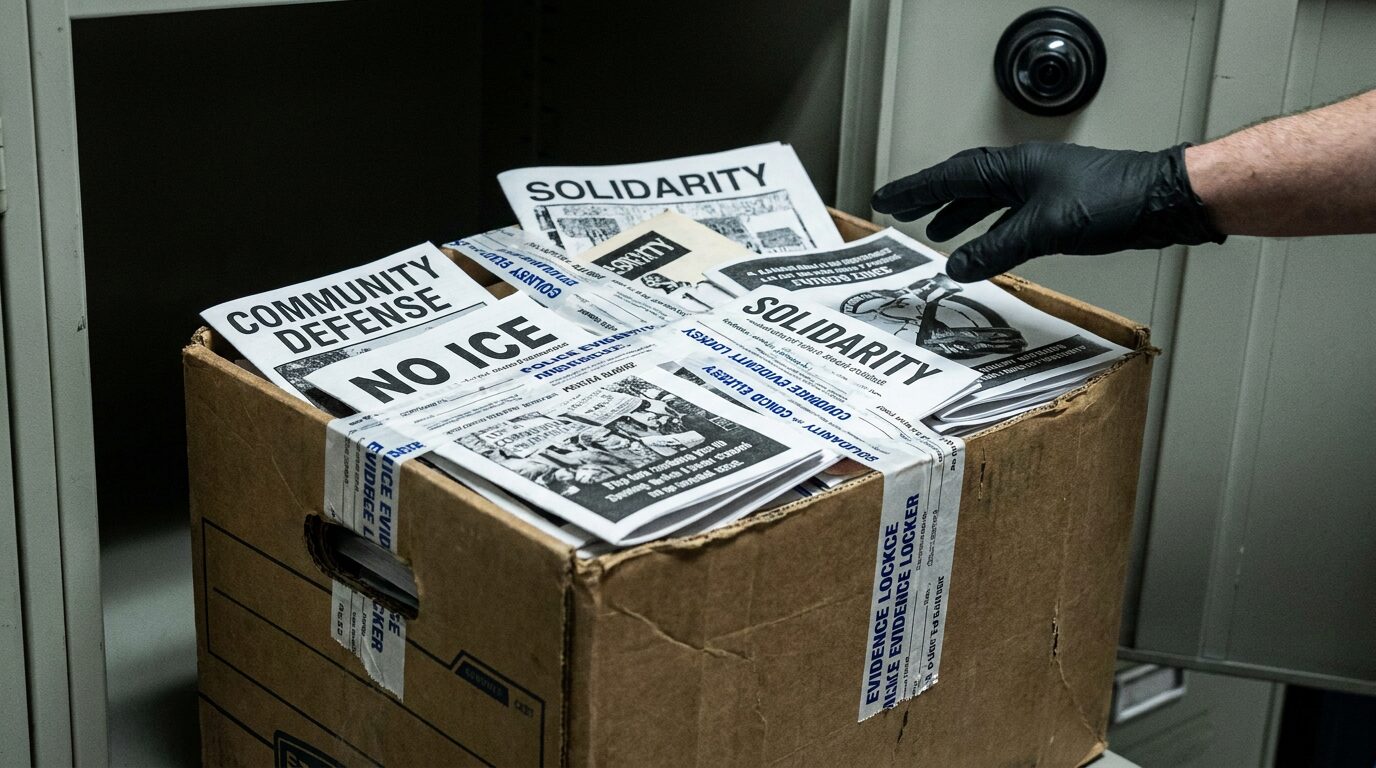
Here is what Daniel "Des" Sanchez Estrada actually did. He was not present the night of July 4, 2025, when a group of protesters arrived at the Prairieland Detention Center outside of Dallas to set off fireworks and signal solidarity with the immigrant detainees held inside. But his wife, Maricela Rueda, was present and subsequently arrested after the demonstration turned violent. According to court documents, agents recorded a phone call made by Rueda in jail, in which she asked her husband to move her car with her phone inside. At some point after the call, Sanchez Estrada was seen in surveillance images dropping off a cardboard box to an address in Denton, Texas. Inside the box, law enforcement officers discovered political zines, including It's Vacant, Take It! (2013), a guide to squatting, and War in the Streets: Tactical Lessons from the Global Civil War (2026). That is the entire predicate for what came next.
Sanchez Estrada is a 39-year-old green card holder and Denton, Texas-based tattoo artist sentenced by a federal court in one of the most severe domestic criminal cases to emerge from the Trump administration's crackdown on anti-government dissent. O'Connor gave Sanchez Estrada a 30-year term. The lengthy sentence was among the eight harsh terms handed down by judges in two courtrooms in Fort Worth to activists who played roles at or after the July 4, 2025, protest at Prairieland Detention Center. Combined, those eight defendants received a total of 450 years in prison. The man who moved a box of pamphlets got 30 of them. The logic demands examination.
The Circular Trap: When Protected Speech Becomes Evidence
Under the auspices of National Security Presidential Memorandum-7[2], Sanchez Estrada was federally charged with "corruptly concealing a document or record" for moving a box of zines the day after the protest. Although he was not present at the protest, nor did he know about it beforehand, prosecutors argued that the content of the literature made it evidence of the defendants' material support for terrorism, and alleged that the decision to move the box was a conspiracy between Sanchez Estrada and his wife. Read that again slowly. The zines weren't evidence of a crime he committed. They were reframed as evidence of crimes committed by other people — people who happened to share his politics — and moving them, even as his own property, became obstruction.
Sanchez Estrada's public defender said the zines he moved were his own and protected by the First Amendment, and that none of them helped convict the other defendants at trial. The defense attorney, Christopher Weinbel, put it plainly in court: "At the heart of this case is a simple truth: Mr. Sanchez moved a box. He is not a murderer, he is not ISIS, he is not a foreign terrorist." The judge sentenced him anyway. In doing so, Judge O'Connor rejected motions for acquittal or a new trial that highlighted the state's failure to identify how the literature in question constituted evidence or prove that Sanchez Estrada intended to conceal it.
“The zines weren't evidence of a crime he committed. They were reframed as evidence of crimes committed by other people — people who happened to share his politics.”
Weinbel's rejected motion captured the prosecutorial sleight of hand directly. Writing in the motion, Weinbel noted that prosecutors "relied entirely on stacked inferences and speculation," and that "the Government's own admissions highlight that the object of the offense was unknown, leaving the jury to speculate about what constituted the alleged evidence." Speculation, in other words, did the work that evidence could not. The jury was invited to fill in a gap that the government itself acknowledged existed.
What Antifa Has to Do With It (Which Is Almost Nothing)
Although the case centered on the government's claim that the defendants were affiliated with antifa, prosecutors offered little evidence of that at trial. Even the judge who oversaw the trial questioned whether he needed to mention antifa in his jury instructions. This is not a minor detail. The antifa label did enormous rhetorical work in this prosecution — it conjured a specter of organized domestic terrorism, activated post-January-6 legal frameworks, and recast a protest that turned violent into something that looked, for sentencing purposes, like a coordinated paramilitary operation. Antifa, short for anti-fascism, has traditionally been used to describe a broad left-wing ideology and general opposition to right-wing politics. But in this courtroom, it functioned as a multiplier — a label that stretched the sentencing range far beyond what the individual conduct warranted.
The trial resulted in the conviction of nine people in total, with charges including seditious conspiracy, use of explosives — including references to fireworks — and "material support for terrorism." The case has been described by federal authorities as one of the first applications of an indictment framework related to an alleged "antifa cell," while defense lawyers and several civil rights organizations dispute this characterization, describing it as a politically constructed crime. Song, the sole defendant convicted of attempted murder, received a 100-year prison sentence. The other defendants' arguments that they should be distinguished from Song because they never fired a gun won them little relief. Sanchez Estrada, who fired nothing and was present at nothing, got 30 years. The proximity of his politics to the event was enough.
The Machinery Underneath
The Freedom of the Press Foundation did not hesitate to name what it was watching. Following the sentencing, the Freedom of the Press Foundation vociferously defended the artist, claiming the charges represent the Trump administration's intent to "criminalize disfavored ideologies."[4] Seth Stern, the Foundation's chief of advocacy, asked the obvious question: "Under the First Amendment, possessing literature cannot be criminal, so what legitimate evidence could he possibly have been concealing? Political zines like those Sanchez possessed are no different from the pro-Revolution pamphlets this country's founders had in mind when they drafted the First Amendment's press clause."
When the administration declares a political viewpoint "terrorism," hiding literature espousing that viewpoint from the government is a perfectly logical response — as is using secure communications technology to communicate with others who share similar politics. But when your thoughts and reading list are deemed illegal, preventing the government from finding out what you think and read becomes a crime in and of itself: obstruction of the thought police. That circularity is not a flaw in the legal theory. It is the point. You cannot escape the net because the net is woven from your own beliefs.
In Chicago and other cities ICE invaded, activists and organizers packaged whistles and zines to distribute to residents. Under the logic of NSPM-7 and Sanchez Estrada's conviction, that is a network of actors engaged in organized political violence. If you read one of their zines, you could be deemed a member of an illicit enterprise, and if you hide one, you're covering for criminals. This is the template now on the books. Not a hypothetical. A 30-year precedent, signed by a federal judge in Fort Worth.
“You cannot escape the net because the net is woven from your own beliefs.”
Who Pays and Who Gets Erased
Following his arrest, Sanchez Estrada, a former DACA recipient and current green card holder, was singled out by ICE, doxxed by DHS, and threatened with deportation.[3] His immigration status was weaponized as a secondary pressure point — another lever to pull, another vulnerability to exploit. The Free Des Support Committee has amplified his story by identifying Sanchez Estrada as a father, teacher, and poet — as a person, in other words, rather than the abstraction the indictment required him to be. That work matters, but it also reveals how much labor ordinary people must perform just to reassert someone's humanity against a system that has formally categorized his reading material as terrorism.
This is what the quiet way rigged maps convince people democracy is pointless and the Sanchez Estrada case share: the machinery is working exactly as designed. The function of a 30-year sentence for moving a box of pamphlets is not primarily punitive — it is demonstrative. It is a message to every organizer, every zine distributor, every person who keeps left-wing literature on a shelf and has a spouse who goes to protests. The message is: your proximity to dissent is your liability. Legal experts caution that such precedent could lead to terrorism charges for mainstream activism. That is not a slippery slope argument. That is a description of the slope that has already been greased, measured, and descended.
"The sentences handed down today make clear that Antifa terrorists who attack law enforcement and federal facilities will face swift and uncompromising justice," said Acting Attorney General Todd Blanche in a statement. That framing does a lot of work. It collapses Daniel Sanchez Estrada — a tattoo artist in Denton who moved a cardboard box — into the same category as someone who fired a gun. It turns pamphlets into weapons and readers into combatants. It asks you not to think too carefully about the gap between what someone did and what the government needs them to have done. He has since filed a motion to overturn his conviction. An appeal is forthcoming. Whether any court will look honestly at what this prosecution actually proved — and what it only needed to feel — is the question that carries the next thirty years of his life.
References
- Police surveillance and facial recognition: Why data privacy is imperative for communities of color (brookings.edu)
- Prairieland Defendant Sentenced to 30 Years in Prison for Moving a Box of Antifascist Zines (theintercept.com)
Establishes the legal framework (National Security Presidential Memorandum-7) under which Sanchez Estrada was federally charged with concealing documents. - Extreme 30-Year Prison Sentence for Artist Daniel “Des” Sanchez Estrada in the Prairieland Case (TX) Highlights Federal Attack on Freedom to Dissent (newpol.org)
Documents that Sanchez Estrada's immigration status was weaponized after arrest, with ICE involvement and DHS doxxing creating deportation threats. - Texas man sentenced to 30 years for transporting pamphlets (freedom.press)
Provides Freedom of the Press Foundation's statement that the charges criminalize disfavored ideologies and that possessing political literature cannot be constitutionally criminal.
About Rafael Tomlin
Rafael Tomlin writes about current politics from a fiercely populist perspective: pro-worker, pro-renter, anti-billionaire capture, anti-authoritarian, and deeply hostile to the machinery that turns public life into cruelty for profit. His work focuses on power, policy, class, democracy, corruption, and who actually pays when political theater becomes law.
More like this
The Surveillance State Didn't Come for You. It Came for the Protesters First.
Across three countries with very different governments, AI-powered facial recognition is being deployed against protesters first — and the political science research on why that sequence matters should scare you.
Trump's DNA, Carroll's Dress, and the Machinery of Institutional Revenge
Trump spent years stonewalling a DNA test that could have cleared his name — and now, owing $88 million in civil judgments, his Justice Department has opened a criminal probe into the woman who asked for it.
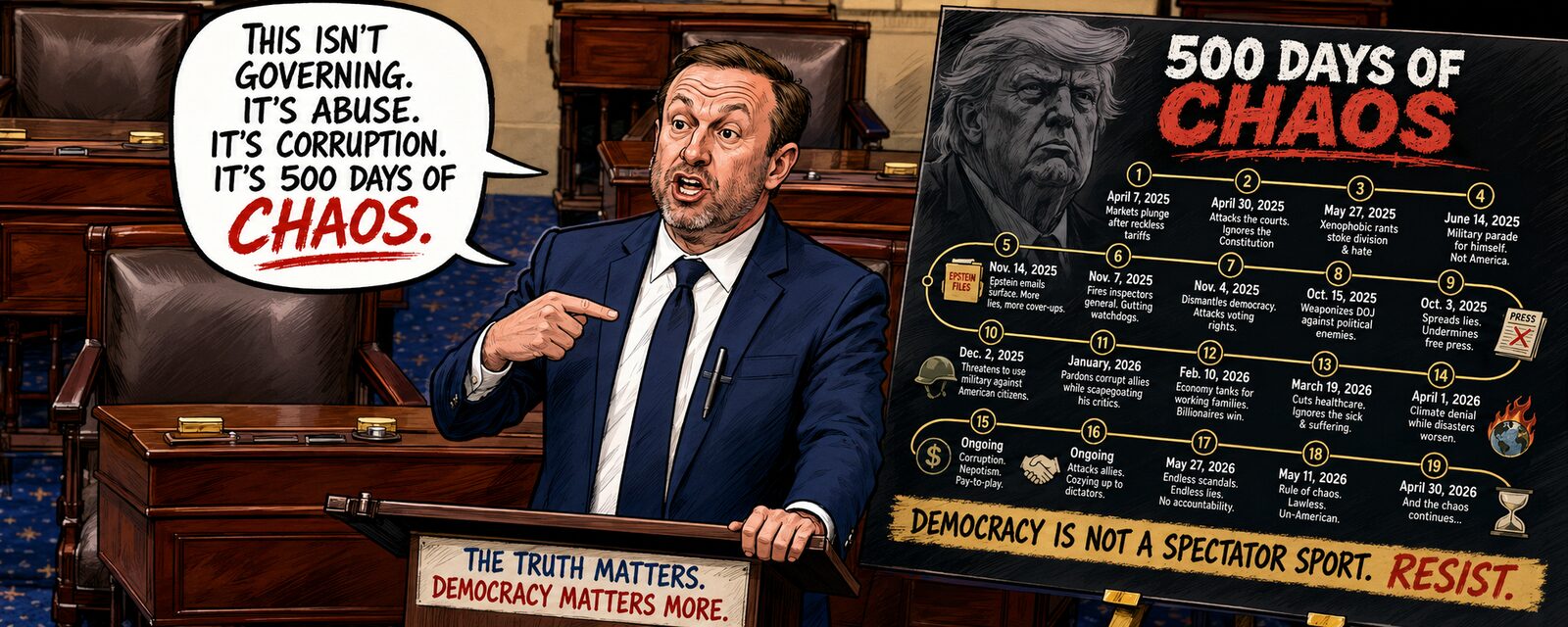
The White House Is a Corruption Machine. Senator Murphy Just Documented Every Moving Part.
Senator Chris Murphy just spent half an hour on the Senate floor reading a documented timeline of corruption — and the pattern it reveals is worse than any single scandal.