The White House Is a Corruption Machine. Senator Murphy Just Documented Every Moving Part.
Senator Chris Murphy just spent half an hour on the Senate floor reading a documented timeline of corruption — and the pattern it reveals is worse than any single scandal.
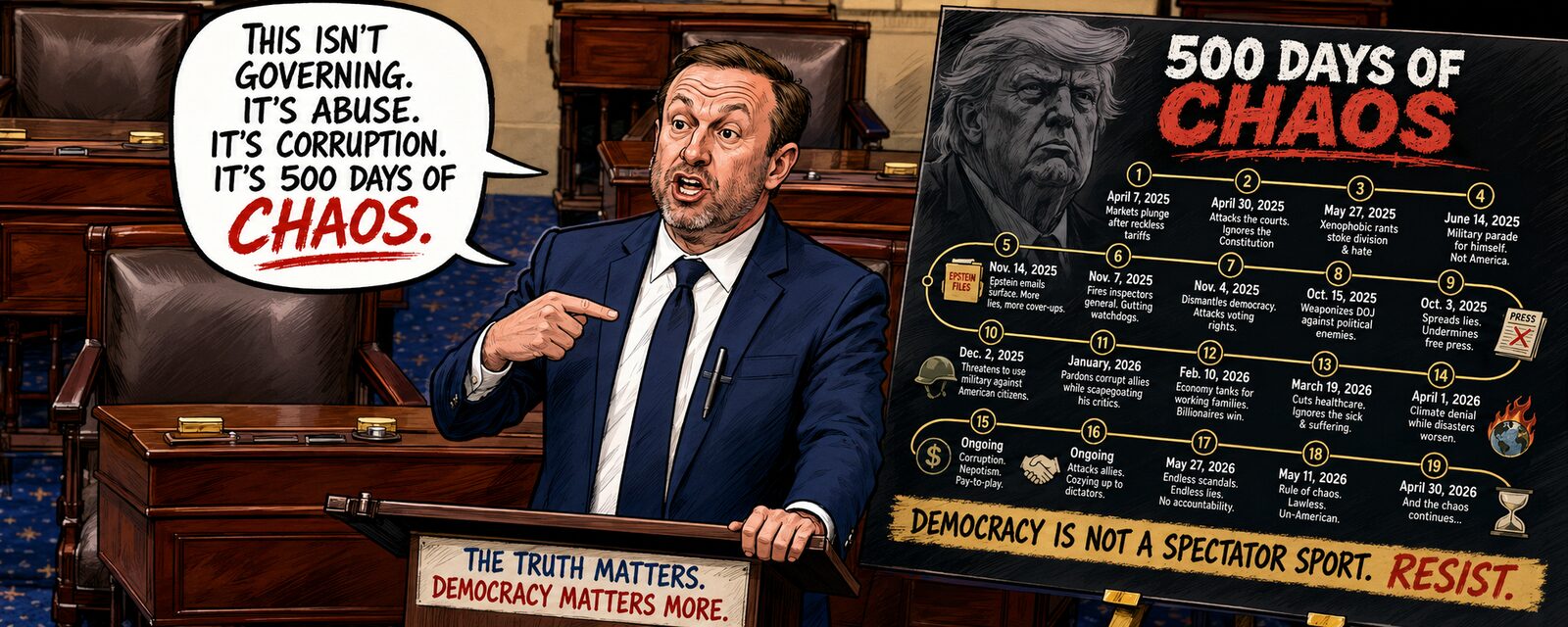
There is a difference between a scandal and a system. A scandal is a thing that happens. A system is a set of incentives that keeps producing the same outcomes regardless of who is watching. What Senator Chris Murphy laid out on the Senate floor last week was not a list of scandals. It was a map of a system — and the map is damning.
Senator Chris Murphy (D-Conn.) spoke on the floor of the U.S. Senate to expose what he called "nuclear-grade corruption and self-dealing" that has defined the first 500 days of President Trump's second term. The speech ran for only half an hour, but carried the weight of more than a year. It was methodical. It was chronological. And it was sourced to specific dates, specific amounts, and specific names. Murphy was not ranting. He was reading a ledger.
Murphy's central charge: "Over the last year and a half, our president, Donald Trump, has turned the White House into a 24/7 corruption operation. This is a national crisis, and we should start acting like it." That's a large claim. The evidence Murphy assembled, drawn from court documents, investigative journalism, financial disclosures, and official government records, makes it a difficult one to dismiss. Let's go through it.
The Crypto Shutdown: A Deputy AG With Half a Million in Skin in the Game
Murphy started with April 7, 2025, when then-acting Attorney General Todd Blanche issued a memo ordering the termination of several Biden-era DOJ investigations into crypto companies. The reason this matters is not just procedural. The then-Deputy Attorney General was a major investor in crypto companies, and he worked for a president who is himself a major player in the crypto industry — yet DOJ simply dropped these investigations. Crypto oversight, gone. The signal sent to the industry: we are not coming for you. The signal sent to every other enforcement agency watching: political loyalty determines who gets investigated.
This is not an abstract conflict-of-interest complaint. It is the enforcement arm of the federal government being pointed away from an industry in which the people running that arm have a direct financial stake. That is not policy disagreement. That is regulatory capture wearing a law enforcement badge.
The Pardon Racket: Pay to Play, In Writing
In May 2025, Murphy said, "the pardon racket starts." His framing: the president is pardoning people based on their ability to pay either him, his political operation, or people close to him. The first documented example was stark. On May 27, Trump pardoned Paul Walczak — a man who stole millions of dollars from nurses and healthcare aides at his nursing home and used the money to buy a $2 million yacht — after Walczak's mother paid $1 million for a face-to-face meeting with Trump. Three weeks after that paid audience, her son received a full and unconditional pardon that went so far as to relieve him of any duty to repay the $4.4 million he stole from his employees.
Let that settle for a moment. A convicted fraudster who stole from nursing home workers walks free — and walks away from his financial obligation to his victims — because his mother bought a meeting. The Campaign Legal Center's detailed analysis of Trump's clemency record[3] frames this as part of a broader pattern: Trump has "turned clemency into currency, creating a loyalty-based justice system where allegiance and money determine who is held accountable."
One former federal prosecutor told the New York Times that "defense attorneys are telling us they can't get their clients to take good or reasonable plea offers because they felt they're better off spending their money on a political donation, drawing Trump's attention, and getting the case dismissed or going to trial and getting a pardon." That is not a metaphor for broken justice. That is a description of a functioning bribe market grafted onto the executive clemency power.
“Defense attorneys are telling us they can't get their clients to take reasonable plea offers — they're better off spending money on a political donation and waiting for a pardon.”
Murphy also flagged the pardon of former Puerto Rico Governor Wanda Vasquez and the foreign billionaire accused of bribing her. Julio Herrera Velutini, a foreign billionaire charged with bribing Puerto Rico's governor, received a pardon in January 2026 after his 25-year-old daughter — whose only previous political donation was $20 to Pete Buttigieg — gave $3.5 million to a Trump super PAC. The White House's defense of the Vasquez pardon cited her endorsement of Trump. It did not address the substance of the charges.
Murphy also addressed the pardon of co-conspirators to White House corruption — officials and allies whose legal jeopardy was resolved not through the courts but through presidential clemency, insulating the network of self-dealing from accountability. The pattern Murphy identified: people implicated in dealings that touched Trump's own financial interests were being pardoned preemptively, before any formal prosecution could establish a public record. In several cases, public officials who abused the public trust were rewarded with pardons not because they showed evidence of rehabilitation, but because they showed evidence of dedication to Trump — and Trump has also abused his prosecutorial discretion to excuse corruption by allies before a presidential pardon even became necessary.
The Homan File: $50,000 in a Bag, and Then the Investigation Vanished
Tom Homan is Trump's "border czar" — the face of the administration's deportation machine, the man presented to the public as the hard-nosed enforcer of American sovereignty. He is also, according to federal investigators, a man who accepted a bag of cash from undercover FBI agents. Homan was caught on tape accepting a bag filled with $50,000 in cash from an undercover FBI agent in Texas in September 2024[1], when he was still a private citizen, according to two people familiar with the matter and a government document confirming the existence of the probe.
The sting operation stemmed from a broader public corruption probe that did not initially target Homan; it led agents to an encounter in which they recorded Homan allegedly accepting a bag containing $50,000 in cash while agreeing to potentially help the men obtain government contracts in the event Trump won the 2024 election. That's the allegation: selling future government contracts in exchange for cash, before he even had the power to deliver them. The Department of Justice shut down the investigation.
The Times reported the FBI closed the probe over doubts it would be able to prove the transaction constituted bribery to a jury[4], but another source told the Times the investigation ended "prematurely" before officials could gather sufficient evidence — and the episode raised concern the Trump administration intentionally ended the case because of Homan's status in the administration. The White House called it a "blatantly political" Biden-era investigation. The circular logic here is worth naming: the administration shuts down an investigation into its own official, then points to the absence of charges as proof of innocence. That is not how evidence works. That is how institutional capture works.
Murphy also connected Homan to former Culpeper County Sheriff Scott Jenkins — a man convicted of bribery who received a Trump pardon. Jenkins was sentenced to 10 years in federal prison after being convicted of accepting more than $75,000 in bribes in exchange for appointing Northern Virginia businessmen as auxiliary deputy sheriffs. President Trump granted Jenkins a full and unconditional pardon four days later. Homan had been issued a Culpeper County deputy sheriff's badge in 2020, when the office was led by Jenkins. The pardon arrived before Jenkins served a single day of his decade-long sentence.
Changpeng Zhao and the Crypto Pardon
Murphy's speech also detailed the pardon of Changpeng Zhao, the founder of Binance — the world's largest cryptocurrency exchange. Zhao had pleaded guilty to federal money laundering charges, admitting that Binance violated U.S. anti-money laundering laws and processed transactions for sanctioned entities including terrorist organizations. He was sentenced to four months in federal prison. Trump pardoned him. The same administration that dropped crypto oversight investigations — with officials personally invested in crypto — then pardoned the most prominent convicted figure in the industry. The policy signal is consistent: the crypto industry operates under a different rule of law when Trump is in office, and access to that protection is available for a price. Murphy's argument was simple: you cannot understand the Zhao pardon in isolation from the administration's financial entanglements with the crypto sector. Taken together, they describe a policy posture that functions as a protection arrangement.
The Vulcan Deal: $620 Million, No Competitive Bids, White House on the Phone
This one has receipts. ProPublica's investigation is among the most significant pieces of accountability journalism published during Trump's second term, and Murphy read it into the Senate record. ProPublica's reporting on the Vulcan loan represents the first time the awarding of a contract from a federal agency has been directly linked to White House intervention.
The company in question is Vulcan Elements. It makes rare earth magnets for drones and satellites, and Donald Trump Jr.'s venture capital firm took a stake in the company three months before the Pentagon announced the deal. Interviews and Defense Department records reviewed by ProPublica show that the request to loan hundreds of millions of dollars to the firm linked to Trump Jr. was made by Peter Navarro, a White House adviser and close friend of Trump Jr.'s. Of the dozens of companies the Pentagon was considering funding at the time, Vulcan's was the only deal initiated by a top aide to the president — an arrangement that defense officials said was without precedent in the office's review process.
After defense officials got the White House request, they asked Pentagon staff to move at an unusually rapid pace. The Pentagon's Office of Strategic Capital typically spends months vetting companies before committing public funds, but in this instance, Pentagon staff were directed to close the Vulcan deal in a matter of weeks, reportedly working late nights to get it done. "The call came from the White House: We have to get this done," one defense official told ProPublica.
Three months after 1789 Capital took an equity stake in Vulcan Elements, the administration committed $620 million to the company — the largest Pentagon loan of its kind — with no competitive process, no independent verification, and no conflict-of-interest review anywhere to be found. The deal was a dramatic win for Vulcan, a North Carolina rare-earth magnet company launched just two years earlier. Estimates of its valuation grew tenfold after the deal was announced. Trump Jr.'s firm had invested when Vulcan was valued at roughly $200 million. Three months after the investment, Vulcan was valued at an estimated $2 billion.
“Of the dozens of companies the Pentagon was considering funding, Vulcan's was the only deal initiated by a top aide to the president — without precedent in the office's review process.”
Republicans voted to block a subpoena of Donald Trump Jr., shielding the president's son from scrutiny about the largest loan the Pentagon's Office of Strategic Capital has ever issued. Not long ago, House Republicans spent two years and millions of dollars investigating Hunter Biden on the theory that a president's son profiting from his father's office requires congressional investigation. The asymmetry is not subtle. Murphy did not let it pass without comment.
Murphy also flagged that Eric Trump separately bragged about scoring a $24 million Pentagon deal — and that Trump Jr. is on the advisory board of and holds millions of dollars worth of shares in a Florida-based drone parts manufacturer, Unusual Machines, which is currently under review for a Pentagon loan of its own. At least four of 1789 Capital's portfolio companies have won contracts from the Trump administration, amounting to more than $735 million. This is not a coincidence cluster. It is a revenue model.
The Rest of the Ledger: Tobacco Money, Ballroom Contractors, and a Reflecting Pool
Murphy's speech also covered several items that have received less national attention but fit the same pattern. On the tobacco bribery allegation: Murphy documented that the tobacco industry had funneled substantial money — $5 million — into Trump's political orbit around the same time the administration moved to weaken FDA tobacco regulations, including pulling back on menthol cigarette restrictions that public health agencies had spent years building. The policy reversal and the financial flow occurred in close temporal proximity. Murphy's argument: this is not coincidence; it is the price of access to regulatory relief.
On the no-bid reflecting pool contract: Murphy identified a Trump-connected ballroom contractor — a personal acquaintance of the president's tied to Mar-a-Lago circles — who received a government contract to renovate the National Mall reflecting pool without a competitive bidding process. There was no competitive bidding process for that contract. Murphy noted this pattern repeats itself: competitive bidding basically doesn't exist when the president or somebody close to him wants a contract directed to a friend or to a company in which they invest. The reflecting pool contractor fits that template exactly.
Murphy also documented that top administration officials were cashing in on government contracts that benefit their own investment portfolios. Stephen Miller, for instance, owns up to $250,000 in Palantir stock — and just a month before Miller's holdings became public, ICE announced it was awarding a $30 million contract to Palantir to provide "real time" surveillance information to ICE officers. Again, no competitive bidding. Again, the money flowing toward people already financially connected to it.
What a System Looks Like When It's Working Against You
The standard defense you will hear is that each of these items, in isolation, has an innocent explanation. The Vulcan loan is critical minerals policy. The Homan investigation was legally flawed. The pardons are within presidential authority. The crypto enforcement shift is a policy choice. Maybe. But the job of political analysis is not to evaluate each item in isolation. It is to ask what the system is rewarding — and what happens when you zoom out.
What you see when you zoom out is this: a president and his family are making money from the office. His officials are making money from their offices. Investigations into those officials are being closed by those same officials' bosses. Pardons are going to people who paid, and to people whose silence or loyalty protects the network. Contracts are going to companies in which family members hold stakes, awarded without competitive bidding, expedited by White House calls, and blocked from congressional oversight by the president's own party. If you walked into a municipal government and saw this pattern, you would call it a crime ring. When it operates from the White House, the scale simply gets bigger and the accountability infrastructure gets weaker. As BrainHook has covered, the institutional guardrails have been eroding for years — and what Murphy documented is what the erosion looks like from the inside.
Murphy framed it this way: "It's time to pull back and see the full picture — to not view this as just one isolated scandal after another, every single one popping up each week or every few days," but to understand the full scope. That is the correct analytical frame. Individual scandals are distracting. The pattern is the story. The pattern is: access is for sale, enforcement is for friends, and the machinery of democratic accountability — competitive contracting, independent prosecution, congressional oversight, judicial review — is being systematically redirected to protect the people running it.
Murphy called explicitly for impeachment. He is unlikely to get it. The Republican majority in the House has no incentive to open a process that would require them to put documented evidence of this administration's conduct into a formal legal record. Democrats on the House Natural Resources Committee moved to subpoena Trump Jr. to testify about the Vulcan deal — the Republican majority refused. That refusal is itself part of the system. The oversight mechanism is staffed by people whose political survival depends on the president they are supposed to be overseeing. That is not a bug. That is the design — and the design is working exactly as the people who benefit from it intend. The question Murphy was really asking from that Senate floor is not whether Congress will act. It is whether the public, watching all of this documented in a single place, finally understands what they're looking at. Not a series of embarrassing incidents. A business model.
References
- DOJ ended probe of 'border czar' Tom Homan for allegedly accepting $50K in FBI sting: Sources (abcnews.go.com)
Documents that Homan was recorded accepting $50,000 in cash from undercover FBI agents in September 2024 while agreeing to help obtain government contracts. - The White House Intervened to Get a $620 Million Deal for a Company Tied to Donald Trump Jr. (propublica.org)
Documents a $620 million Pentagon loan to a Trump Jr.-linked company despite denials of political favoritism from White House and company officials. - Inside the Pardon Playbook: An Analysis of President Trump’s Clemency Abuses (campaignlegal.org)
Establishes Trump's pattern of transforming clemency into a loyalty-based system where money and allegiance determine who receives pardons. - Tom Homan Bribery Allegations: What To Know About Probe Into Trump’s Border Czar (forbes.com)
Reports the FBI closed its investigation into Homan over doubts about proving bribery charges to a jury.
About Paul Wardell
Paul Wardell writes about politics, institutions, voters, media, class, power, polarization, and the incentives that make public life feel dumber than it needs to be. Left-leaning but stubbornly practical, his work focuses on how systems actually behave, not how partisans wish they behaved.
More like this
Trump's DNA, Carroll's Dress, and the Machinery of Institutional Revenge
Trump spent years stonewalling a DNA test that could have cleared his name — and now, owing $88 million in civil judgments, his Justice Department has opened a criminal probe into the woman who asked for it.
Trump's Name Was Redacted Dozens of Times. Here's What the Shape of That Silence Tells Us.
The released Epstein documents don't prove a conspiracy — but the architecture of what's been withheld is its own kind of evidence.
America's Political Violence Early Warning System Is Being Dismantled Before the Midterms
Political violence is measurably rising, the early-warning infrastructure built to catch it is being stripped for parts — and the same administration doing the stripping is generating the flashpoints.