The Surveillance State Didn't Come for You. It Came for the Protesters First.
Across three countries with very different governments, AI-powered facial recognition is being deployed against protesters first — and the political science research on why that sequence matters should scare you.
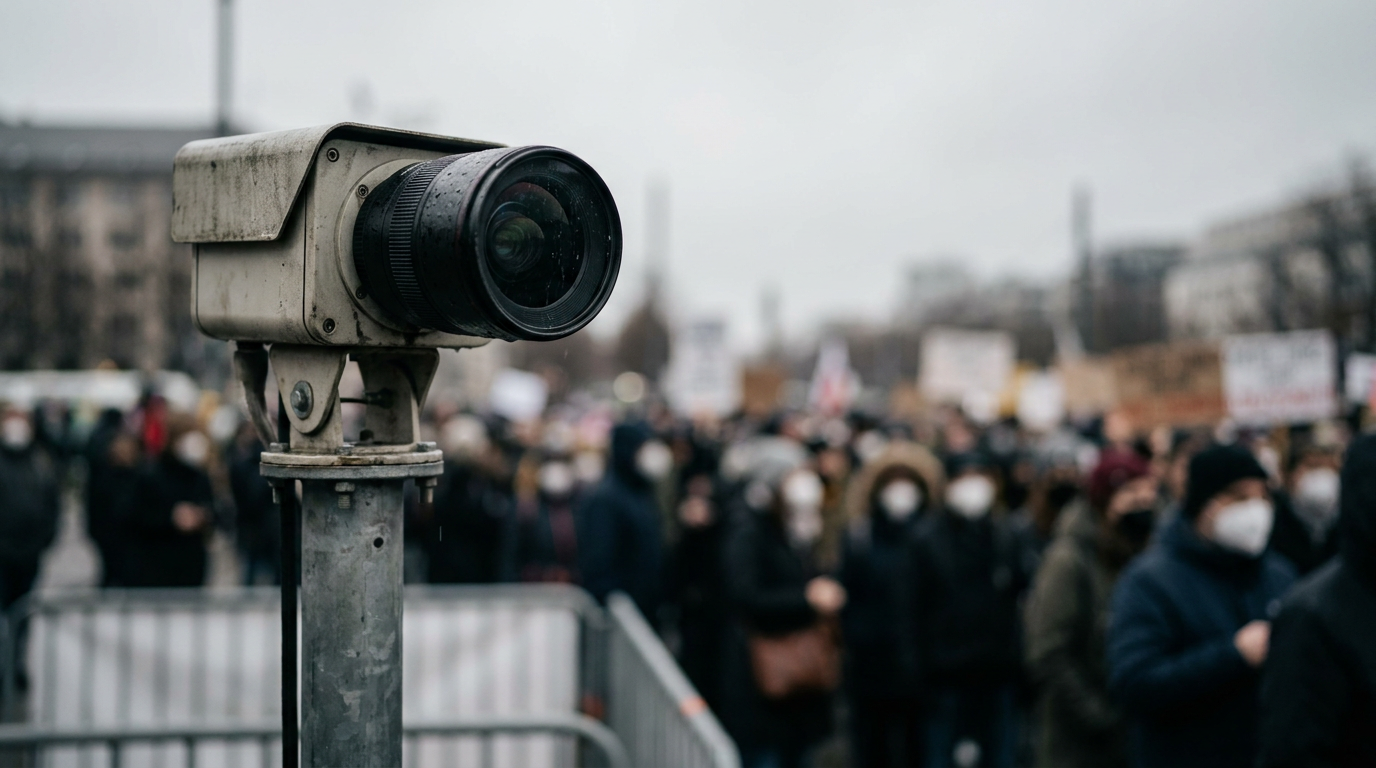
There is a standard move in the authoritarian playbook that gets skipped over because it sounds reasonable every single time it's used. A government announces that it needs better tools to manage unrest. There have been incidents, officials say. Public safety is at stake. The technology already exists. Why wouldn't a responsible government use it? The announcement comes with footage of broken windows, or a burned car, or a crowd that looks frightening on a camera phone. Then the facial recognition cameras go up. And everyone who was not at that protest exhales.
That exhale is the mechanism. Not the cameras. The exhale.
A 2025 study published in Frontiers in Political Science examined how contemporary authoritarian-populist regimes are legitimizing AI-powered surveillance — specifically facial recognition — through a security rationale applied first and most visibly to protest movements. The researchers analyzed the legislative frameworks, political rhetoric, and documented deployment patterns in Hungary, Turkey, and the United States, and found something that should puncture the comfortable assumption that surveillance is a targeted tool for targeted threats. The pattern is almost identical across all three countries: identify a politically legible threat, deploy the technology against that threat, normalize the infrastructure, and then let the infrastructure do what infrastructure does — expand.
This is not a conspiracy. It does not require a secret plan. It requires only that governments face no structural resistance when they decide that a protest movement is a security problem, that vendors want contracts, that the technology works well enough on the people least able to fight back in court, and that most citizens believe, sincerely and incorrectly, that the system being built around the edges of their lives will never reach the center of it.
The Protest as Laboratory
Protesters make ideal test subjects for surveillance infrastructure for reasons that are almost embarrassingly practical. They gather in public, where Fourth Amendment protections in the U.S. are thinnest. They are politically legible as a threat to at least some portion of the public, which makes deployment easier to justify. They often lack the legal resources for sustained constitutional challenges. And because they are already perceived by some as disruptive, the optics of surveilling them are far more manageable than the optics of, say, scanning the faces of churchgoers or commuters. The 2025 Frontiers study frames this through the lens of what scholars call biopolitical control — a concept drawn from Foucault but updated here to describe how modern states use biological identifiers, including faces, bodies, and movement patterns, to sort populations into categories of threat and compliance.
Hungary is the sharpest case study. Viktor Orbán's government embedded facial recognition into its broader smart-city and border security infrastructure, then activated it during protest moments with minimal legislative friction because the legal groundwork had already been laid under counterterrorism and public order statutes. The cameras were not introduced as protest cameras. They were introduced as security cameras. The protest application came later, quietly, as a matter of operational decision rather than new law. That distinction matters enormously: when surveillance expands through administrative discretion rather than legislation, there is no vote to stop it, no debate to win, no amendment to add.
“The cameras were not introduced as protest cameras. They were introduced as security cameras. The protest application came later, quietly, as a matter of operational decision rather than new law.”
Turkey's pattern is more aggressive and better documented. Following the 2013 Gezi Park protests and the 2016 coup attempt, the government dramatically expanded its biometric surveillance architecture. By the early 2020s, Turkish authorities were using facial recognition during protests with a speed and scale that suggested pre-built capacity, not improvised response. Critics, journalists, and opposition politicians were among those identified. The lesson the Frontiers researchers draw is not that Turkey became a surveillance state because of a protest. It is that the protest was the justification that unlocked infrastructure already waiting to be used.
What the American Version Looks Like
The United States case is more diffuse and more dangerous for that diffusion. Federal law enforcement used facial recognition during the 2020 Black Lives Matter protests — a fact established through reporting and FOIA requests, not official disclosure. Clearview AI's database, built by scraping billions of social media images without consent, was being used by law enforcement agencies while most of the public had no idea the company existed. The FBI, DHS, and dozens of local police departments were running faces through systems that had never passed through a legislature[3], never faced a public vote, and operated under guidance documents that amounted to internal policy rather than law.
This is where the American version diverges from the Hungarian or Turkish model in form but not in function. Orbán's government consolidated surveillance under state control. The U.S. distributed it across a fragmented patchwork of federal agencies, local police, fusion centers, private vendors, and data brokers — which makes it harder to name, harder to regulate, and harder for the public to locate as a coherent threat. The result is the same: a population of protesters scanned, identified, and entered into databases, with essentially no democratic authorization. As research on democratic backsliding has consistently found, the erosion of civil liberties rarely announces itself as erosion. It presents as modernization, security, efficiency, or simply as nothing — because the people it happens to first are rarely the people who write the headlines.
If you've read about how democracies slide without warning, this sequence will feel familiar. The mechanism is incremental. Each step looks defensible in isolation. The picture only becomes visible when you zoom out far enough to see the whole frame — and most political cultures are structurally resistant to that kind of zoom.
The False Positive Problem Is a Feature, Not a Bug
Facial recognition technology is not neutral in its errors. Research on algorithmic bias in face recognition systems has documented consistently higher false positive rates for Black faces, women, and darker-skinned individuals[1] — the same populations who are already most likely to be surveilled, arrested, and prosecuted at elevated rates by the existing criminal legal system. When a facial recognition system misidentifies someone at a protest, that error does not land in a vacuum. It lands on a person who is already standing in the path of a state that has decided protest is a security threat. Several documented wrongful arrests[2] in the United States have followed directly from facial recognition mismatches. The people wrongfully arrested were Black men.
This is worth sitting with: a technology that is less accurate on the people most likely to be targeted by the state is being deployed by the state specifically against protesters. The error is not an accident to be corrected before the system is used. The system is being used now, error rates and all. That tells you something about what the technology is actually for. Accuracy matters when the goal is truth. It matters less when the goal is deterrence — when the point is that people at protests know they may be scanned, may be identified, may be wrong-matched, and have to decide whether the cause is worth that risk. Chilling effects do not require accurate surveillance. They require credible surveillance. The threat is the point.
“Chilling effects do not require accurate surveillance. They require credible surveillance. The threat is the point.”
Security Rationale as Political Grammar
The 2025 Frontiers study is careful to distinguish between security as a genuine governmental function and security rationale as political grammar — a language that converts contested power moves into technical necessities. When Orbán deploys facial recognition at protests, he is not solving a crime problem. He is using the vocabulary of crime-solving to do something else: suppress visible opposition, shrink the space of legitimate dissent, and signal to potential protesters that the state is watching. When American officials defended facial recognition use during 2020 protests by citing public safety, they were speaking the same grammar in a different accent. The rationale is load-bearing. Without it, the deployment looks like what it is: a government using cutting-edge technology to identify and track its political opponents.
Understanding this grammar matters because the public's response to surveillance is mediated by framing in ways that are well documented in political psychology. Studies on political acquiescence and consent show that people accept restrictions on civil liberties at significantly higher rates when those restrictions are framed as protecting an in-group from an out-group threat — and that the willingness to accept them extends even when the restrictions affect the respondent's own freedoms, as long as the initial justification holds. The protest as a threat. The protester as a risk category. That framing does not just justify the deployment. It pre-empts the objection.
There is also something worth noting about the role of AI itself in this dynamic. The involvement of artificial intelligence in surveillance creates a specific kind of legitimacy effect: decisions made by algorithmic systems read as more objective, more neutral, and more authoritative than decisions made by individual officers. Research on how people perceive AI-generated judgments suggests that the machine framing suppresses skepticism and increases acceptance — which is precisely the wrong response when the machine is making consequential errors on a racially skewed distribution. The AI doesn't make it fairer. It makes the unfairness harder to argue with.
From the Margins Inward
The Frontiers researchers describe the movement of surveillance as centripetal: it begins at the political margins — protesters, immigrants, activists, religious minorities, journalists — and moves inward toward the general population as the infrastructure matures, the legal precedents accumulate, and the public's sense of threat or urgency either grows or is manufactured. This is not a theoretical prediction. It is a description of what has already happened. The surveillance architecture built to track undocumented immigrants has been used against citizens. The databases built to monitor extremist groups have swept in ordinary political organizations. The tools designed for counterterrorism have been turned on labor organizers, environmental activists, and racial justice movements. The targeting begins narrow. The infrastructure does not stay narrow.
The concept of acquiescence as a political mechanism is relevant here in a precise way. It is not that the public enthusiastically endorses each step. It is that each step is small enough, and targeted at a marginal enough group, that active resistance never quite crystallizes. By the time the infrastructure is broad enough to affect people who thought they were safely outside its scope, it is also entrenched enough that reversing it requires a political will that the entrenchment itself has been quietly eroding.
What the Pattern Requires You to Believe
“The surveillance state does not need your permission. It needs your indifference — and it has spent years making indifference feel like the reasonable position.”
To be comfortable with what the 2025 Frontiers study describes, you have to believe several things simultaneously. You have to believe that governments will use expansive surveillance powers only against people who actually deserve it. You have to believe that technology with documented racial bias will be applied fairly. You have to believe that infrastructure built without democratic authorization will remain subject to democratic limits. You have to believe that the countries in this study — Hungary, Turkey, the United States — are fundamentally different in kind, not just in degree, from one another. And you have to believe that you, specifically, are not the kind of person who will ever end up in the wrong database at the wrong moment, attending the wrong event, standing near the wrong person, holding the wrong sign.
None of those beliefs survive contact with the evidence. The surveillance state does not need your permission. It needs your indifference — and it has spent years making indifference feel like the reasonable position, the moderate position, the position of people who have nothing to hide and therefore nothing to fear. That phrase — nothing to hide, nothing to fear — is not a reassurance. It is a confession of what the system requires: a public that has already accepted the premise that surveillance is legitimate, that the state decides who hides what, and that the cost of dissent includes having your face stored in a government database forever. The protesters were first. The question the research forces is simple and uncomfortable: who is next, and what will you have already agreed to by the time it's you?
References
- NIST Study Evaluates Effects of Race, Age, Sex on Face Recognition Software (nist.gov)
Provides evidence that face recognition algorithms exhibit higher error rates across demographic groups, with differentials affecting accuracy for Black faces and women. - Police surveillance and facial recognition: Why data privacy is imperative for communities of color (brookings.edu)
Documents wrongful arrests in the United States resulting from facial recognition mismatches, with victims being Black men. - Six Federal Agencies Used Facial Recognition On George Floyd Protestors (vice.com)
Establishes that six federal agencies including the FBI used facial recognition on images from 2020 Black Lives Matter protests during May–August 2020. - Clearview AI Offered Thousands Of Cops Free Trials (buzzfeednews.com)
Documents that over 7,000 law enforcement individuals from nearly 2,000 agencies used Clearview AI's scraped database to search faces, including Black Lives Matter protesters.
About Rafael Tomlin
Rafael Tomlin writes about current politics from a fiercely populist perspective: pro-worker, pro-renter, anti-billionaire capture, anti-authoritarian, and deeply hostile to the machinery that turns public life into cruelty for profit. His work focuses on power, policy, class, democracy, corruption, and who actually pays when political theater becomes law.
More like this
Democracies Don't Warn You Before They Stop Being One
Political scientists have spent two decades mapping exactly how democracies die without a coup — and the indicators they built now point at the United States.
Institutional Collapse Doesn't Look Like a Coup. It Looks Like Everyone Deciding Not to Fight.
Political scientists have a name for the pattern where courts, corporations, universities, and legislators each decide individually that resistance isn't worth it — and the math of those private surrenders adds up to the end of accountability itself.
Republicans Are Happier Under Authoritarianism. That's Not a Paradox.
A psychological concept called 'person-environment fit' explains why some voters thrive under conditions that look, from the outside, like democratic collapse.