The Quiet Way Rigged Maps Convince People Democracy Is Pointless
A new study finds that rigged district maps don't just distort who wins — they drain the public's belief that showing up matters at all.
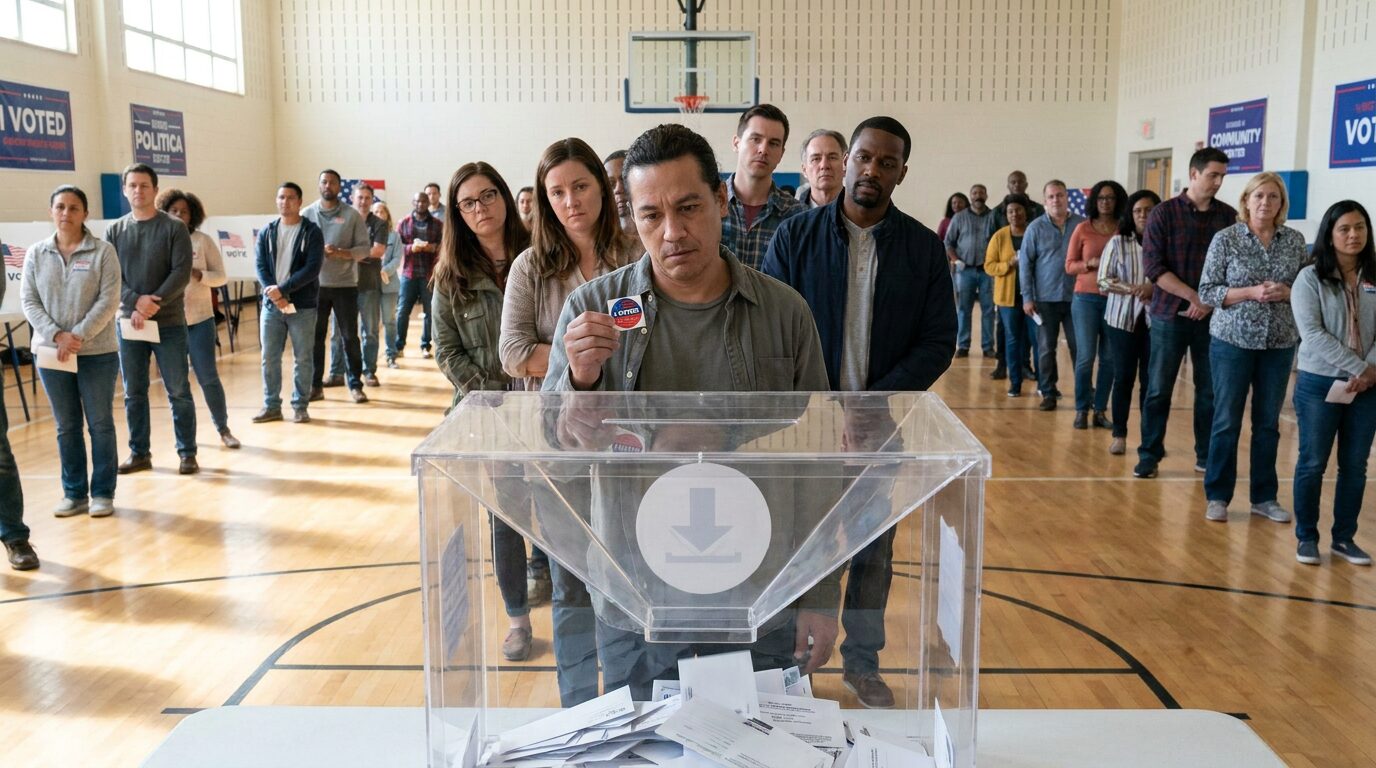
Think about the last time you tried to participate in something where the outcome felt fixed before you started. Not necessarily corrupt in a dramatic, FBI-raid kind of way. Just — quietly, structurally tilted. You knew the rules nominally allowed for your participation, but the architecture of the thing made your participation essentially decorative. If you're honest about it, you probably stopped showing up. Or you kept showing up but with less. Less energy, less money, less faith that it mattered.
That's not apathy. That's a rational response to a system that has communicated, through its design, that your input is optional. And according to a new peer-reviewed study led by UC Riverside political scientist Shaun Bowler, published in Political Research Quarterly[1], that is precisely what partisan gerrymandering does to American voters — including the ones whose party is doing the gerrymandering.
The Cost Isn't Just Bad Maps — It's Lost Belief
Gerrymandering, for those who need the quick version: every ten years, after the census, states redraw their congressional and legislative district boundaries. Historically, state legislatures handled this. They still do in many places. And when the party in power draws the lines, they tend to draw them in ways that make it very difficult for the other party to win — regardless of how voters actually feel. The technical measure Bowler's team used is called the "Efficiency Gap,"[2] which captures how many votes each party "wastes" under a given map. A high efficiency gap means one party's votes are systematically diluted. The other party's voters are packed into districts where they win easily, and the opposition is cracked across districts where they can never quite reach a majority. It is, by design, a system that makes certain votes matter less.
What the research adds — and this is the part that should bother everyone — is what that structural manipulation does to democratic faith at scale. Bowler's team drew on two large YouGov surveys of registered voters: a 2020 survey of 18,200 respondents and a 2022 survey of 10,200, both weighted to reflect the national voting population with at least 200 respondents from every state and the District of Columbia. They linked survey responses to the MIT Elections Performance Index, which scores states on measurable markers of election quality — ballot rejection rates, post-election audits, online voter registration tools, and similar indicators. They also incorporated U.S. Department of Justice conviction rates for public officials from 2011 to 2020 as a measure of actual governmental corruption. The picture that emerged: when voters perceive elections as predetermined by politicians rather than decided by the people casting ballots, they disengage. They donate less. They volunteer less. They stay home.
“When people believe elections are predetermined by politicians, rather than decided by voters, they may be less inclined to donate to candidates, volunteer, or even show up at the polls.”
Why Even Winners Feel Cheated
Here is the detail that makes this study genuinely interesting rather than just politically convenient for one side: the disillusionment crosses party lines. Bowler put it plainly. "Even if you're a Republican in Texas, you know cheating went on," he said. "If the referee is always on your side, did you really win the game? When a representative wins this way, it is like being awarded a trophy you didn't earn." That's a psychologically precise observation. There is a particular hollowness to a victory that didn't require you to actually persuade anyone. The legitimacy of a win depends partly on the process that produced it. When the process is visibly bent, even beneficiaries sense that something is off — that the win doesn't mean what wins are supposed to mean.
This connects to something that financial psychology and behavioral research have documented in adjacent contexts for years: people aren't purely outcome-oriented. They care, often intensely, about procedural fairness. An outcome that arrives through a process perceived as rigged tends to generate resentment, even when the outcome is favorable to the person evaluating it. The feeling isn't quite guilt — it's closer to a nagging sense that the transaction was false, that the legitimacy wasn't real. In politics, that feeling scales. When enough people carry it, the system itself loses the credibility it needs to function. This is what researchers mean when they talk about democratic legitimacy as a public good — something that, once depleted, is very hard to rebuild. And like most public goods, it tends to erode quietly, incrementally, without any single dramatic moment you can point to.
The Disengagement Loop
The mechanism Bowler's research points toward is a kind of disengagement loop. Gerrymandering signals to voters that the game is settled before it starts. That signal, absorbed widely enough, reduces the felt value of participation. Lower participation then makes it easier for entrenched majorities to hold power — which reinforces the sense that elections don't really decide anything. Which further reduces participation. You can see the structural parallel to other areas of civic and financial behavior: when people believe a system is fundamentally stacked against them, they stop investing in it. Not because they are lazy or uninformed, but because the expected return on their effort has been communicated to be essentially zero.
This kind of rational withdrawal is often misread as apathy or cynicism, which are moral categories that imply something is wrong with the disengager. But what Bowler's research suggests is that voter disengagement, at least in gerrymandered environments, is better understood as a calibrated response to genuine signals. The map itself is the communication. It says: your vote has been routed around. And people hear that, even when they can't name the Efficiency Gap or explain redistricting law.
What Independent Commissions Actually Change
The research is also consistent with an emerging argument for independent redistricting commissions — bodies that draw district maps with varying degrees of separation from state legislatures. As political scientist Bruce Cain has observed, "commissions generally vary in their separation from elected officials and their ability to enact district boundaries autonomously. The independent citizen commissions are the culmination of a reform effort to limit the conflict of interest implicit in legislative control over redistricting.[2]" Bowler's findings don't prove a direct causal chain, but they are consistent with the idea that removing the conflict of interest produces better civic outcomes — including higher participation in elections and maps that allow for actual shifts in power rather than entrenched majorities. Where commissions have been implemented, the 2024 results suggested that maps drawn outside of legislative control tended to more accurately reflect statewide voter preferences, with power actually moving when voters moved.
“The map itself is the communication. It says: your vote has been routed around.”
None of this resolves the political fights over redistricting, which are fierce, ongoing, and, as of August 2025, very much alive — the Texas State Capitol was still fielding proposed maps as this research was published. But what the study clarifies is that the costs of partisan gerrymandering are not just representational. They are psychological. They accumulate in the beliefs people carry about whether democratic participation is worth their time, money, and effort. And once people have decided that showing up doesn't matter — that the referees are captured, that the outcome was written before they walked in — getting them back is not simply a matter of drawing better lines. The belief, once established, tends to persist even when the conditions that produced it change. That's the part that should concern everyone, regardless of which party currently holds the pen.
References
- Gerrymandering erodes confidence in democracy (news.ucr.edu)
Provides the peer-reviewed study finding that partisan gerrymandering undermines public faith in elections and democratic legitimacy. - The Turnout Effects of Redistricting Institutions (brennancenter.org)
Explains that independent redistricting commissions represent a reform effort to separate district-drawing from legislative control and reduce conflicts of interest.
About Rafael Tomlin
Rafael Tomlin writes about current politics from a fiercely populist perspective: pro-worker, pro-renter, anti-billionaire capture, anti-authoritarian, and deeply hostile to the machinery that turns public life into cruelty for profit. His work focuses on power, policy, class, democracy, corruption, and who actually pays when political theater becomes law.
More like this
The Redistricting War Has a Winner. It's Not Voters.
A 2026 Supreme Court ruling reshaped the rules of political mapmaking, and the damage it's about to do runs deeper than any single congressional district.

Democracies Don't Warn You Before They Stop Being One
Political scientists have spent two decades mapping exactly how democracies die without a coup — and the indicators they built now point at the United States.
What Separates People Who Follow News From People Who Actually Act on It
A new Pew survey sorted Americans into four civic types — and the gap between watching public life and actually living it is wider than you might expect.