3I/ATLAS Came From Another Star. Its Chemistry Doesn't Match Anything We Know.
The third confirmed interstellar object has a carbon-dioxide-to-water ratio unlike any comet in our solar system — and the leading explanation is that it's been drifting alone for longer than Earth has existed.
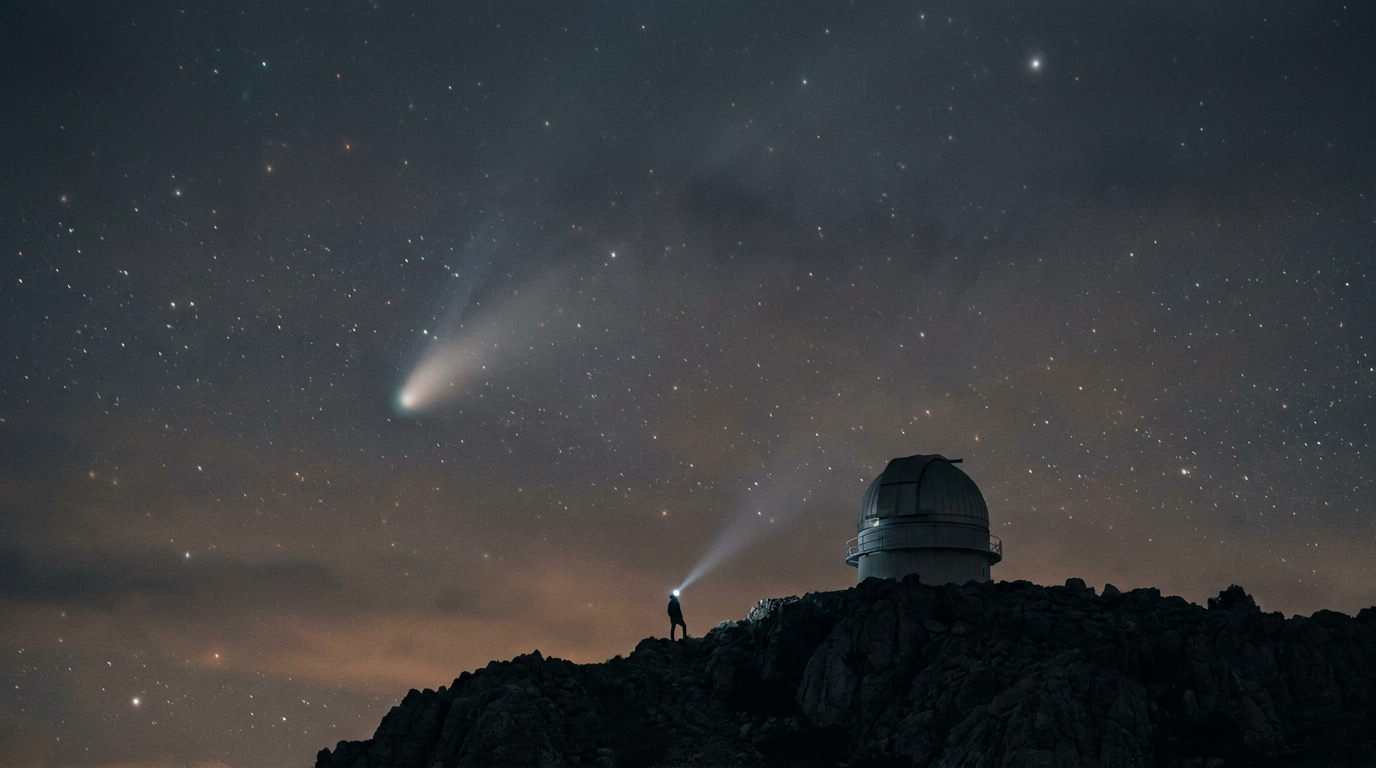
On the morning the alert went out, the object had already been tracked for less than forty-eight hours. The ATLAS survey system — Asteroid Terrestrial-impact Last Alert System[4] — caught it crossing the inner solar system on a trajectory that required no calculation to recognize as wrong. The path was hyperbolic, steep enough that no gravitational nudge from Neptune or Jupiter could account for it. The object was not bound to the sun. It had not originated here. By the time astronomers confirmed its interstellar provenance and logged it as 3I/ATLAS, the scientific community was already lining up time on every available telescope, because the window to study it was short and the object, they suspected, would be extraordinary.
They were right, though not in the way many expected. What emerged from the early spectroscopic observations was not an exotic mineral signature or an impossible spin rate or an object shaped like a thin metallic needle — the stuff of quick imaginative leaps. What emerged was a ratio. Carbon dioxide against water, measured in the object's coma as solar heating began boiling its surface volatiles off into space. That ratio was high. Unusually high. Higher than any cometary measurement on record from solar system bodies, by a margin too large to wave away as instrument uncertainty or favorable geometry. The chemistry of 3I/ATLAS does not match anything catalogued from our own neighborhood.
The solar system has had three confirmed interstellar visitors now. The first, 1I/'Oumuamua, passed through in 2017 and produced a controversy that has not fully quieted — no coma, anomalous acceleration, a shape that was alternately described as pancake-flat and cigar-elongated depending on which model you trusted. The second, 2I/Borisov, arrived in 2019[3] and behaved considerably more like a familiar comet, releasing water and carbon monoxide in patterns that, while not perfectly mirroring anything in our catalog, at least sat within a recognizable range. 3I/ATLAS is something else. Where Borisov was strange but legible, this object looks like it is from a different compositional vocabulary entirely.
Understanding why requires stepping back from the anomalous number and asking what it means, physically, for a small body to carry that signature. Carbon dioxide and water ice are both common volatiles, both present in comets throughout the solar system, but they do not survive in the same proportions everywhere or forever. They are altered by heat, by radiation, by time, and by the environments a body passes through on its way from formation to detection. When the ratio tips this far, it is telling you something about the object's history — its origin, its age, or both. The leading interpretation, now circulating through preprint servers and conference discussions, is that 3I/ATLAS may have been traveling through the interstellar medium for something close to seven billion years.
What the Ratio Is Actually Measuring
In a freshly formed comet, water ice is typically the dominant volatile. It freezes early in a protoplanetary disk, is abundant, and is stable under the cold pressures of the outer solar system. Carbon dioxide is also present, but in smaller fractions. The ratio shifts over time through a process called volatile stratification: as a comet ages and cycles through heating events, the more volatile compounds — including carbon dioxide — can become preferentially depleted from near-surface layers, or conversely, can become concentrated if water is lost faster through other mechanisms. In solar system comets, the CO2-to-H2O ratio generally sits within a well-characterized band. It varies, but it clusters. 3I/ATLAS is not clustering. It is outside the band.
The interstellar medium is not empty space in any useful sense. It is a low-density environment threaded with cosmic rays, ultraviolet radiation from distant stellar sources, and sparse clouds of gas and dust. Over geological timescales, exposure to cosmic ray bombardment drives chemistry on icy surfaces — a process known as radiolysis[2]. High-energy particles penetrate ice, break molecular bonds, and trigger recombinations that produce new compounds. In laboratory simulations of icy grain irradiation, carbon dioxide can accumulate as a radiolytic product within water-rich ice matrices. Extended exposure — across billions of years, across the full transit from one stellar system toward another — could plausibly produce a surface composition that looks unlike anything that spent its life in the relative shelter of a solar neighborhood.
“Seven billion years of cosmic ray exposure does not leave an object unchanged. It rewrites the surface chemistry, molecule by molecule, until what you're reading is a record of deep time rather than a record of formation.”
This is, it must be said, an inference, not a confirmed mechanism for this specific object. The radiolysis hypothesis is well-grounded in laboratory astrochemistry and has been applied to interstellar grain chemistry for decades. Extending it to explain a measured CO2-to-water anomaly in an interstellar object is a reasonable extrapolation, but it has not been tested against 3I/ATLAS data with sufficient modeling depth yet. What researchers can say with confidence is that the ratio is real, that it is anomalous by any comparative solar system standard, and that prolonged interstellar transit under radiation provides a physically coherent framework for explaining it. The alternative — that 3I/ATLAS formed in a stellar system where this ratio was the native starting condition — is possible but harder to model, because no known planet-forming environment produces that signature at formation.
The Age Problem and Why Seven Billion Years Is Not a Guess
The figure of seven billion years is not arbitrary. It comes from back-of-the-envelope transit time estimates that combine the object's velocity relative to the local standard of rest — a measure astronomers use to gauge motion against the average of nearby stars — with plausible source distances. 3I/ATLAS is moving fast enough, and from a direction consistent enough with the general flow of stars in this galactic neighborhood, that its ejection from a parent system in the early Milky Way is a workable scenario. Planetary systems eject small bodies constantly. During the formation of our own solar system, billions of comets were flung into the Oort Cloud or fully unbound by gravitational interactions with the gas giants. Every stellar system probably does this. The galaxy is littered with the refugees of other people's planet formation, and occasionally one of them arrives here.
Seven billion years is roughly the age of Earth, plus a few hundred million years. It predates the formation of our solar system. If the transit time estimate holds — and it is an estimate, not a measurement; we cannot directly clock how long an object has been in flight — then 3I/ATLAS was already drifting through the dark when the sun was still a protostellar cloud. The radiolysis accumulation over that kind of span is not trivial. Laboratory experiments suggest that cometary analogs irradiated for equivalent durations at interstellar cosmic ray flux rates do show elevated oxidized carbon fractions, which CO2 represents. The numbers are imprecise, the scaling uncertain, but the directional arrow points the right way: long exposure should produce a surface chemistry skewed in exactly the direction this object appears to be skewed.
What Spectroscopy Can and Cannot Tell Us
“A spectrum is not a biography. It tells you what is outgassing now, from the layers that solar heating can reach — not what the interior holds, not where the object was born, and not what it looked like a billion years ago.”
The coma is the key observational resource here, and it has real limits. As 3I/ATLAS approached perihelion — its closest point to the sun — increasing solar flux drove sublimation from its surface, releasing gases that spectroscopes could resolve into molecular signatures. Carbon dioxide at 4.26 micrometers[1], water at multiple infrared bands, traces of other species beginning to resolve in high-sensitivity observations. The ratio is measured in what is coming off right now, from the upper layers of the nucleus. Cometary interiors are compositionally stratified. The surface is processed by every thermal event; the deep interior, if cold and compressed enough, may preserve something closer to the original formation mix. We are reading the biography of the object's skin, not its core.
This creates a genuine interpretive tension. If radiolysis reshaped the surface chemistry over seven billion years of interstellar transit, the CO2 elevation may reflect that processing rather than something native to 3I/ATLAS's home system. But if the parent system genuinely formed objects with high initial CO2 fractions — perhaps because it had different temperature gradients in its disk, or a different carbon-to-oxygen ratio in its constituent cloud — then what we are reading is a formation signal rather than a transit signal. Disentangling these two possibilities from outgassing measurements alone is a classification problem that current data cannot fully resolve. Researchers are looking for secondary tracers: the isotopic ratios of carbon and oxygen, the presence of specific radiolytic products like CO3 or carbonic acid traces, the relative abundance of carbon monoxide versus carbon dioxide, which respond differently to thermal and radiative processing.
Why Borisov Comparison Matters More Than It Looks
2I/Borisov is the closest thing to a control case we have. When it passed through in 2019, astronomers were able to measure its composition in some detail, and what they found was, broadly, comet-like. It had water, carbon monoxide, a reasonably familiar distribution of activity with heliocentric distance. Its dust-to-gas ratio was within the solar system range. Some researchers found its CO abundance slightly elevated, but the object did not require any extraordinary chemistry to explain. The interpretation was that Borisov had either spent less time in the interstellar medium, or had originated in a system with broadly similar conditions to our own, or both. It fit. It was weird in trajectory, not weird in substance.
3I/ATLAS does not fit. That divergence is useful. It suggests that interstellar objects are not a single population with a single chemistry. They are a sample — biased toward whatever sizes and compositions survive ejection and transit — drawn from the full diversity of planetary systems and interstellar dwell times across the galaxy. Borisov and 3I/ATLAS may represent two ends of a distribution whose shape we cannot yet see because we have three data points total, one of which, 'Oumuamua, was so strange in so many ways that it arguably occupies its own category. Three objects do not make a population study. But they begin to suggest that composition variance in interstellar visitors may be large, and that the chemistry we think of as normal — solar system normal — may be a local condition rather than a universal one.
The Window Closes, and What Gets Left Behind
“The object does not slow down, and it does not wait. Every day of delay is data lost to geometry, distance, and fading signal.”
The observational window on 3I/ATLAS is finite and shrinking in real time. As it moves away from perihelion, solar heating drops, outgassing slows, the coma thins, and the spectral signal degrades. Ground-based observatories are racing to accumulate high-resolution spectra while the object is still bright enough to yield isotopic measurements. Space assets — including telescopes with infrared sensitivity that cuts through thermal confusion — have been redirected where possible. Whether the data collected over this window will be sufficient to distinguish between the radiolysis-reprocessed-surface interpretation and the exotic-natal-chemistry interpretation is genuinely uncertain. The answer may not come from this pass. It may come from modeling work done over the next several years, once the full spectral dataset has been processed and compared against improved laboratory radiolysis experiments.
That is the honest shape of where this stands: a confirmed anomaly, a physically coherent leading explanation, a set of secondary predictions that may or may not be testable with current data, and an object already moving back into the dark. What gets left behind is not a solved mystery. It is a sharper question. The CO2-to-water ratio in 3I/ATLAS marks it as compositionally unlike anything our solar system produced — and that difference is either a message from another star's formation conditions or a record of seven billion years of radiation writing slowly on ice. Both possibilities are strange. Both are, in their own way, worth taking seriously. The universe spent a long time making this object before sending it through here, and we had a few months to read it. That we came away with an unresolved anomaly instead of a clean answer is not a failure. It is, as it usually is in this field, where the real work begins.
References
- How Open NASA Data on Comet 3I/ATLAS Will Power Tomorrow's Discoveries - NASA Science (science.nasa.gov)
Provides the spectroscopic measurement of carbon dioxide at 4.26 micrometers in 3I/ATLAS's coma during perihelion approach. - Radiolysis of H2O:CO2 ices by heavy energetic cosmic ray analogs (aanda.org)
Establishes the scientific basis for radiolysis, the process by which cosmic rays alter ice composition over geological timescales. - The carbon monoxide-rich interstellar comet 2I/Borisov (nature.com)
Provides context that 2I/Borisov, the second interstellar comet, arrived in 2019 and behaved like a familiar comet with recognizable volatile patterns. - ATLAS - The ATLAS Project (atlas.fallingstar.com)
Describes the ATLAS survey system that detected 3I/ATLAS crossing the inner solar system on a hyperbolic trajectory.
About Rowan Ellery
Rowan Ellery writes about anomalies, unexplained sightings, strange signals, and the uneasy border between observation, misinterpretation, and genuine mystery. Their work focuses on keeping curiosity alive without letting evidence dissolve into folklore.
More like this
An Interstellar Comet Crossed Our Solar System. We Had 12 Spacecraft Ready.
Comet 3I/ATLAS is only the third object ever confirmed to have crossed into our solar system from another star — and unlike the first two, we had an entire fleet waiting for it.
3I/ATLAS Left Our Solar System. Its Water Stayed Strange.
A new ALMA study found that 3I/ATLAS carries water with a deuterium ratio far outside anything measured in our solar system — and what that number actually means is stranger than the spacecraft headlines ever were.
The Object From Interstellar Space Got Scanned for Signals. Here's What Was Actually Found.
Breakthrough Listen and the SETI Institute both pointed instruments at 3I/ATLAS — and the null result tells us something specific, limited, and genuinely worth understanding.