The Cruel Bargain of a Sharp Mind: Years of Protection, Then Sudden Decline
Cognitive reserve delays dementia symptoms by years — but the same buffer that buys time may compress what comes after into something far more brutal.
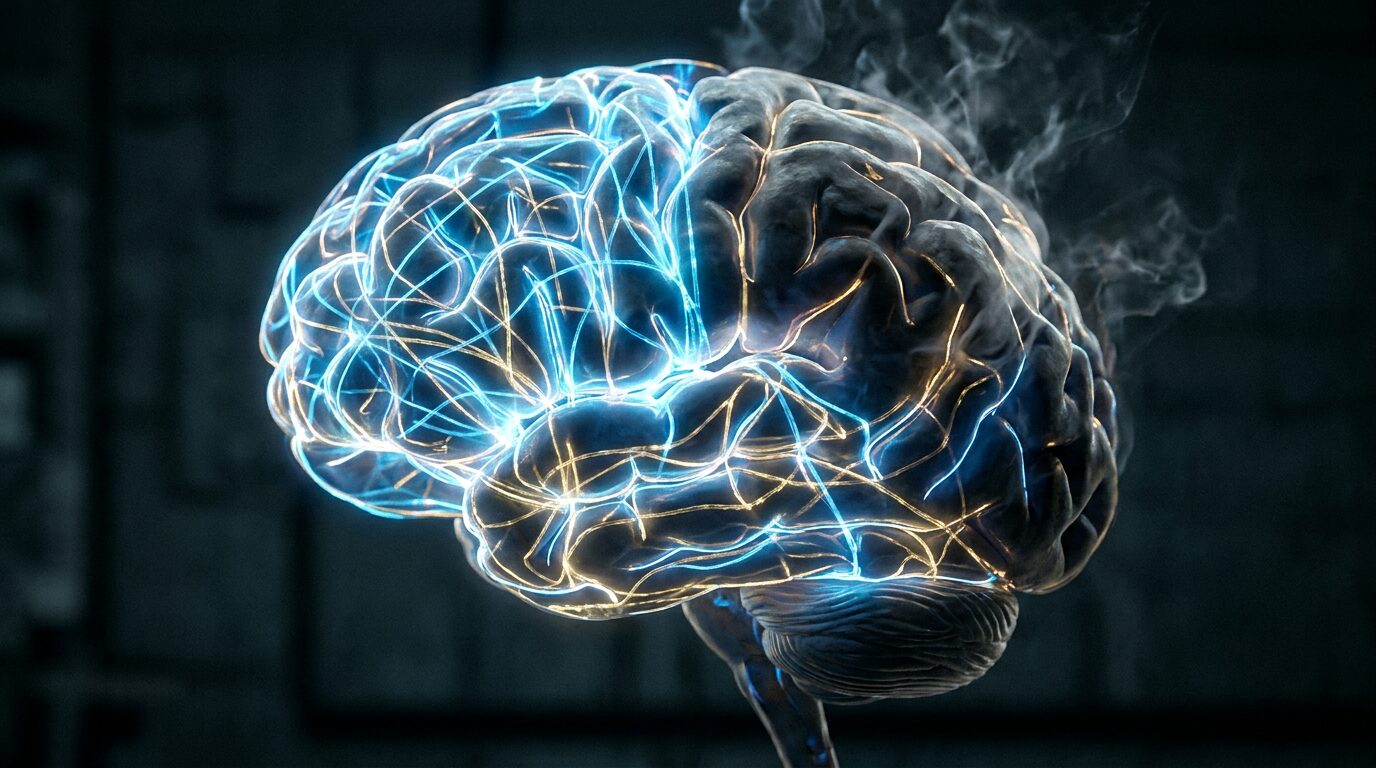
The story about cognitive reserve is almost too satisfying to question. Stay curious. Keep learning. Speak two languages. Read widely, work with your hands, stay socially connected. Do these things across a lifetime, and your brain accumulates a kind of structural padding — redundant neural networks, denser synaptic connections, more efficient routing — that lets it absorb damage quietly, without showing symptoms, for longer than a brain that never built the same reserves. Decades of longitudinal research have confirmed the basic outline[2]. Education and lifelong mental engagement genuinely do delay the clinical onset of dementia. The evidence here is real, and it matters.
But there is a second finding woven into the same data, one that gets far less airtime in wellness culture and cognitive-health coverage: people with higher cognitive reserve tend to decline more steeply once dementia does announce itself. The buffer holds longer — and then it gives way faster. Whether this represents a genuine biological paradox or a statistical artifact of how we measure and define decline is still an active area of inquiry, but the pattern has appeared consistently enough across different populations and study designs to deserve an honest look. Understanding it does not undermine the case for building cognitive reserve. It complicates and deepens it.
What Cognitive Reserve Actually Means
Cognitive reserve is not a single structure you can point to on a brain scan. It is more like a functional property — the brain's capacity to tolerate accumulated pathology without translating that pathology into measurable cognitive symptoms. The concept emerged partly from postmortem observations that some individuals whose brains showed extensive Alzheimer's-type changes had shown little or no cognitive impairment while alive[6]. Their brains were damaged by any neuropathological measure, but they had somehow kept functioning. The working explanation is that years of demanding mental activity had built networks dense and redundant enough to route around the damage, at least for a while. Education level, occupational complexity, bilingualism, and sustained intellectual engagement are the factors most consistently associated with higher reserve in the research literature, though they likely serve as proxies for something more fundamental: the cumulative volume and variety of cognitive demands placed on the brain over a lifetime.
This is worth being precise about, because reserve is often conflated with brain volume, general intelligence, or raw cognitive performance — none of which are quite the same thing. A brain with high reserve is not necessarily the largest or fastest brain. It is, in the relevant sense, the most flexible one: capable of sustaining function even as underlying pathology quietly accumulates. As pieces like our coverage of what the aging brain does well have noted, cognitive aging is uneven by design, and reserve is part of what explains that unevenness.
The Threshold Problem
Here is where the story gets more complicated. If cognitive reserve works by allowing the brain to absorb damage without showing symptoms, then by the time symptoms do appear in a high-reserve individual, the underlying damage has likely progressed further[1] than it has in a lower-reserve individual who reached the clinical threshold earlier. The higher-reserve brain held the line longer — but it held it while the pathology kept spreading. When the reserve finally runs out, there may be substantially more disease to reveal.
“The buffer holds longer — and then it gives way faster. The higher-reserve brain held the line while the pathology kept spreading.”
This is the threshold model, and its implications are not comfortable. Delayed symptom onset is genuinely good — it preserves years of functional independence, relationship capacity, and quality of life. That benefit is real and should not be minimized. But if delay comes paired with a steeper trajectory after the threshold breaks[3], then the window between first noticeable symptoms and severe impairment may be compressed in people who built the most reserve. They appear sharp for longer. They deteriorate faster once it starts. The clinical and practical implications of that tradeoff are significant, and they are not adequately captured by the simple message of "build more reserve."
It is worth being honest about what the evidence does and does not yet settle here. The steeper-decline pattern is a consistent observation in longitudinal datasets, but the mechanistic explanation remains contested. Some researchers argue it reflects pure mathematics: if you are diagnosed later in the disease course, you have less time and neural tissue remaining before reaching severe impairment. Others suggest there may be something about the high-reserve brain's compensatory strategies that makes the eventual unraveling more abrupt — that the rerouting and redundancy that delay symptoms also make the eventual failure less gradual. These are different claims with different implications, and the research has not cleanly separated them yet.
The Role of Social Isolation in This Picture
One reason this matters beyond academic neuroscience is what it implies about the social determinants of cognitive health. The same social circumstances that build cognitive reserve — stable employment, access to education, rich social networks, occupational complexity — also protect against the depression, loneliness, and chronic stress that independently accelerate cognitive decline. Research on the social determinants of mental health[5] has documented the connections between social isolation and depression onset across the life course, with longitudinal evidence pointing toward pathways from isolation to loneliness to subsequent depression and anxiety symptoms — and emerging cross-sectional associations between loneliness and dementia risk as well.
This matters for the cognitive reserve story because reserve is not built in isolation, literally or figuratively. The activities that accumulate reserve — sustained learning, bilingual conversation, occupationally demanding work, collaborative intellectual engagement — are mostly social activities, or they unfold in social contexts. Strip away the social scaffolding and you strip away much of what made those activities cognitively demanding in the first place. A retired professor who loses professional community, stops teaching, and becomes socially isolated is not banking the same reserve per year that she was at fifty. The reserve she built remains, but the maintenance is disrupted.
Research on the default mode network[4] has shown that individuals at risk for depression may preferentially engage self-referential brain circuitry when processing negative information — a pattern associated with rumination that may represent an underlying neurocognitive vulnerability. Loneliness and social withdrawal promote exactly the kind of ruminative, inward-facing mental activity that engages that circuitry without providing the varied, externally demanding cognitive load that builds and sustains reserve. It is a different kind of mental busy-ness, one that does not appear to confer the same neuroprotective benefit.
What This Changes About the Reserve Conversation
None of this argues against building cognitive reserve. The case for education, lifelong learning, social connection, and cognitive engagement remains solid, and the years of functional independence that reserve can provide are not trivial. But the threshold model does shift what the goal should be understood as. If reserve primarily delays the symptomatic threshold while leaving underlying pathology free to accumulate, then reserve-building is most valuable when paired with active efforts to detect and slow that underlying pathology — vascular risk reduction, sleep quality, metabolic health, inflammation control — rather than treated as a standalone strategy that manages the problem on its own.
Put differently: reserve is a buffer, not a cure, and it is not an infinite one. The smarter framing is to build the buffer while also working on the conditions that determine how much pathology accumulates during the years the buffer is doing its job. Circadian rhythm and sleep quality matter here in ways that are increasingly well-documented. Vascular health matters. Metabolic health matters. These are not as narratively satisfying as the story of the brilliantly educated mind that holds dementia at bay through sheer intellectual force, but they are closer to what the biology actually supports.
“Reserve is a buffer, not a cure. The smarter framing is to build it while also working on what determines how much pathology accumulates while it holds.”
There is also a clinical implication worth naming plainly. If high cognitive reserve can mask significant underlying disease — meaning that a person presents as sharp even as Alzheimer's pathology advances — then relying on behavioral symptoms alone to trigger evaluation may systematically delay diagnosis in exactly the people who built the most reserve across their lives. The irony is pointed: the very habits that define a cognitively healthy life may also be the habits that make it hardest to catch the disease early enough for intervention to matter. That is not an argument against those habits. It is an argument for not letting them make clinicians or patients overconfident about what the absence of symptoms actually means.
The brain's capacity to compensate is genuinely one of its most remarkable features. That compensation is hard-won, built across decades of demanding experience, and it confers real protection that should not be dismissed. But compensation is not the same as prevention, and a brain that has been working harder to appear intact than it actually is may be closer to its limit than anyone — including the person inside it — realizes. That uncertainty is worth sitting with honestly, rather than letting the triumph narrative of "build more reserve" paper over it.
References
- Cognitive reserve and clinical progression in Alzheimer disease (neurology.org)
Demonstrates that by symptom onset, high-reserve individuals have accumulated more underlying pathological damage than lower-reserve individuals diagnosed earlier. - Cognitive reserve over the life course and risk of dementia: a systematic review and meta-analysis (pmc.ncbi.nlm.nih.gov)
Provides systematic review and meta-analysis evidence that education and lifelong mental engagement delay dementia's clinical onset. - steeper trajectory after the threshold breaks (academic.oup.com)
Provides evidence that high-reserve individuals show steeper cognitive decline trajectories after symptom onset compared to lower-reserve individuals. - The default mode network and rumination in individuals at risk for depression (pmc.ncbi.nlm.nih.gov)
Shows that individuals at risk for depression engage self-referential brain activity when processing negative information, illustrating the ruminative pattern the article contrasts with cognitively demanding reserve-building activities. - The social determinants of mental health and disorder: evidence, prevention and recommendations (pmc.ncbi.nlm.nih.gov)
Documents causal links between social circumstances and mental health outcomes, supporting the article's claim that social isolation accelerates cognitive decline. - Cognitive reserve (en.wikipedia.org)
Documents postmortem cases where individuals with extensive Alzheimer's pathology showed little cognitive impairment while alive, establishing the cognitive reserve concept.
About Marcus Okafor
Marcus Okafor covers general wellness, brain health, cognitive aging, sleep, and the biology of staying sharp across a lifetime. His work traces how the body and mind maintains, loses, and sometimes rebuilds — from the nitty gritty science of your bones — to the strange frontiers of the glymphatic system flushing toxins overnight — to the way imagined conflict primes the same stress circuitry as the real thing.
More like this

Your Brain at 65 Is Better Than You Think at These Specific Things
Some cognitive abilities don't just survive aging — they actually improve, and knowing which ones changes what brain health should mean after midlife.
Chronic Loneliness Rewires the Brain — And the Damage Is Not Metaphorical
Prolonged social isolation doesn't just feel bad; it triggers a cascade of stress signaling and neuroinflammation that measurably reshapes the aging brain.

Your Ears Are Going Quiet. Your Brain Is Already Paying the Price.
Untreated hearing loss doesn't just leave you straining to hear — it quietly reshapes the brain in ways that look a lot like early dementia.