Cognitive Load
The total mental effort your brain uses to process information. When tight finances create a 'background process' of tracking cash, this load reshapes attention and limits how much else you can handle.
Not to be confused with: Cognitive Tax, Cognitive Overhead
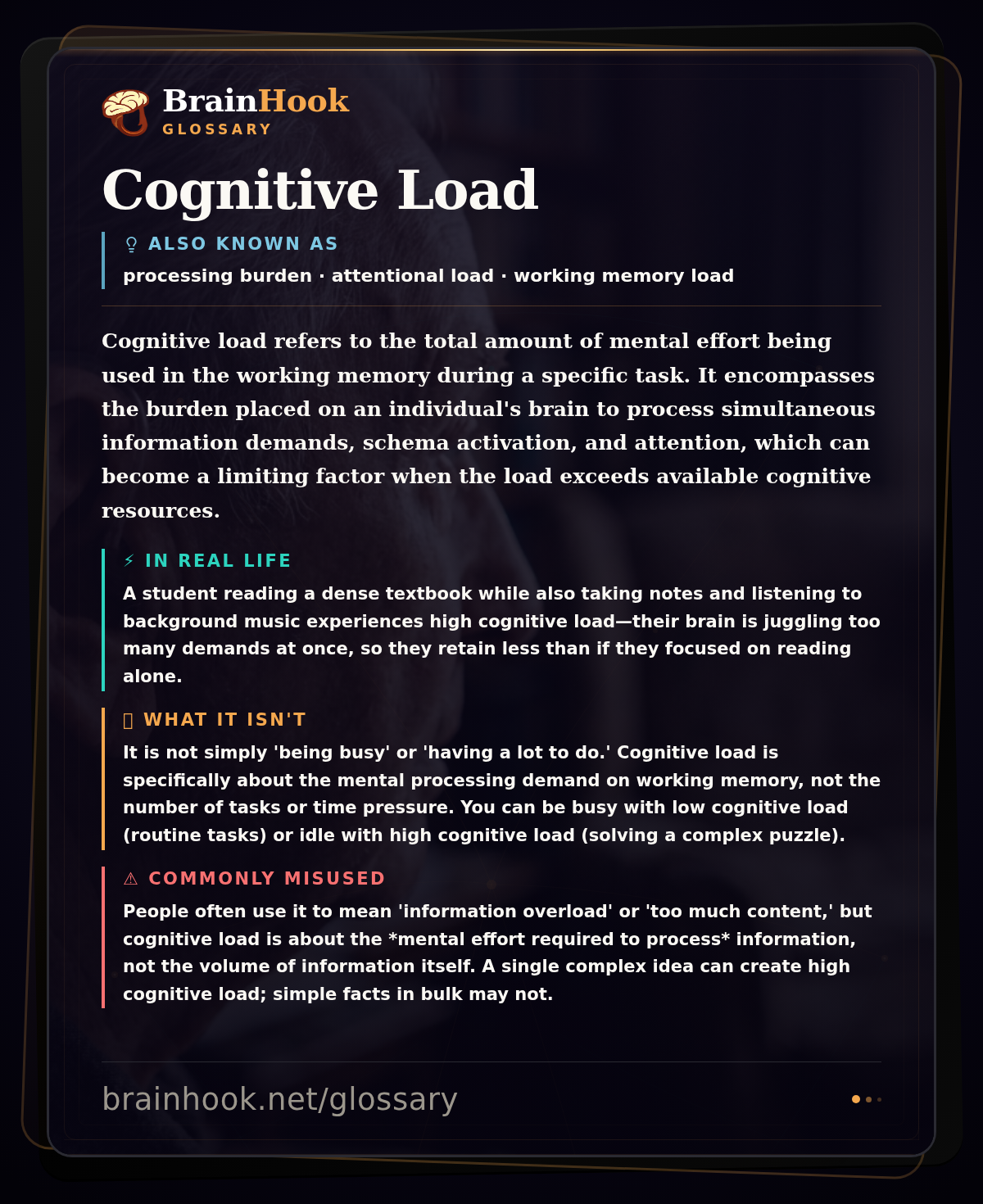
Cognitive load refers to the total amount of mental effort being used in the working memory during a specific task. It encompasses the burden placed on an individual's brain to process simultaneous information demands, schema activation, and attention, which can become a limiting factor when the load exceeds available cognitive resources.
What this means in real life
A student reading a dense textbook while also taking notes and listening to background music experiences high cognitive load—their brain is juggling too many demands at once, so they retain less than if they focused on reading alone.
What it isn’t
It is not simply 'being busy' or 'having a lot to do.' Cognitive load is specifically about the mental processing demand on working memory, not the number of tasks or time pressure. You can be busy with low cognitive load (routine tasks) or idle with high cognitive load (solving a complex puzzle).
Commonly misused online
People often use it to mean 'information overload' or 'too much content,' but cognitive load is about the *mental effort required to process* information, not the volume of information itself. A single complex idea can create high cognitive load; simple facts in bulk may not.