Social Determinants of Cognitive Health
Social circumstances like education and stable employment build cognitive reserve, protecting the brain from depression and stress while helping it optimize performance despite damage.
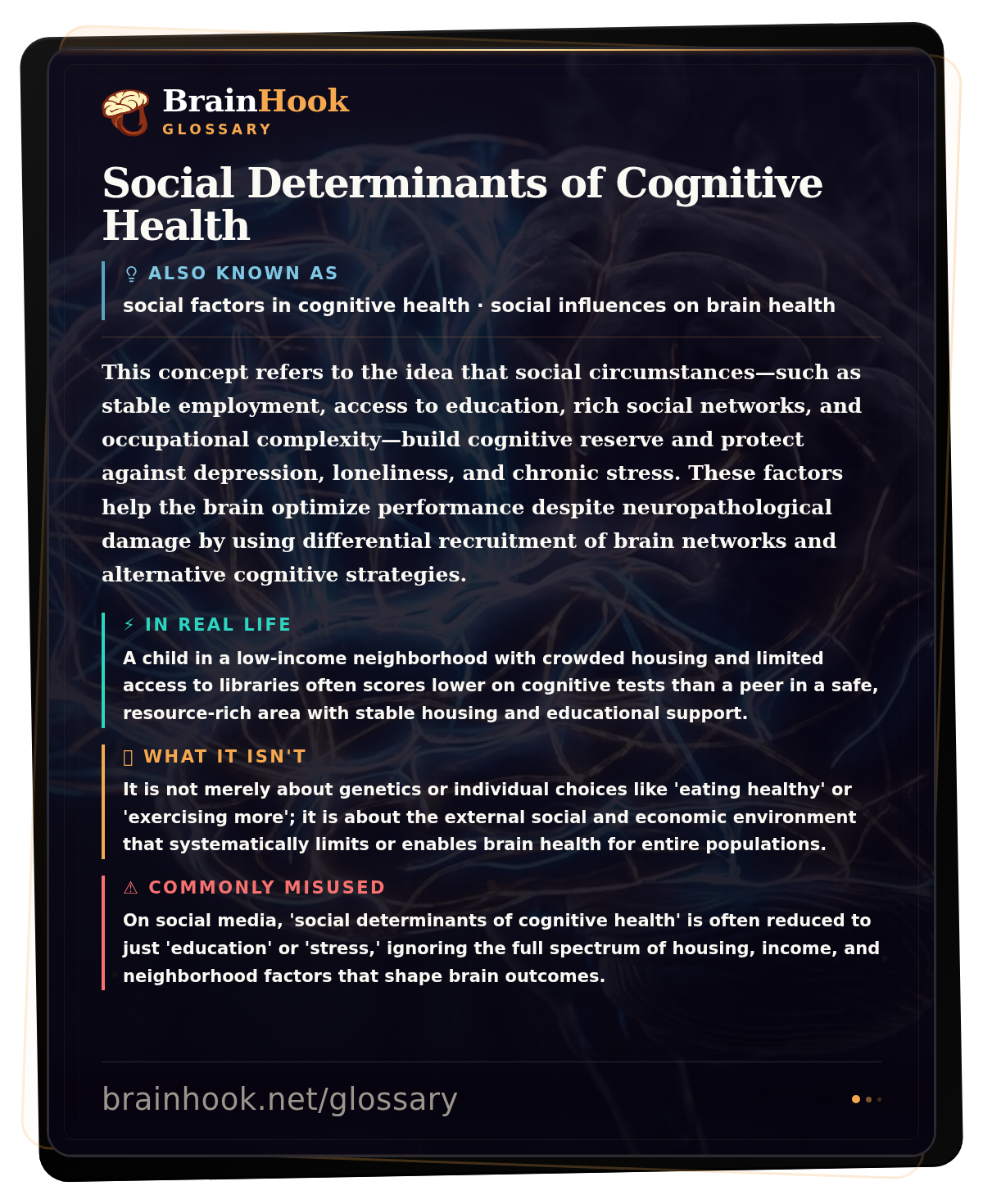
This concept refers to the idea that social circumstances—such as stable employment, access to education, rich social networks, and occupational complexity—build cognitive reserve and protect against depression, loneliness, and chronic stress. These factors help the brain optimize performance despite neuropathological damage by using differential recruitment of brain networks and alternative cognitive strategies.
What this means in real life
A person with stable employment, strong friendships, and access to libraries and gyms may maintain sharper thinking into old age, while someone facing chronic unemployment, isolation, and food insecurity may experience faster cognitive decline—not due to inherent ability, but circumstance.
What it isn’t
This is not the idea that poverty or hardship directly 'damages' the brain in a fixed way. Rather, it recognizes that ongoing stress, limited resources, and reduced opportunity for mental stimulation create conditions where cognitive decline becomes more likely—but these are modifiable factors, not destiny.
Commonly misused online
Often flattened to mean 'rich people are smarter'—when the real claim is that stable income, education, and social connection reduce chronic stress and enable brain-protective habits like learning and exercise, regardless of starting IQ.