Why Fixing a Fight Over Text Almost Never Actually Fixes It
When you try to fix a fight over text, you're not just sending words — you're sending them through a channel that systematically strips out everything that makes repair work.
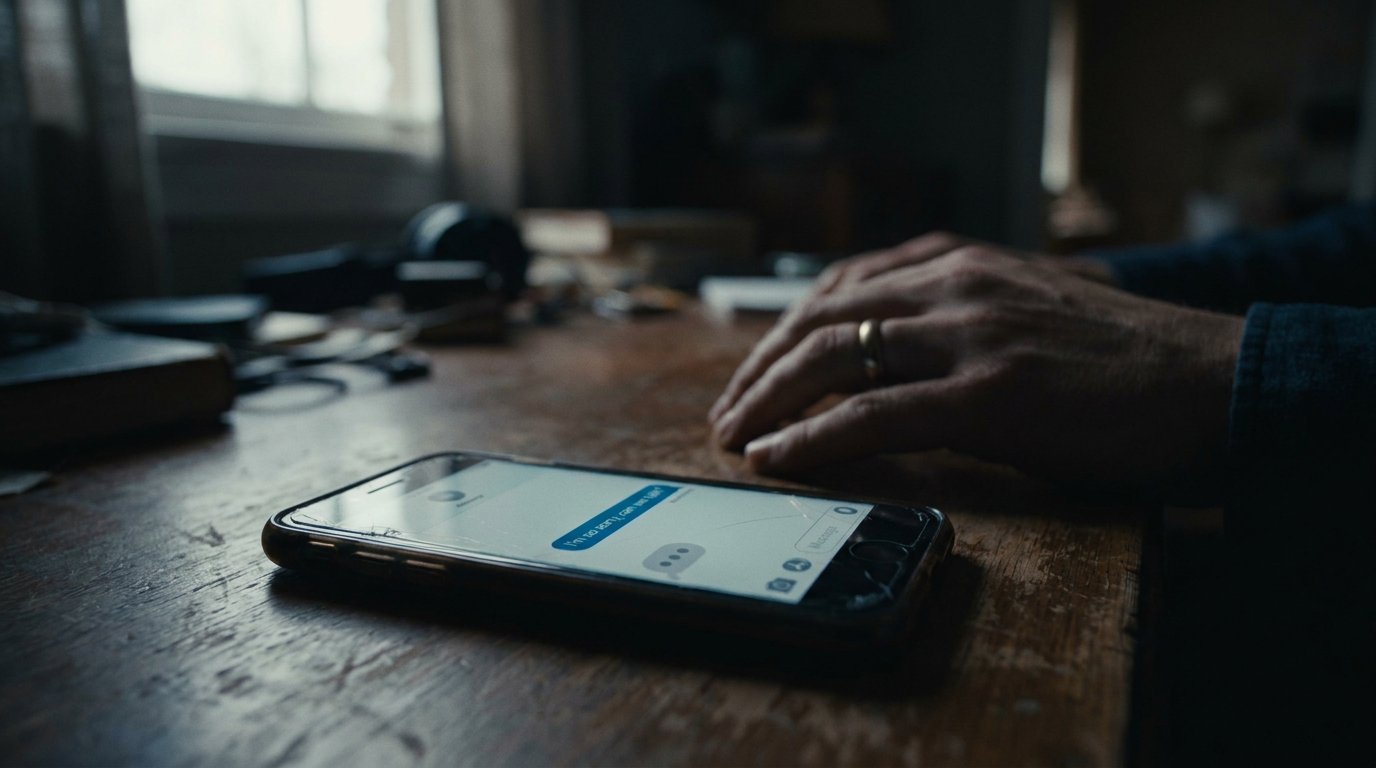
You know the feeling. The argument happened the night before, or three hours ago, or maybe it's still technically happening, suspended in silence. You've thought through what you want to say. You've revised it. You've deleted the first draft and written something softer, something more careful, something that finally sounds like the version of yourself you actually want to be. You hit send. And then the three dots appear, disappear, and don't come back. Or a reply arrives that makes it clear the message landed somewhere you never intended to put it. The gap between what you meant and what was received feels suddenly enormous, a distance no follow-up text seems able to cross.
This is not a failure of effort or sincerity. It is a failure of medium. Text-based communication is a genuinely unusual way for humans to attempt emotional repair — and the deficits it introduces are not minor inconveniences. They are structural. They remove the prosodic cues, the facial expressions, the postural openness, the micro-timing of responses that a nervous system reads, largely without conscious awareness, as the raw data of safety. What remains is a string of characters that the reader must interpret inside a brain already primed for threat.
The science of conflict resolution has, for decades, pointed to a consistent set of ingredients that make repair attempts[3] succeed: bidirectional eye contact, softened vocal tone, slowed speech rate, forward posture, genuine latency in response — the pause that signals someone is actually processing what you said. Researcher John Gottman's work on couples' conflict documented what he called repair attempts, the bids one partner makes to de-escalate, to signal goodwill, to interrupt a negative spiral. What that research also found was that repair attempts only work when the receiving partner is calm enough to recognize them. In person, a gentle touch, a shifted tone, or a visible wince can carry that recognition across the threshold. In a text message, those signals don't exist. The message has to do all of that work with punctuation and word choice alone.
And it almost never can. Not because the words are wrong — sometimes they are precisely right — but because the channel itself is running a kind of lossy compression on human emotional signal. What gets transmitted is a degraded version of the intended message, and what gets decoded on the other end is shaped heavily by the receiver's current state, their attachment history, and the accumulated residue of the argument itself. The text arrives into a system that is already interpreting everything as evidence.
The Missing Bandwidth
Communication researchers often talk about channel richness[4], the capacity of a medium to carry multiple simultaneous cues. Face-to-face conversation sits at the high end: it transmits vocal tone, pitch, pace, facial expression, gesture, gaze direction, and physical proximity all at once. A phone call carries voice but not vision. Text strips the channel down to its absolute minimum, a sequence of symbols with no inherent tone, no duration, no warmth. What we do instead is import tone from context. If the context is conflict, the import is almost automatic: ambiguity reads as coldness, brevity reads as dismissal, and a long message reads as an attack wrapped in politeness.
This matters more during conflict than at any other time because the brain's threat-detection systems are already elevated. The amygdala, which processes emotional salience and registers potential danger, is more reactive under stress. Research in social neuroscience has shown that when people are in a heightened emotional state, they're more likely to interpret neutral stimuli as negative — a bias sometimes called negative affect priming. A text message sent after an argument doesn't arrive in a neutral environment. It arrives into a nervous system that is metabolically tuned to find problems. The same three words, 'Can we talk,' will parse differently in a resting brain than in one still running the cortisol load of a recent argument. In the latter, the question reads not as an invitation but as a summons.
“A text message doesn't arrive in a neutral environment — it arrives into a nervous system already tuned to find problems.”
There is also the problem of asynchrony. Unlike a spoken conversation, where turns unfold in real time and each response is a live event the other person witnesses, texting allows — even encourages — extended gaps between messages. Those gaps are not neutral either. They are interpreted, filled in with meaning, assigned motivation. A ten-minute delay in a reply can feel, to a person who is already anxious, like confirmation of exactly what they feared: that the other person is still angry, is pulling away, is deciding to end things. The delay isn't data. But it gets treated as data, because under stress, the mind will accept a plausible narrative over an empty space every time.
What Attachment Does to the Channel
Layer attachment patterns on top of this bandwidth problem and the picture becomes considerably more complicated. Attachment theory — originally developed to explain infant-caregiver bonds and later extended to adult romantic relationships — describes the internal models people carry about how close relationships work: whether connection is safe, whether other people are reliable, whether distance signals danger. These models, built through early relational experience and refined over time, don't stay neatly in the background during conflict. They run in the foreground, shaping what a person notices, what they remember, and how they interpret incoming messages.
Someone with an anxious attachment style — characterized by a heightened sensitivity to signs of rejection or abandonment — may read a brief repair text as evidence of continued withdrawal. The very brevity that was intended as a light, non-pressuring opening move lands as proof that the other person is still emotionally distant. An avoidantly attached person, whose learned strategy under relational stress is to create space and reduce emotional exposure, may experience a detailed repair text as escalation. A long, carefully reasoned message signals to them that the emotional temperature is still dangerously high. The same message, decoded through different attachment lenses, becomes two different communications entirely.
“The same message, decoded through different attachment lenses, becomes two entirely different communications.”
This is not a character flaw in either person. Attachment patterns are adaptive responses to relational history. The problem is that they were calibrated on in-person interaction, where rich cues are available to course-correct interpretation in real time. In text, where cues are scarce and static, the attachment system doesn't wait for more data. It pattern-matches against what it already knows, and what it already knows is the emotional shape of every prior conflict. The result is that a text sent in genuine goodwill can activate fear, confirm threat, and deepen withdrawal — not despite the sender's best intentions, but sometimes precisely because of how those intentions were packaged.
Emoji Won't Save You
The informal cultural workaround for stripped emotional signal is emoji, and it's worth being honest about what emoji can and cannot do. They can add emotional valence where there was none: a softening punctuation mark, a gestural shorthand for warmth. Research on digital communication has found that emoji use does modulate tone perception[2] — receivers rate messages with prosocial emoji as warmer and less aggressive than the same message without them. That's real. But the effect is modest, and it cannot carry the weight that conflict places on the channel. An emoji is a static symbol with a culturally learned meaning. It does not have a face that can be misread slightly and then immediately corrected by a shift in expression. It cannot convey hesitation, or how long someone paused before adding it, or whether they deliberated between two and settled on this one as less threatening. It is a crude approximation of a signal that, in person, would be continuous and dynamic.
Worse, emoji carry their own ambiguity, and that ambiguity is culturally and generationally variable. Research has documented significant disagreement between senders and receivers[1] about what specific emoji actually communicate — the same symbol interpreted as sincere by one person and sarcastic by another, as warm by one generation and passive-aggressive by the next. In ordinary conversation this might be trivial. In conflict, it is not. A misread emoji in the context of a repair attempt can transform a gesture of warmth into evidence of contempt, which is precisely the thing that Gottman's research identifies as the most corrosive element in relational conflict.
The Reread Problem
One feature of text-based communication that rarely comes up in discussions of its limitations is one of its apparent strengths: permanence. Unlike a spoken conversation, a text exists. It can be reread. And during conflict, it will be. This is not benign. When a person in a heightened state of distress rereads a message, they are not accessing it neutrally. They are running it through the same filter of negative affect priming they used on first reading, often amplifying whatever felt threatening the first time and flattening whatever was reassuring. The reread strips out the slight optimism of first encounter and substitutes confirmation of the worst interpretation. And because the text is right there, unchanged, the person rereading it may feel a false sense of certainty: I am not imagining this. It says what it says.
What it actually says is whatever mood the reader brings to it. That is true of all language to some degree, but the persistence of text makes it uniquely prone to being litigated. In-person conversations blur. Details soften. The memory of tone, of warmth, of how the other person looked when they said it, fades in ways that tend to moderate our most extreme interpretations. A text does not fade. It waits, pixel-perfect, for the next reading.
“A text waits, pixel-perfect, for the next reading — and every rereading happens through the same filter as the first.”
What Actually Works
None of this means text is useless during conflict. It means it's useful for a narrower range of tasks than most people assign it. A text can signal that you want to reconnect without attempting to do the reconnecting itself. It can buy time, open a door, establish that you are still present. 'I'm not going anywhere. Can we talk tonight?' is a text that stays within the channel's actual competence: it conveys intention and availability without asking words to carry the freight of tone, nuance, and emotional complexity that the medium cannot transmit.
What text reliably cannot do is resolve the content of a conflict, repair a specific breach, or substitute for the in-person conversation where the nervous systems of both people can actually synchronize. The concept of co-regulation — the process by which two people in close proximity, through shared vocal pace, breathing rhythm, and facial mirroring, help each other move from a state of threat activation toward one of safety — is a physiological process. It requires physical presence or at minimum a live voice. It cannot happen over asynchronous text, because the mechanisms that drive it are not encoded in language. They are encoded in the body.
The strangest thing about fighting over text is how much effort people pour into crafting the right message, when the problem is not the message at all. The problem is that the channel itself is doing a kind of quiet damage — not to the relationship, necessarily, but to the possibility of repair. Every carefully chosen word, every considered punctuation mark, every deliberate emoji is an attempt to compensate for a structural deficit that cannot be compensated for. Eventually, the only thing that actually works is the one that felt too vulnerable to try first: showing up, voice available, face readable, willing to be understood in real time rather than decoded in absence.
References
- A Systematic Review of Emoji: Current Research and Future Perspectives (frontiersin.org)
Documents significant disagreement between senders and receivers about what specific emoji communicate, showing emoji carry their own ambiguity. - The impact of emojis on perceived responsiveness and relationship satisfaction in text messaging (journals.plos.org)
Provides research evidence that emoji use does modulate tone perception, making messages appear warmer and less aggressive than without them. - R is for Repair (gottman.com)
Defines repair attempts as statements or actions that prevent negativity from escalating, foundational to the article's discussion of conflict de-escalation. - Media richness theory (en.wikipedia.org)
Explains media richness theory framework showing face-to-face communication transmits multiple simultaneous cues while text strips the channel to minimum symbols.
About Vera Sloane
Vera Sloane writes about emerging technology, synthetic media, AI interfaces, robotics, digital environments, and the strange ways the future slips into ordinary life before most people have language for it. Her work focuses on near-future drift, where innovation stops feeling hypothetical and starts rearranging daily behavior, expectation, and mood.
More like this
The Reason You Fight Better in Person Than Over Text
The gap between a screen fight and an in-person fight isn't just about how you say things — it's about what your nervous system can and can't do when the person isn't there.

Anxious + Anxious Attachment: When Two People Both Need Reassurance and Neither Feels Safe Enough to Give It
Two people with anxious attachment can feel like a perfect emotional match — until both nervous systems demand soothing at once and neither has any left to give.

The Argument Wasn't About the Dishes. Your Brain Knew That Already.
Attachment researchers have a name for the moment a dirty pan becomes a referendum on whether you matter — and understanding the mechanism can change how you fight.