The Reason You Fight Better in Person Than Over Text
The gap between a screen fight and an in-person fight isn't just about how you say things — it's about what your nervous system can and can't do when the person isn't there.

The argument started somewhere around noon, in the middle of two people's separate workdays. One person sent a message that landed wrong. The other responded colder than intended. By 2 p.m. there was a backlog of misread tone, retreating silence, and a kind of verbal sparring that neither person would recognize as themselves if they could watch it from outside. By the time they were in the same room that evening, they were carrying six hours of accumulated interpretation — most of it wrong.
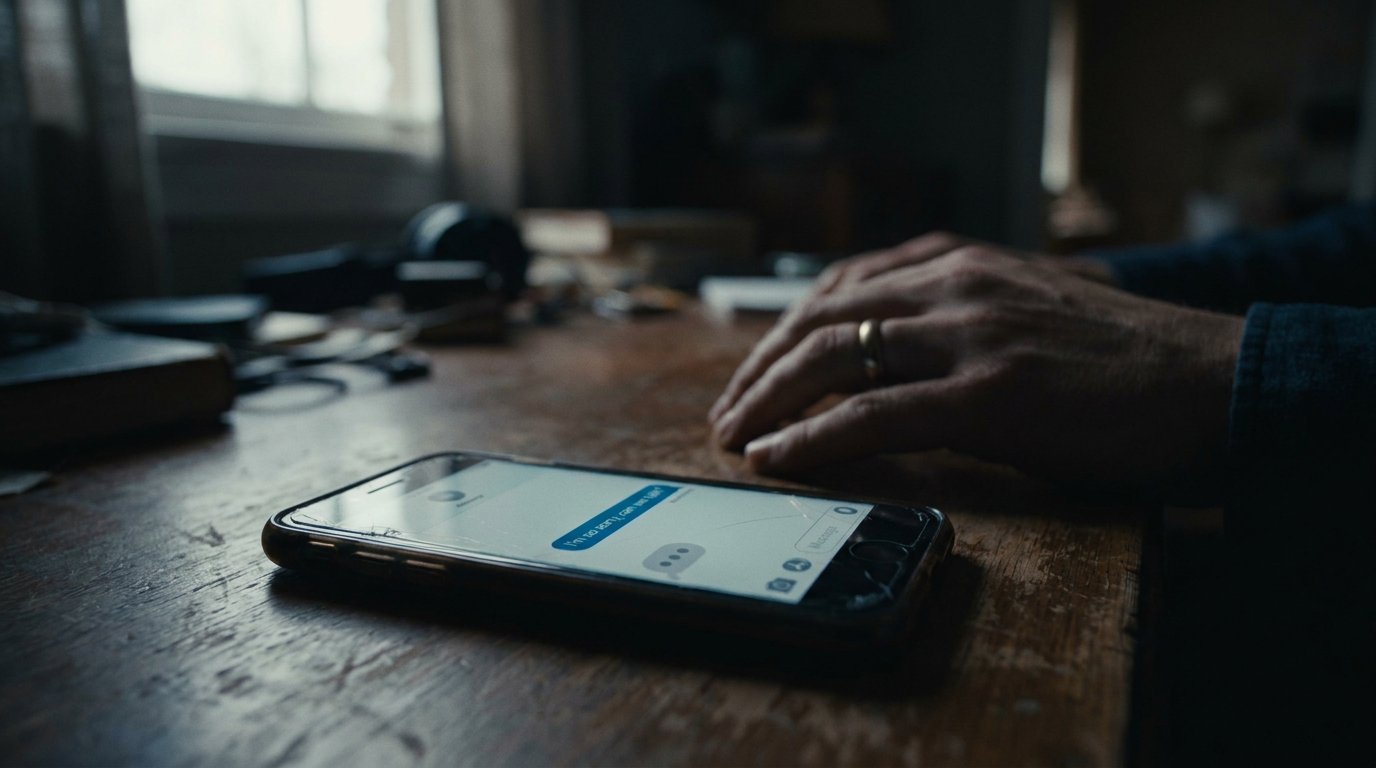
Couples fight in text now in a way that didn't have a name twenty years ago. Not just the occasional difficult exchange, but sustained conflict across hours, sometimes days, conducted entirely through a screen. It has become ordinary. And because it's ordinary, most people treat it as a simple translation of what a conversation would have been — just slower, more private, easier to reread. That assumption is doing a lot of quiet damage.
Research on couples' communication has started to catch up with what many people have learned the hard way. Studies tracking texting behavior longitudinally — measuring how couples use digital channels during conflict versus how they communicate in person — consistently show that digital conflict carries different risks than face-to-face conflict, and the difference is not about formality or word choice. The medium itself changes the mechanics of the argument. It changes what information each person has access to, what each nervous system is doing while the exchange is happening, and critically, what can and can't happen to move toward repair.
Most people, if asked, would say the problem with fighting over text is that tone doesn't come through clearly. That's true. But it is also, by a large margin, the least interesting part of the problem.
The Body Is Not Optional in Conflict
When two people are in the same room during a difficult conversation, an enormous amount of information is flowing between them that neither is consciously tracking. Facial microexpressions. Postural shifts. Whether someone is leaning forward or pulling back. The slight softening around someone's eyes when they are about to say something that costs them something. These are not decorative details. They are the actual signal system that partners use to gauge safety, sincerity, and movement in a conversation. They are how you know the other person is still with you, even when the words are hard.
Research in affective neuroscience has established that humans regulate each other's emotional states through co-presence in ways that are automatic and largely below the level of conscious awareness. The technical term for this is co-regulation[1], and it is not a metaphor. Being physically near someone you are attached to affects your cortisol response, your heart rate variability, and the speed at which you recover from physiological arousal. During a conflict, that shared physical space is doing stabilizing work even when the conversation is going badly.
Take that away and something fundamental shifts. Over text, your nervous system is running the conflict alone. You are physiologically aroused by the argument — your threat response is engaged — but there is no co-regulatory signal coming back. Your partner cannot place a hand on the table between you. Their voice cannot drop into the slower cadence that signals they are not attacking you anymore. You are left inside a story you are constructing, largely from prior experience, half-read cues, and whatever emotional state you were in when the message arrived.
“Over text, your nervous system is running the conflict alone.”
What the Data on Couples' Texting Actually Shows
Longitudinal work on couples' digital communication — including studies that have tracked texting frequency, sentiment, and timing across the arc of relationships over several years — has produced a finding that surprises people when they first hear it: frequent texting in a relationship is not inherently a positive sign, and in men, heavy use of texting as a primary mode of communication during conflict is associated with lower relationship quality over time. Not because texting is bad, but because couples who default to text for conflict resolution are systematically avoiding the conditions that make repair possible.
Research by Lori Schade and colleagues in the Journal of Couple & Relationship Therapy[2] drew on diary data from hundreds of young adult couples and found that for men, higher texting frequency was inversely associated with relationship satisfaction, and for both partners, using texts as a vehicle for serious conflict was linked to a sense of disconnection even when the conversation appeared, textually, to have resolved. The exchange ended, both parties stopped messaging, and the surface looked calm. But neither person actually felt repaired.
This is worth pausing on. The conversation looked done. It wasn't. And one of the more insidious things about digital conflict is that it can produce a false sense of closure — a neat thread, a period at the end, a final message that seemed to settle things — while leaving the underlying rupture untouched. In person, unresolved conflict has a feeling. It lives in the room. Over text, it can go quiet in a way that gets mistaken for resolution.
“Digital conflict can produce a false sense of closure while leaving the underlying rupture untouched.”
Why Repair Is Structurally Harder in Text
Repair is the work that happens after a rupture — the small gestures and larger conversations that rebuild trust, renegotiate understanding, and signal that the relationship is still intact. Researchers like John Gottman have spent decades documenting that the capacity for repair[3] is one of the strongest predictors of whether a relationship can sustain long-term conflict without deteriorating. Repair does not have to be elaborate. It can be as small as a shift in tone, a softening of posture, a question asked instead of a statement made. But repair requires readable signals. And text strips most of them out.
In person, a repair bid can be subtle and still land. A half-smile during a tense moment. A change in eye contact. Leaning forward instead of away. These are signals that something is shifting, that the person across from you is making a move toward connection even if they are not yet saying it in words. Over text, none of that is available. A repair bid has to survive the journey from intention to typed language to interpretation on the other end — and at each stage, something can go wrong. The person who types something genuine can look sarcastic. The person who means softness can land as flat. The bid gets lost, and the other person never knows to receive it.
There is also a timing problem. In-person conflict moves in real time, and both parties are tracking the arc of the exchange moment by moment. Over text, there are gaps — minutes, sometimes hours — and those gaps become containers for interpretation. A slow reply reads as stonewalling. A brief reply reads as dismissal. A message sent after a long pause reads as either carefully considered or coldly composed, and the reader gets to decide which, usually based on how threatened they already feel. The gap itself becomes part of the argument.
The Part About Threat Perception
When a person is in conflict with someone they love, what they are also managing — often without knowing it — is a threat response. Conflict with a partner activates the same neural circuitry as other forms of social threat, because the relationship itself is a form of security, and the fight carries a low-level signal that the security is in question. In-person conflict gives the nervous system something to work with: the embodied presence of the other person, which your attachment system reads as evidence that they are still there.
Over text, that evidence is absent. What you have instead is a message, and a message is easy for a threatened nervous system to read as worse than it is. Research on what's called hostile attribution bias — the tendency to read ambiguous social behavior as intentional aggression — shows that people are significantly more prone to hostile interpretations of ambiguous communication when they are already physiologically aroused. During a conflict over text, you are aroused and the signals are ambiguous almost by definition. The conditions are nearly optimized for misread.
This is also why escalation moves so fast in text fights. In person, conflict has natural brakes — the visible distress of the other person, the sound of their voice cracking or dropping, the pause before they speak. These are involuntary signals that land before you can override them. Over text, there are no involuntary signals. There is only a message, and the pause before you send your reply is entirely your own, which means the decision to escalate or de-escalate is carried almost entirely by the person sending, not shared between both people in the room.
What Carries Over and What Doesn't
None of this means that text has no place in the emotional life of a relationship. It can carry warmth efficiently. It can sustain connection across distance. It can be a genuine vehicle for appreciation, small bids for connection, humor, and even vulnerability when the relationship is on stable ground. Research on texting and relationship satisfaction generally finds that high-quality, warm texting between partners who are already securely connected is a reinforcing loop — it adds to a bond that already has enough structure to hold it.
But conflict is a different condition. It requires what text cannot reliably provide: the ability to signal safety, to read whether the other person is still engaged, to make a repair bid that lands as one, to let your body tell you that the threat is passing. Partners who know this intuitively — who reach some wordless threshold in a heated exchange and say, without ceremony, let's talk about this later or call me — are doing something smarter than they probably realize. They are not avoiding the conflict. They are moving it to terrain where it has a better chance of going somewhere real.
“They are not avoiding the conflict. They are moving it to terrain where it has a better chance of going somewhere real.”
The Fight You're Actually Having
The hardest thing to hold onto, in the middle of a long text exchange that has gone bad, is that the conversation on the screen is not quite the same conversation you would be having if you were together. It looks like it. It uses the same names, the same grievances, the same history. But the medium has changed what each person is working with — how they read the other, how they regulate themselves, how quickly threat perception overtakes comprehension. The argument over text is a version of the argument, running on stripped-down information, in bodies that are alone.
That doesn't make it fake. What gets said in text fights is often real — the hurt, the frustration, the thing one person has been trying to say for months and finally typed at 3 p.m. on a Tuesday because they couldn't hold it anymore. But real content moving through the wrong channel has a way of landing differently than it was meant, and being answered differently than the speaker needed, and piling up into something that looks like conflict history but is really a record of two people trying to do something the medium made harder.
Most couples who fight badly over text are not bad at conflict. They are using an instrument with real limits for something that needs more than it can offer. The fight that has been building for two days in a thread might take twenty minutes to resolve in the same room — not because the room is magic, but because the room has the two of them in it, doing the quiet involuntary work of being human together, which turns out to be harder to skip than either of them knew.
References
- Coregulation, Dysregulation, Self-Regulation: An Integrative Analysis and Empirical Agenda for Understanding Adult Attachment, Separation, Loss, and Recovery (doi.org)
Provides the neuroscience research defining co-regulation: how physical proximity automatically regulates partners' cortisol, heart rate, and stress recovery. - Using Technology to Connect in Romantic Relationships: Effects on Attachment, Relationship Satisfaction, and Stability in Emerging Adults (doi.org)
Longitudinal diary study showing men's heavy texting during conflict correlates with lower relationship satisfaction and false sense of resolution. - Repair is the Secret Weapon of Emotionally Connected Couples (gottman.com)
Establishes that repair capacity—how couples handle mistakes—is a key predictor of long-term relationship stability.
About Elena Rivera
Elena Rivera writes about the hidden architecture of relationships — how attachment shapes conflict, why friendships quietly collapse without anyone deciding to let them, and the structural forces that make intimacy harder to maintain than most people expect. Her work focuses on what research reveals about the things people feel but rarely have language for in their closest relationships.
More like this
Why Fixing a Fight Over Text Almost Never Actually Fixes It
When you try to fix a fight over text, you're not just sending words — you're sending them through a channel that systematically strips out everything that makes repair work.

Money Stress Doesn't Just Drain Your Account. It Distorts How You See Your Partner.
Financial pressure doesn't just strain your budget — new research shows it quietly rewires how you perceive your partner's words and intentions, turning an economic problem into a relational one.

The Argument Wasn't About the Dishes. Your Brain Knew That Already.
Attachment researchers have a name for the moment a dirty pan becomes a referendum on whether you matter — and understanding the mechanism can change how you fight.