The Government's Official Journalist Blacklist Isn't About Insults—It's Infrastructure
The Trump administration turned whitehouse.gov into a state-run press shaming operation — and the mechanism is more dangerous than the insults.
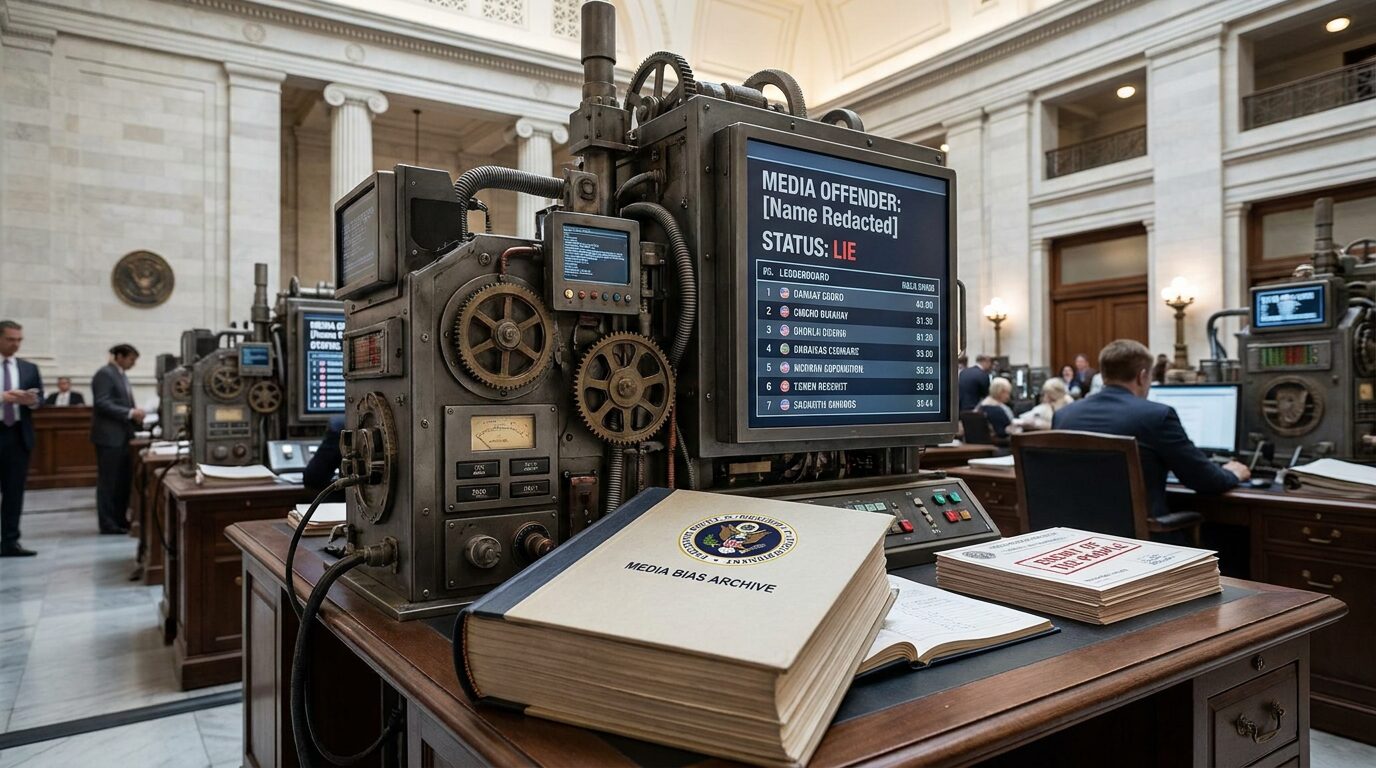
There is a page on the official website of the United States government — funded by your taxes, hosted at whitehouse.gov/mediabias[1] — that names individual American journalists, stamps their work with labels like "lie," "left-wing lunacy," and "malpractice," and ranks news organizations on a leaderboard the site calls "a race to the bottom." It launched the weekend after Thanksgiving 2025. Most people still don't know it exists. They should.
This is not a campaign ad. It is not a political action committee's attack mailer. On an official United States government website funded by taxpayers, there is a page that names specific American news agencies and journalists and brands them as media offenders. Not a campaign site. Not a political action committee. The White House. Whitehouse.gov. The building your taxes pay for. That distinction is not semantic. It is the whole ballgame.
The portal includes an "Offender Hall of Shame" — a database of articles, news outlets, and reporters that the White House classifies with categories including "bias," a "false claim," a "lie," "left-wing lunacy," or "misrepresentation." The White House also created a "Media Offender Tipline," where anyone can report biased or false articles they may find. The government, in other words, has built an infrastructure for public denunciation and crowdsourced surveillance of the press. Call it what it is: state propaganda with a tip jar.
The Machinery, Not the Insults
The Trump administration wants you to argue about whether the underlying journalism is fair. That argument is a decoy. Trump has always trash-talked the press — calling reporters "piggy," telling a CBS correspondent "are you stupid?" — and none of that constitutes a structural threat. A president is legally entitled to be rude and wrong in public. What he is not entitled to do is build a government apparatus designed to discipline the press through institutional leverage. That is what this page does, and the insults are just the noise meant to make you miss it.
Historically, U.S. presidents have clashed with the press, but the public "naming and shaming" of journalists on an official government platform is described as unprecedented in recent U.S. history by multiple sources. The precedent matters enormously, because the page does not operate in a vacuum. The "offender" branding and the public tipline stand next to lawsuits the same administration has filed against CBS, ABC, and the Wall Street Journal. They stand next to FCC licensing pressure. They stand next to decisions about who gets a White House press pass. Thread those together and you don't have criticism — you have a coordinated system of coercion[2] in which the shame page functions as the public-facing component.
The Society of Professional Journalists sent a formal protest letter to press secretary Karoline Leavitt calling for the page's removal. "It feels to us like this kind of government-backed targeting resembles online harassment, and that's especially dangerous at a moment when journalists already face widespread abuse and threats," said SPJ executive director Caroline Hendrie. But she identified something even more corrosive than the harassment itself: "When journalists correct mistakes transparently, they are following the rules, and government officials should not weaponize ethical behavior as evidence of wrongdoing. If corrections are punished, journalists are incentivized not to correct errors." Read that twice. The page doesn't just target bad journalism. It punishes good journalism. It trains reporters to fear corrections more than errors. That is a system designed to degrade journalistic integrity from the outside in.
“The page doesn't just target bad journalism. It punishes good journalism. It trains reporters to fear corrections more than errors.”
What the Leaderboard Is Actually For
There is a "Repeat Offenders" chart for outlets the government says keep getting it wrong. The list of named publications reads like a directory of American journalism: the Associated Press, Reuters, Bloomberg, CNN, CBS, NBC, the New York Times, the Washington Post, the Wall Street Journal, the BBC — even Fox News and the conservative Daily Signal show up when a story displeases the White House. That breadth is informative. This is not a tool for correcting left-wing bias. It is a tool for punishing independence. Any outlet, regardless of its editorial tilt, lands on the list the moment it publishes something the president resents.
The point is clarified by what happened to CBS. The network's new ownership brought in Bari Weiss as a guiding editorial voice — a move widely read as a repositioning toward the administration's comfort zone. CBS seemed on the way to a repositioning that should have reassured the White House. Yet the network still ended up in the top three of "offender" media. Because there are no structural allies: all it takes is one week of bad headlines or a story that irritates the president to be hung on the wall. Submission buys you nothing. The list is an instrument of permanent leverage, not a correctible grade.
The Media Bias page tabs don't stay locked away in a corner of whitehouse.gov — they get revived on X, on Truth Social, on fundraising mailing lists, and on podcasts by commentators close to the White House. They become the reading grid for entire political communities, fueling micro-campaigns targeted against individual journalists, used to support boycotts, pressure on advertisers, and coordinated protests. The government, in this model, doesn't need to directly silence anyone. It outsources the pressure to the crowd and keeps its hands technically clean.
The Comparative Anatomy of Press Control
Scholars of democratic backsliding — the slow erosion of institutional norms rather than their sudden demolition — have a name for this pattern. It is called autocratization, and one of its most reliable early features is the delegitimization of independent journalism through official channels before any formal censorship begins. In Russia, the Kremlin brands journalists and outlets as "foreign agents," and the media regulator Roskomnadzor went after independent newsrooms for how they covered the war in Ukraine, then drove them off the air. Russia names the enemy in public first. The shutdown comes later. In Hungary, Viktor Orbán's allies launched pro-government outlets dressed up as fact-checkers that push the state's narrative and discredit the press that questions it. In Turkey, a site called "Fact Checking Turkey" treats statements by government officials as the measure of truth and aims its fire at foreign coverage the government dislikes. The architecture is recognizable. What varies is only the speed.
None of that means the United States is Hungary or Turkey. It means that the tool being used has a documented track record, and that track record does not end well for a free press. As I've written before, democracies don't announce their transformation — they slide, norm by norm, until the slide feels like the floor. The question is not whether whitehouse.gov/mediabias is a bill of attainder or a First Amendment violation on its face. Courts are already wrestling with the edges of that. The question is what incentive structure it creates and what behavior it rewards.
“The government doesn't need to directly silence anyone. It outsources the pressure to the crowd and keeps its hands technically clean.”
The Tipline Is the Tell
If you want to understand what this apparatus is really designed to do, read the official White House press release calling for submissions. "That's why the White House is calling on everyday Americans to support the truth and hold the Fake News accountable. By visiting whitehouse.gov/biastips, anyone can submit biased or undeniably false articles, and valid submissions will be used to keep the Media Bias Portal updated. So-called 'journalists' have made it impossible to identify every false or misleading story, which is why help from the American people is essential." That is the state mobilizing its citizenry to surveil and report on the press. It is government-organized crowdsourced monitoring of journalism. In a different context, in a different country, we would not hesitate to call it what it is.
By June 2026, the page had expanded past newsrooms into a category called "Leftist Influencers," naming individual online commentators such as Brian Tyler Cohen and David Pakman, accusing private citizens of spreading false claims about the president. California Governor Gavin Newsom's office flagged that the targets also swept in figures like Don Lemon and Stephen Colbert. The expansion confirms what the structure always implied: there is no principled limiting principle. Once a government builds a shame infrastructure, its scope follows political convenience, not journalistic malpractice.
The administration's defense — that it is simply "holding the media accountable" — would be more credible if the White House applied any consistent standard to itself, if it published corrections for its own false statements, if the "offenses" it cataloged bore any relationship to documented errors rather than to coverage the president personally disliked. Shortly after the site's launch, journalists identified several errors on the site itself, including an entry wrongly attributing a press briefing question to a Fox News reporter. The page was quietly taken down before reappearing without the Fox reference. A fact-checking operation that cannot accurately fact-check its own fact-checking is not a fact-checking operation. It is a propaganda operation wearing fact-checking's clothes.
The damage this does to public epistemics — to the shared capacity of citizens to evaluate what is true — is harder to litigate than a First Amendment case, but it is arguably more serious. The White House's public cataloging of disputed news coverage may influence public trust in both the media and the presidency, shaping perceptions about which sources are credible and what constitutes accurate reporting. That is the institutional rot beneath the noisy surface. Corruption of this kind doesn't always announce itself with a dramatic seizure of power. Sometimes it arrives wearing a leaderboard and a tip jar, asking you to sign up for "Offender Alerts" delivered straight to your inbox. The building still has flags out front. The function has already changed.
References
- Media Offenders (whitehouse.gov)
Provides the actual content and structure of the Media Bias Portal, including the 'Offender Hall of Shame' database with labeled claims and outlet names. - Trump’s assault on the First Amendment (ibanet.org)
Describes Trump administration's crackdown on freedom of speech targeting press, lawyers, and student protesters as evidence of assault on First Amendment.
About Paul Wardell
Paul Wardell writes about politics, institutions, voters, media, class, power, polarization, and the incentives that make public life feel dumber than it needs to be. Left-leaning but stubbornly practical, his work focuses on how systems actually behave, not how partisans wish they behaved.
More like this
Institutional Collapse Doesn't Look Like a Coup. It Looks Like Everyone Deciding Not to Fight.
Political scientists have a name for the pattern where courts, corporations, universities, and legislators each decide individually that resistance isn't worth it — and the math of those private surrenders adds up to the end of accountability itself.
The Surveillance State Didn't Come for You. It Came for the Protesters First.
Across three countries with very different governments, AI-powered facial recognition is being deployed against protesters first — and the political science research on why that sequence matters should scare you.
Democracies Don't Warn You Before They Stop Being One
Political scientists have spent two decades mapping exactly how democracies die without a coup — and the indicators they built now point at the United States.