The Hollow Room After the Stream Ends: What Creator Loneliness Really Feels Like
Creator loneliness isn't a side effect of overwork — it's what happens when a platform fuses your self-worth to a number that can never actually see you back.
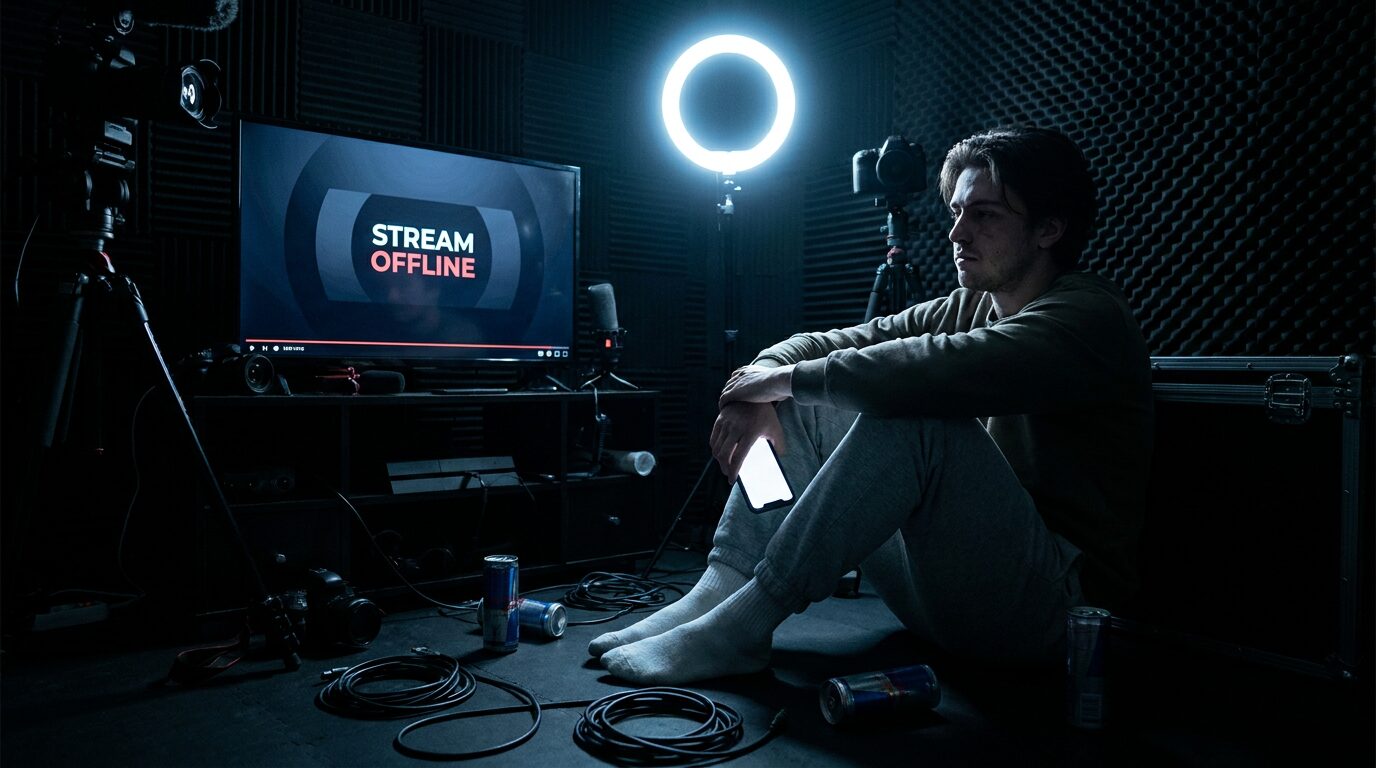
Imagine ending a live stream that peaked at forty thousand concurrent viewers. The comments were moving too fast to read. The donations stacked up in the corner of the screen. For ninety minutes, the attention was total, almost physical in its intensity. Then the stream ends, and the room goes quiet, and you sit in the silence with your phone still warm in your hand, and the feeling that moves in isn't satisfaction. It's something closer to the particular hollowness of having talked to a wall that talked back in aggregate.
This is the texture of creator loneliness, and it is stranger and more structurally interesting than the burnout narrative the industry usually reaches for. The problem isn't simply that creators work too hard or sleep too little — though those pressures are real. It's that the labor of being a creator involves a continuous, metrified performance of self for an audience that cannot, by the logic of the medium, offer anything close to mutual recognition in return. The numbers go up. The person behind them goes unseen.
What Audiences Give and What They Cannot
There is a structural asymmetry at the center of creator culture that deserves more attention than it gets. Audiences form parasocial bonds with creators — genuine, emotionally nourishing attachments that are, by definition, one-directional. The audience member may feel they know the creator intimately: their opinions, their anxieties, their morning routines, their relationship history, whatever has been rendered as content. The creator, meanwhile, knows their audience as a number, a demographic summary, a comment section, a retention graph. The intimacy flows almost entirely one way. And the creator is on the producing end of it, manufacturing the conditions for connection in others while remaining, themselves, structurally unknown.
Research into how social media shapes loneliness has begun to illuminate why this doesn't resolve itself through sheer volume of contact. A 2024 policy brief from the European Commission's Joint Research Centre[1] found that "passive consumption of social media seems to reinforce feelings of disconnection[1]" — that scrolling through other people's lives, without genuine reciprocal exchange, tends to deepen rather than relieve the sense of being alone. Creators face a version of this dynamic in reverse. They are not passive consumers. They are hyperactive producers. But their output enters a system designed to be consumed passively, which means that even their most earnest self-disclosure lands, for most viewers, as content to scroll past rather than a moment of genuine meeting.
“The creator manufactures the conditions for connection in others while remaining, themselves, structurally unknown.”
When the Metric Becomes the Mirror
What distinguishes creator loneliness from ordinary professional isolation is the mechanism by which self-worth gets reorganized. Most forms of creative or knowledge work involve feedback loops — a review, a performance evaluation, a sales figure — but these arrive intermittently and are understood, at least partially, as external measures of a discrete output. What platform logic does differently is make the feedback continuous, public, and inseparable from identity. Engagement metrics aren't attached to a product you made; they're attached to a version of you that you performed. A subscriber count dropping isn't a product underperforming. It reads, emotionally, as the self being rejected.
This dynamic sits inside a broader pattern of technological transformation that a comprehensive review in PMC[2] describes as a significant reshaping of individuals' psychological health — one driven by the speed and scale of digital platforms, which have changed not just how people work but how they experience their own worth and stability. The creator economy intensifies this to an almost clinical degree. The self-concept, that relatively stable internal sense of who you are and what you're worth, becomes externally scaffolded on metrics that fluctuate by the hour. And as we've covered elsewhere, the threshold for stability never arrives with scale — more followers tend to mean more exposure to the volatility, not immunity from it.
The Gallup State of the Global Workplace Report[4] offers a useful, if unexpected, parallel. Among workers, those in leadership positions — the people with the most visibility, the most perceived agency, the most status — reported higher levels of stress, loneliness, and sadness than individual contributors, even as they also reported higher engagement and thriving. Leadership, the data suggests, brings social distance alongside its authority. The creators sitting at the top of the attention economy are living a version of this paradox: maximum visibility, minimum intimacy. The distance between being watched and being known turns out to be nearly total.
The Distress Loop Nobody Names
There's a second layer to this that compounds the first. Creators don't just produce content — many of them consume it obsessively, tracking competitors, monitoring discourse, watching how the algorithm is moving. They are often heavy users of the very platforms whose feedback loops are reorganizing their sense of self. Research on news media consumption during the pandemic found that increased exposure to distressing media content had demonstrable negative effects on mental health — the study, published in JMIR Mental Health[3], showed that the relationship between anxious content consumption and psychological distress was real and measurable. Creators occupy an unusual position in this: they are both the producers of attention-capturing content and, in their off-hours, its anxious consumers. The loop doesn't stop when the camera does.
What the JRC finding on passive scrolling[1] makes visible is that the mode of engagement matters as much as the volume of it. Passive consumption reinforces disconnection; active, reciprocal exchange does not. Creators are active in producing but largely passive in receiving — they watch the numbers, they read aggregate sentiment, they absorb the tone of comment sections. Very little of what comes back to them is genuinely interpersonal. The platform has been designed to scale connection, and in doing so it has replaced connection with its statistical shadow.
“The platform was designed to scale connection. In doing so, it replaced connection with its statistical shadow.”
What No Previous Creative Labor Did
It is worth being precise about what makes this structurally novel rather than simply a modern version of ordinary creative anxiety. A novelist who receives a harsh review is not confronted with a live, public, continuously updating number attached to their face. A musician who has a bad album cycle does not watch their sense of personal worth fluctuate in real time on a dashboard they check between breakfast and lunch. The temporal compression of creator feedback — the fact that it is always now, always public, always personal — is genuinely new. No previous creative labor structure has so completely fused the metric of professional performance with the ongoing experience of being perceived as a person.
This is also why the remedies most commonly offered — take a break, set boundaries, go offline — tend to feel both obviously correct and functionally useless to full-time creators. The architecture of their professional existence is built on continuous presence. Logging off doesn't just mean rest; it means abandonment of the audience whose attention is simultaneously the business model, the social world, and the primary source of whatever validation the platform has spent years conditioning the creator to need. The child who learned that love has conditions is, in some ways, a useful template: the platform teaches you, over time, that presence earns connection, and then makes absence feel like annihilation.
The Shape of the Problem
None of this means creator culture is irredeemable or that the audiences watching are doing something wrong. Parasocial bonds are not fake simply because they are asymmetric; they carry real emotional weight for the people who form them. The problem is not that millions of people are watching. It's that the system translating that attention into data has no mechanism for converting scale into intimacy, and then it asks the person at the center to treat the data as if it were a relationship. Forty thousand concurrent viewers is not forty thousand friends. It is one number, refreshing.
What creator loneliness reveals, finally, is something about the limits of visibility as a substitute for being known. Loneliness has a way of actively perpetuating itself, and the creator's version of this loop is particularly well-designed: more content to fill the void, more engagement to chase, more of the self rendered into signal, and the silence in the room after the stream ends getting a little harder each time to explain to anyone who wasn't there.
References
- How you scroll matters: passive social media use linked to loneliness (joint-research-centre.ec.europa.eu)
Establishes that passive social media consumption reinforces disconnection, a dynamic the article applies to creators receiving audience feedback. - Mental Health and Well-Being in the Modern Era: A Comprehensive Review of Challenges and Interventions (pmc.ncbi.nlm.nih.gov)
Describes how digital platforms reshape psychological health through continuous, speed-driven feedback mechanisms affecting self-worth and stability. - The Mental Health Impact of Daily News Exposure During the COVID-19 Pandemic: Ecological Momentary Assessment Study (pmc.ncbi.nlm.nih.gov)
Demonstrates that increased exposure to distressing content has measurable negative mental health effects, supporting the article's claim about creators' anxious consumption loops. - State of the Global Workplace Report (gallup.com)
Provides data showing leadership positions correlate with higher stress and loneliness despite visibility, paralleling creator economy visibility-intimacy paradox.
About Noah Chen
Noah Chen writes about internet culture, digital identity, fandom, parasociality, creator economies, algorithms, and the ways media platforms reshape attention, status, belief, loneliness, and selfhood. His work follows culture where it increasingly lives: inside feeds, fandoms, comment sections, recommendation systems, online movements, and synthetic relationships, without reducing digital life to either moral panic or technological inevitability.
More like this
The Lonely Algorithm Problem Nobody at Meta Wants to Talk About
New longitudinal research reveals that loneliness doesn't just make Instagram feel worse — it warps how users perceive the algorithm itself, creating a feedback loop the platform is structurally built to ignore.
You Post. You Engage. You're Still Lonelier. Here's the Loop.
A 2025 Baylor study found that posting and lurking both increase loneliness over time — which means the problem isn't your habits, it's the emotional architecture of the platform itself.

Burnout Hits Hardest at 25 Now. That Used to Be 42.
New workforce data shows peak burnout has shifted nearly two decades younger — and the culprit isn't screen addiction or generational softness but a structural mismatch your nervous system was never built to absorb.