The Discovery That's Quietly Unraveling Planet Nine's Best Defense
The whole case for a hidden ninth planet rests on a handful of orbits that shouldn't line up — but they're lining up less and less with every new discovery.
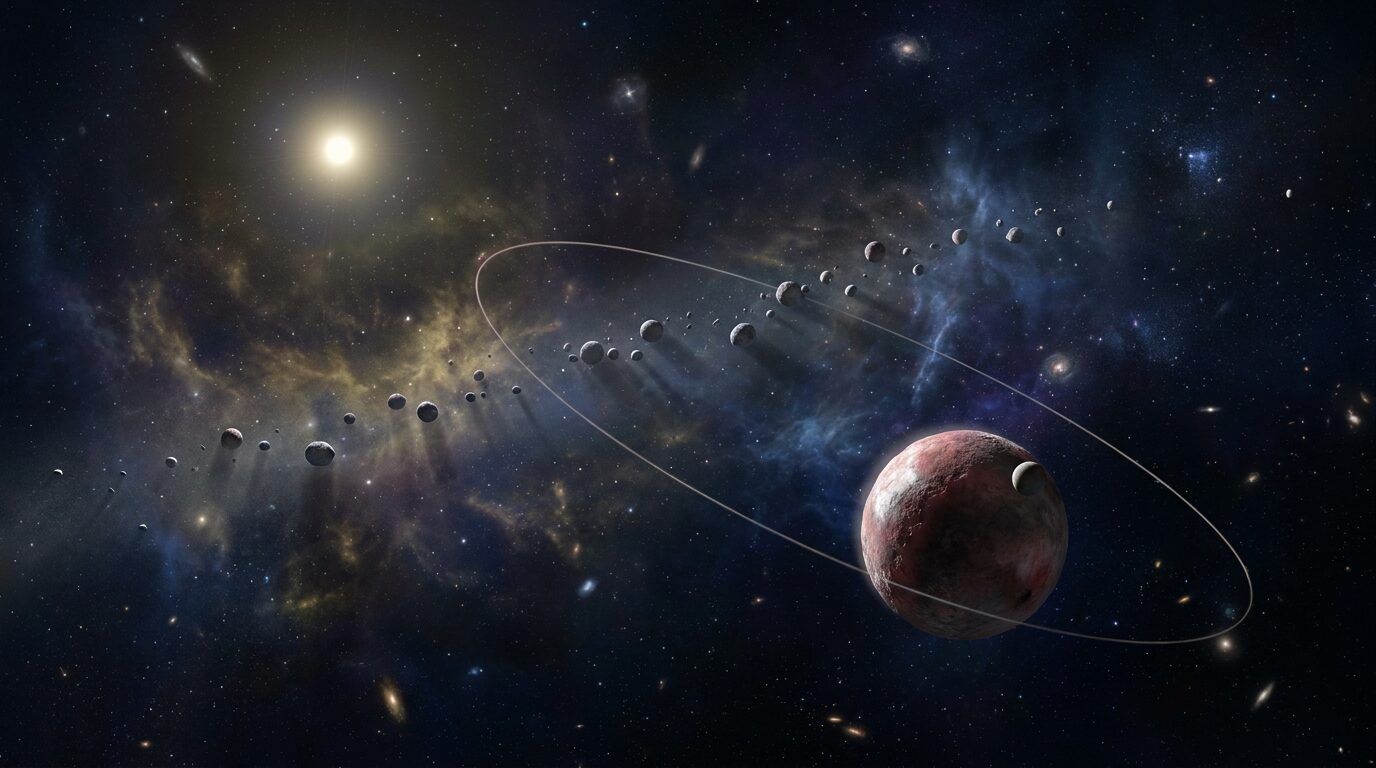
The Planet Nine hypothesis has always been a ghost story told in orbital mechanics. In 2016, Caltech astronomers Konstantin Batygin and Mike Brown looked at a cluster of distant icy objects beyond Neptune and noticed something strange: the orbits of some Kuiper Belt objects appeared to be unusually clustered and aligned, despite being too far from the influence of Neptune's gravity. Their conclusion was audacious. By repeatedly simulating the evolution of the solar system and comparing it with real observations, Batygin and Brown determined these objects' unusual orbits could be due to the gravitational tugs of a faraway world roughly five to ten times more massive than Earth that orbits the Sun once every 10,000 years. No one had seen this planet. No telescope had caught even a pixel of it. The entire argument rested on a gravitational inference — on the idea that something enormous was out there, invisibly herding these objects into formation.
That inference just took another hit. Over the past year, two separate discoveries have turned up objects in the outer solar system whose orbits flatly refuse to fit the predicted pattern — and one of those objects is a sednoid, the rarest and most dynamically pristine class of trans-Neptunian body we know of. The researchers most troubled by the data aren't skeptics who doubted Planet Nine to begin with. Some are the same people who have spent years building the case for it.
What the Clustering Argument Actually Claims
To understand why these discoveries sting, you need to understand exactly what the orbital clustering argument asserts — and how narrow its evidential base has always been. The claim, first described by astronomers Scott Sheppard and Chad Trujillo in 2014 and then formalized by Batygin and Brown, is that a specific subset of extreme trans-Neptunian objects (ETNOs) — bodies with semi-major axes greater than roughly 150 to 250 astronomical units — have their orbits preferentially aligned in the same direction. Planet Nine's orbit is anti-aligned with the orbits of the clustered KBOs, meaning its perihelion is roughly opposite theirs. The gravitational geometry is elegant: this orbital relationship acts like a cosmic lever, maintaining the KBOs' unusual configuration through gravitational interactions over millions of years. Batygin and Brown later reanalyzed their data accounting for observational biases and stated that the clustering "remains significant at a 99.6% confidence level." That sounds decisive. It isn't.
The problem was always sample size. So far, astronomers have found only a dozen of the most distant probes of Planet Nine's supposed sphere of influence. Statistical claims built on twelve objects are inherently fragile. Samantha Lawler, an astronomer at the University of Regina, has been making this point for years. Her team's work on the Outer Solar System Origins Survey found something damning: eight objects had average distances from the sun greater than 150 AU — the kinds of objects that could be used as gravitational probes for Planet Nine. And their orbits were not clustered at all. Her conclusion was blunt: "Our data for these most extreme objects is completely consistent with a random distribution," she says, and therefore does not require any special explanation such as an extra planet. "I really don't think there is any clustering." Brown's counter has been equally blunt: the OSSOS observations are themselves biased. That argument has been running for the better part of a decade. What's changed now is that the objects keep arriving — and they keep failing to cooperate.
2017 OF201: The Outlier That Does the Math Wrong
A small team led by Sihao Cheng of the Institute for Advanced Study discovered an extraordinary trans-Neptunian object, named 2017 OF201, at the edge of our solar system — one potentially large enough to qualify as a dwarf planet, the same category as Pluto. The orbit of 2017 OF201 is extremely large and elongated, bringing it from 45 to 1,610 astronomical units away from the Sun — at its farthest point, that's roughly forty times the distance to Neptune. It takes approximately 25,000 years to complete a single lap. At 700 kilometers in estimated diameter, it would be the second-largest known object in such a wide orbit. By the numbers, this is exactly the sort of object that should carry a fingerprint of Planet Nine's gravity.
It doesn't. The orientation or longitude of perihelion of 2017 OF201's orbit does not align with other extreme TNOs like Sedna, whose orbits have been hypothesized to be clustered because of the gravitational influence of a distant massive planet, dubbed Planet Nine. In the published paper, the team notes that 2017 OF201's longitude of perihelion is an outlier to the apparent clustering claimed among other extreme TNOs. The researchers ran N-body simulations including Planet Nine at its predicted orbital parameters. The result was unambiguous: the orbit of 2017 OF201 is difficult to reconcile with the specific Planet Nine configurations from Brown and Batygin (2021) and Siraj et al. (2025). Therefore, 2017 OF201 offers an additional challenge to the Planet Nine hypothesis, complementing other challenges such as observational selection effects and questions regarding the statistical significance of the reported clustering.
Batygin's response was to call the object's orbit chaotic — meaning Neptune's gravity is still relevant to its trajectory — and therefore outside the domain of objects Planet Nine would sculpt. That's a defensible position. But note what it requires: the hypothesis now excludes certain objects from its evidence pool on orbital-stability grounds, which means the sample it draws from is getting smaller and more curated, not larger and more robust. Co-discoverer Jiaxuan Li initially thought, upon seeing 2017 OF201's orbit, that it killed Planet Nine. He walked that back to "it's 49 percent killed." Lawler was less equivocal: "the original argument for Planet Nine is getting weaker and weaker," she said in response to the discovery.
“The hypothesis now excludes certain objects from its evidence pool on orbital-stability grounds. The sample it draws from is getting smaller and more curated, not larger and more robust.”
Ammonite: The Fossil That Shouldn't Exist Where It Does
If 2017 OF201 was a wrench in the gears, the sednoid nicknamed Ammonite — formally designated 2023 KQ14 — is something more structurally serious. Sednoids are the gold standard objects for this debate. They are extreme even by outer-solar-system standards: sednoids follow more extreme orbits than ordinary TNOs, with high eccentricity, distant perihelia, and large semi-major axes. Crucially, their perihelia are so distant that 2023 KQ14 is far enough away from Neptune that its orbit is barely affected by the planet's gravity. Its orbit is dynamically stable for billions of years and had likely remained unchanged since the beginning of the Solar System 4.5 billion years ago. That last sentence is what makes sednoids such powerful evidence either way: they are orbital fossils, unchanged since the solar system's violent formation epoch. Whatever sculpted them did so at the very beginning, and the record is pristine.
Ammonite was discovered by the Subaru Telescope atop Mauna Kea on 16 May 2023, as part of the internationally led FOSSIL astronomical survey. Subsequent observations with the Canada-France-Hawaii Telescope, also on Maunakea, plus a reach through archival data, gave astronomers 19 years of positional data with which to reconstruct its orbit. The resulting Nature Astronomy paper[1] describes what they found: 2023 KQ14, nicknamed 'Ammonite', has a perihelion of 66 AU, a semi-major axis of 252 AU, and an inclination of 11°. The orbit of Ammonite does not align with those of the other Sedna-like objects and fills the previously unexplained gap in the observed distribution of distant solar system objects. Simulations demonstrate that Ammonite is dynamically stable over 4.5 billion years.
This is the sharp edge. 2023 KQ14 is unusual because the direction of its orbital apsides is not aligned with those of previously known TNOs with high-perihelion elliptical orbits — the sednoids — which challenges the hypothesis that an unseen distant planet could be aligning their orbits. Whereas the orbits of the three previously known sednoids appear to cluster between ϖ = 0° and ϖ = 90°, the orbit of 2023 KQ14 points in the opposite direction at ϖ = 271°. Dr. Yukun Huang of the National Astronomical Observatory of Japan, who ran the orbital simulations, stated it plainly: "The fact that 2023 KQ14's current orbit does not align with those of the other three sednoids lowers the likelihood of the Planet Nine hypothesis." There are now four known sednoids. One of them faces the wrong way.
The Retreat to a More Distant Planet
The Planet Nine camp has a response to Ammonite, and it's not nothing. If Planet Nine exists, then it should orbit the Sun at a farther distance — around 500 AU — in order to keep the orbit of 2023 KQ14 stable for at least one billion years. In other words: Planet Nine is allowed to exist, but it has to be farther away than previously thought. Stable orbits of recently discovered distant objects, such as sednoids, challenge the hypothesis, implying that if Planet Nine exists, it must be located beyond 500 AU. This is a recurring pattern in the hypothesis's history. Each time an anomalous object appears, the predicted planet's location shifts outward. That's not inherently bad science — it's the hypothesis responding to new constraints — but it does mean that Planet Nine is now a moving target, in the most literal sense. A planet at 500 AU is correspondingly fainter than one at 380 AU, and the search window for finding it directly grows accordingly.
This matters enormously for what comes next. The Vera C. Rubin Observatory in Chile[3] — now in its first years of full-sky survey operations — was supposed to settle the clustering question definitively. The Vera C. Rubin Observatory will take images of the Southern Hemisphere over the next 10 years. It will access around 10 billion objects and is poised to detect Planet Nine — if it exists. Brown himself has said that "a nice thing about Rubin is that whether you find Planet Nine or not, it will put to rest any questions about whether there is clustering. There will be many more objects discovered, and it'll be quite obvious that this clustering is real." That prediction was made when the sample of known ETNOs was small enough to give the clustering argument room to stand. Rubin is adding objects fast. If the new arrivals — like 2017 OF201 and Ammonite — keep orienting themselves in directions that break the pattern, Brown's confident prediction becomes the test that kills the idea. The Rubin data cuts both ways, and the planet's advocates know it.
“Each time an anomalous object appears, the predicted planet's location shifts outward. Planet Nine has become a moving target, in the most literal sense.”
What This Doesn't Mean
None of this rules out a large planet in the outer solar system. The outer solar system is genuinely strange — this, even Planet Nine skeptics concede. Lawler herself, the most persistent critic of the clustering claim, has said: "I think there's a lot of the orbital distribution in the Kuiper Belt that we can't explain currently. You can't explain it with just Neptune. There is other physics going on. Some of it can be explained by galactic tides. But some of it — there has to be something out there that we haven't discovered yet." There may indeed be something out there. What 2017 OF201 and Ammonite are chipping away at is the specific version of Planet Nine proposed by Batygin and Brown — a world of five to ten Earth masses at a few hundred AU whose gravity herds ETNOs into a coherent cluster. That model keeps requiring modification to survive the new data, and a hypothesis that requires continuous retreating from its own predictions is doing something other than accumulating evidence. The published discovery paper for 2017 OF201 is careful to note that the object does not definitively disprove Planet Nine; it "offers an additional challenge," stacked on top of observational bias questions and the prior OSSOS results. But stacked challenges have a cumulative weight.
There's something almost fitting about the fact that the researchers sharpening this challenge — Sihao Cheng's team at the Institute for Advanced Study and Princeton, the FOSSIL survey team in Japan and Taiwan — were themselves looking for evidence about Planet Nine when they made these finds. They weren't trying to kill the hypothesis; they stumbled into its softest tissue. "2017 OF201 spends only 1% of its orbital time close enough to us to be detectable. The presence of this single object suggests that there could be another hundred or so other objects with similar orbit and size; they are just too far away to be detectable now," Cheng noted. That's the real challenge, deeper than any single orbital misalignment: the outer solar system is populated with things we haven't found yet, following paths we haven't mapped. The clustering signal that launched Planet Nine into the mainstream may be real, or it may be a kind of selection effect — a pattern that looks coherent only because we're seeing an incomplete hand. As the Rubin Observatory deals more cards, that question will have an answer. Whether astronomers will like it is another matter.
References
- Discovery and dynamics of a Sedna-like object with a perihelion of 66 au (doi.org)
Provides orbital parameters and discovery details for sednoid 2023 KQ14, showing its misalignment with other known sednoids challenges Planet Nine. - Discovery of a Dwarf Planet Candidate in an Extremely Wide Orbit: 2017 OF201 (iopscience.iop.org)
Documents 2017 OF201's orbital characteristics and its failure to align with predicted Planet Nine clustering patterns. - Action! NSF–DOE Vera C. Rubin Observatory Begins Capturing the Greatest Cosmic Movie Ever Made | Rubin Observatory (rubinobservatory.org)
About Brenna Vance
Brenna Vance writes about the cosmos — stars that predate the universe's own chemistry, spacecraft flying close enough to the sun to catch it misbehaving, the physics of what the universe is still getting wrong. Her work focuses on the moments when an observation breaks a model, and what that break actually means.
More like this
What 15 Terabytes Per Night Can Reveal About the Universe's Deepest Secrets
The Legacy Survey of Space and Time officially began in June 2026 — and the sheer scale of what it's designed to catch raises questions that go well beyond counting stars.
The 700-Meter Asteroid That Hid Inside Venus's Orbit for Who Knows How Long
Asteroid 2025 SC79 wasn't hiding cleverly — it was hiding in the one patch of sky we structurally cannot watch, and it took a two-image twilight window to prove it was there at all.
An Interstellar Comet Crossed Our Solar System. We Had 12 Spacecraft Ready.
Comet 3I/ATLAS is only the third object ever confirmed to have crossed into our solar system from another star — and unlike the first two, we had an entire fleet waiting for it.