A Satellite's Camera Caught What Its Sensors Missed During the Solar Storm
During a triple-CME solar storm in November, ESA's Swarm satellite detected a high-energy proton surge not with its magnetic sensors — but with the cameras it uses to find its own location in space.
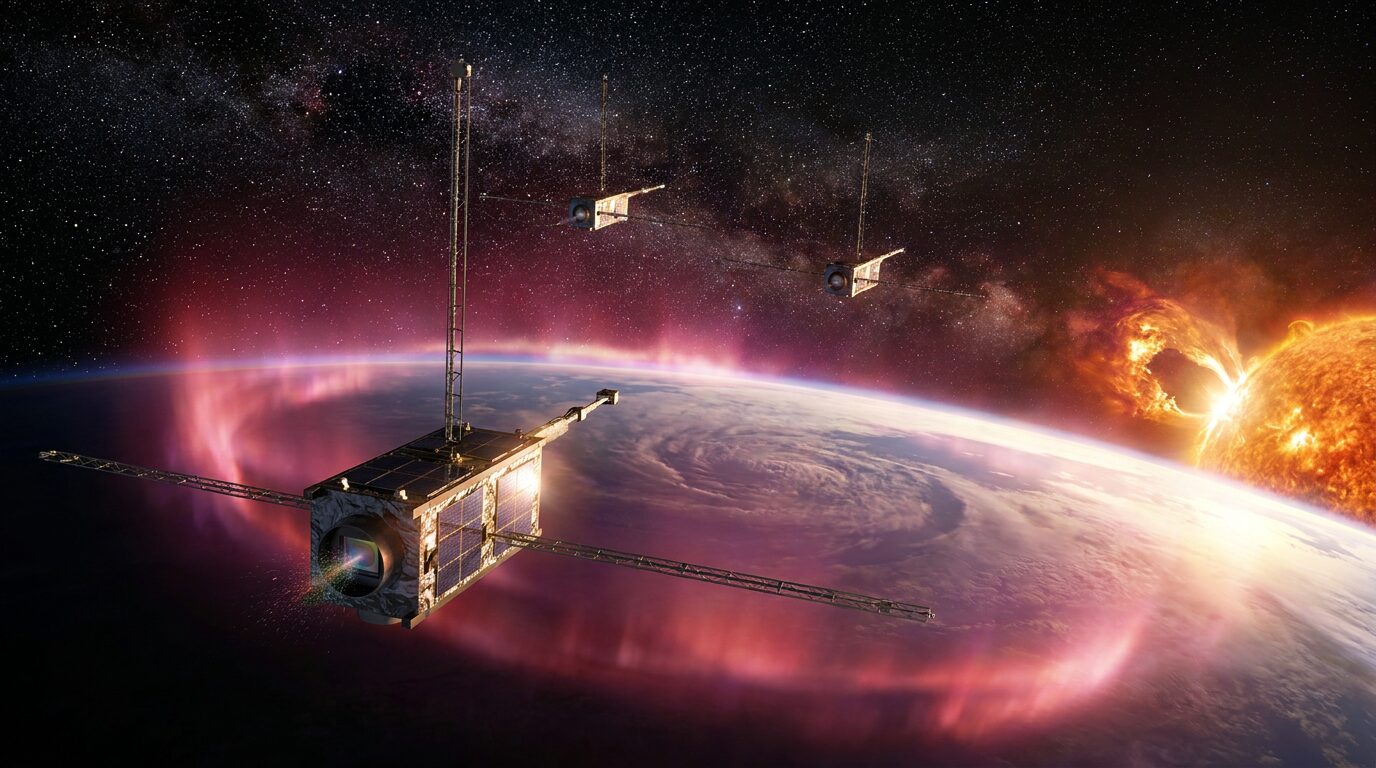
On 12 November 2025, something lit up inside the polar regions that Swarm's designers had not specifically planned for. Three consecutive coronal mass ejections[1] had departed the Sun within a 48-hour window, a cluster dense enough to hit Earth in rapid succession and drive one of the more severe geomagnetic storms of recent memory. Swarm's magnetometers registered magnetic fluctuations ten times stronger than normal — significant by any measure, consistent with what a serious storm can do to Earth's magnetic environment. But the stranger detection came from a different instrument entirely.
According to ESA, it was Swarm's star trackers — the optical cameras the spacecraft uses to orient itself by identifying known star patterns — that flagged a sudden, intense influx of high-energy protons entering the polar regions. The proton flux reached levels 300 times higher than normal. This was a first for the Swarm mission: a positioning instrument pressed into accidental service as a particle detector.
An Instrument Doing Something It Wasn't Designed For
Star trackers work by photographing a patch of sky, identifying recognizable stellar configurations, and using that map to calculate the spacecraft's precise orientation. They are, at their core, sensitive optical detectors — cameras tuned to pick up faint light against black space. That sensitivity is exactly what made them vulnerable to the proton storm, and, as it turns out, useful. When high-energy protons stream into a low-Earth orbit sensor array, they can register as bright artifacts in the image data. Normally that would be noise to filter out. Here, it was signal — accidental, unambiguous, and scientifically interesting. The parallel to star tracker interference in other orbital contexts is hard to miss: these instruments routinely interact with energetic phenomena in ways their original specifications don't anticipate.
“An instrument designed to find stars ended up detecting a solar particle event — because the same sensitivity that resolves faint starlight also responds to energetic protons at 300 times normal flux.”
This matters beyond the novelty of it. Swarm's primary scientific instruments are built to map Earth's magnetic field with precision. They are not particle detectors. The star trackers, by contrast, caught something the magnetometers could not characterize in the same way — a direct, high-resolution snapshot of the proton influx at the poles during the storm's peak. That kind of data is useful precisely because it came from an instrument with a different response profile than the dedicated science payload.
What the Storm Actually Did
Between 11 and 13 November, the three overlapping CMEs produced a geomagnetic disturbance severe enough to generate proton auroras — a diffuse, glowing phenomenon distinct from the rippling curtains of light associated with electron auroras. Proton auroras appear at lower latitudes during intense storms and are rarely visible under ordinary solar conditions. They are also a useful indicator of just how disrupted Earth's magnetic shielding has become, because high-energy protons reaching low-Earth orbit in those quantities requires significant compression and distortion of the magnetosphere.
During severe geomagnetic storms, Earth's magnetic shield — the structure that ordinarily deflects most of the solar wind — becomes disturbed enough to allow a much greater number of energetic particles to penetrate toward low-Earth orbit. In this case, the flux was unusually intense even by storm standards. A short radio blackout was recorded across Europe, Africa, and Asia, lasting approximately 30 to 60 minutes, consistent with the ionospheric disruption that energetic solar particle events typically produce.
Why the Detection Method Is the Story
Space science has a recurring pattern worth paying attention to: instruments detecting phenomena they were not built to measure. The history of accidental detections — signals caught at the edge of a detector's sensitivity, particles logged as noise, interference patterns that turned out to be astrophysical — is longer than most formal mission specifications suggest. What Swarm's star trackers recorded on 12 November belongs in that category. The spacecraft was positioned to measure Earth's magnetic field. It ended up providing a rare, direct measurement of a solar proton event at low-Earth orbit, from a sensor usually tasked with finding Vega and Canopus.
High-energy solar proton events are genuinely rare phenomena. They're not a direct hazard to people on Earth's surface, where the atmosphere and magnetosphere provide adequate shielding under most conditions. But they matter considerably to satellites, astronauts in orbit, and any electronics operating in that environment. A storm that can push proton flux to 300 times baseline and hold it there across two days of cascading CME impacts is the kind of event that calibration engineers and mission operators want documented with as much instrumental variety as possible.
“The storm produced something rare enough that even Swarm's own mission team described this detection as a first — caught by the instruments least expected to see it.”
What Swarm's accidental proton detection adds to the record is a demonstration that orbital spacecraft already carry more scientific capability than their formal instrument manifests acknowledge. The star tracker is classified as an attitude-control tool. On 12 November, it functioned as something closer to a particle monitor. That does not change what it was built for. But it does suggest that when an exceptional event occurs, the instrument doing the watching matters less than the fact that something was watching at all — and that scientists are still learning which of their tools, under the right conditions, will show them something they hadn't planned to see.
References
- Swarm detects rare proton spike during solar storm (esa.int)
Confirms that Swarm's star trackers detected a 300-fold spike in high-energy protons during the November 11-13 geomagnetic storm, a first for the mission.
About Rowan Ellery
Rowan Ellery writes about anomalies, unexplained sightings, strange signals, and the uneasy border between observation, misinterpretation, and genuine mystery. Their work focuses on keeping curiosity alive without letting evidence dissolve into folklore.
More like this
The Pentagon's Infrared Footage Has a Star Tracker Problem No One Is Naming
A sensor distortion accidentally catalogued during the November 2025 solar storm turns out to be exactly the kind of artifact that makes infrared UAP footage look most dramatic — and most unreliable.
ESA Built a Machine That Creates Solar Eclipses on Demand
ESA's Proba-3 mission flies two spacecraft in lockstep formation to block the sun on demand — unlocking a continuous view of the solar corona that has defeated astronomers for a century.
The Galileo Project Watched 80,000 Objects. 144 Broke the Rulebook.
The Galileo Project's first major sky survey didn't produce a smoking gun — it produced a data problem so precise it finally tells us what kind of evidence we actually need.