Russia Has Been Bombing Ukrainian Children for Years. The World Keeps Counting the Bodies.
The attacks keep coming, the death tolls keep varying, and the international response keeps falling just short of the pressure needed to stop any of it.
A two-and-a-half-year-old toddler. A twelve-year-old. Children aged eight, pulled from rubble in the Zhytomyr region, west of Kyiv. These are not abstractions. These are the names that don't make it into most headlines, the casualties that get folded into a number at the bottom of a wire report and forgotten by the next news cycle. Russia has been targeting Ukrainian cities — with drones, with missiles, with the full industrial logic of modern aerial bombardment — and the death toll keeps climbing, the ages of the victims keep getting younger, and the international response keeps arriving about a half-step behind what would actually matter.
UNICEF and the UN Secretary-General documented a toddler among four children killed in Kyiv attacks[1], and the UN chief called the targeting of civilians and civilian infrastructure a violation of international humanitarian law that must "end immediately." The Independent reported three children among at least twelve killed[3] during what Ukrainian Air Force officials described as the largest aerial bombardment since the war began in February 2022 — 367 drones and missiles, striking more than thirty cities and villages in a single overnight campaign. PBS documented a separate overnight barrage[4] killing at least eleven people and setting fire to the Kyiv-Pechersk Lavra, an eleventh-century monastery. Al Jazeera reported another strike on Kyiv that killed a twelve-year-old child[5] and wounded dozens more. These are not versions of the same event. They are separate incidents. That's the point.
The Children's Hospital That Shouldn't Have Been a Target
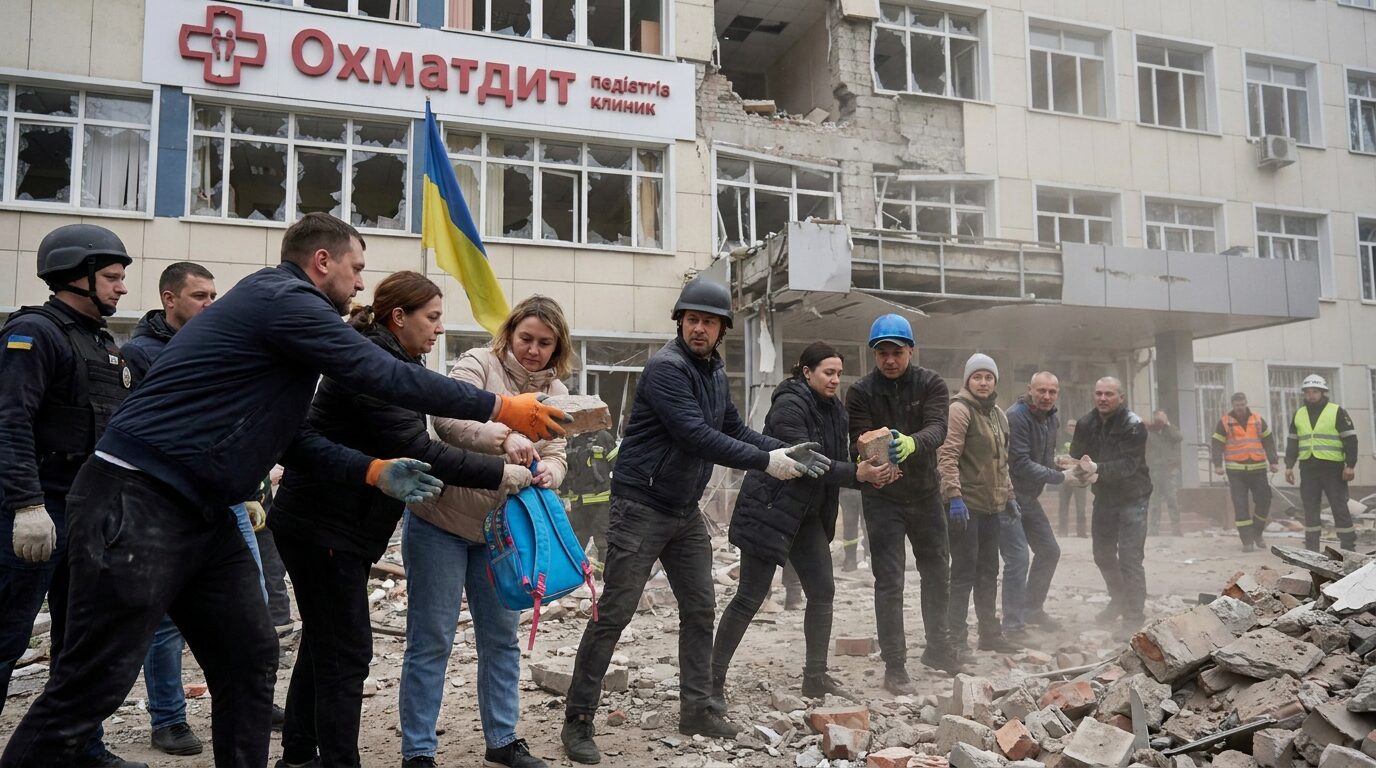
Of all the documented strikes, the attack on Okhmatdyt stands as perhaps the clearest evidence of what Russia is actually doing — and what the word "targeting" means in this context. Okhmatdyt is Ukraine's largest pediatric clinic, treating 20,000 children annually, renowned specifically for its cancer treatment. When a powerful Russian missile hit it, children as young as eighteen months — some mid-dialysis for kidney conditions — had to be hurriedly disconnected from their machines and evacuated through the building's windows. The Guardian reported[2] that a twenty-one-year-old nurse named Maria Soloshenko was in the toxicology ward during the strike and treated another nurse with an open head wound before helping evacuate children through those windows. Outside, civilians formed a human chain to clear rubble by hand. Search efforts were repeatedly interrupted by air-raid alarms — the infamous Russian "double-tap" tactic, designed to kill rescuers.
“'They want to hit us as we save our children. It's barbaric,' said one volunteer, hiding in the shelter during the double-tap alarms.”
The word "barbaric" is doing real analytical work there. A double-tap attack on a children's hospital isn't a targeting error. It isn't collateral damage. It is a deliberate choice to maximize casualties among the most vulnerable, timed specifically to kill the people trying to save them. Under international humanitarian law, this is not a gray area. The UN Secretary-General said so plainly. What is a gray area is what the international community is prepared to do about it.
The Diplomatic Gap Between Condemnation and Pressure
In the aftermath of the 367-drone bombardment — the largest of the war — Ukrainian President Volodymyr Zelensky made a pointed observation that deserves to be quoted and examined. He called on G7 countries for a decisive and substantive response[3], arguing that "without truly strong pressure on the Russian leadership, this brutality cannot be stopped" and that weak international response "only encourages" Putin. That phrase — "only encourages" — is a precise diagnosis of the incentive structure at play. When a military power strikes a children's hospital, fires hundreds of drones at civilian cities, kills toddlers in apartment blocks, and the response is condemnation plus incremental sanctions plus recurring pledges of air-defense support that consistently arrive too slowly and in too small a quantity, the signal being sent is not "stop." The signal being sent is: "continue until someone actually makes you stop."
That same overnight bombing campaign — the one that killed at least eleven people and struck the Kyiv-Pechersk Lavra — came hours before Russia and Ukraine completed a major prisoner exchange, swapping around 1,000 people each way, with 303 more soldiers transferred on the day of the strikes. PBS noted[4] that the attacks also followed phone calls between Zelensky, Putin, and President Donald Trump — calls that Washington framed as evidence of continuing diplomatic engagement. Think about what that sequence communicates institutionally: humanitarian gestures and diplomatic channels operating simultaneously with mass aerial bombardment of civilians. That is not contradiction. That is Russia demonstrating that diplomacy imposes no real cost on its military behavior, and that the two tracks — prisoner swaps, phone calls, and drone barrages — can coexist indefinitely.
What the Counting Actually Tells Us
The death tolls across the documented incidents vary: four children killed in one Kyiv attack, three children among twelve total in another, eleven total in a third, sixteen in a fourth. These discrepancies reflect the difficulty of real-time casualty accounting in active combat zones, not fabrication — and they span separate events over a period of more than a year. What they collectively tell us is not a single "Night of Horror" but something more unsettling: a sustained, systematic campaign in which the killing of Ukrainian civilians, including children, is not a bug or an accident but a recurring operational output. UNICEF noted[1] that even if the war ended today, its impact on children's mental health "will be for generations to come" — sudden mood swings, post-traumatic stress, feelings of hopelessness documented in children in Donetsk, Sumy, and Kharkiv. A kindergarten was reportedly damaged in the same attacks that killed the toddler. Children are returning to school to the sound of air-raid sirens that are, in UNICEF's words, "becoming kind of a norm."
“These are not versions of the same event. They are separate incidents. That's the point.”
There is a tendency in Western political discourse — accelerated by the sheer volume of bad news and the structural incentives of media ecosystems that reward novelty over continuity — to process each atrocity as its own discrete event, to be outraged, to count the dead, to issue a statement, and then to wait for the next one. Institutional collapse doesn't always announce itself loudly — and neither does the slow erosion of the international norm against targeting civilians. What Russia has been doing in Ukraine is not just a war crime committed once and condemned. It is a pattern, sustained over years, that the international community has not yet found the political will to actually stop. The Overton window on what counts as an acceptable level of Russian violence against Ukrainian civilians has been moving steadily in a direction that should alarm anyone paying attention.
In a village near Kyiv called Markhalivka, a seventy-six-year-old woman named Liubov Fedorenko came home to find her street looking "like Bakhmut, like Mariupol." She told reporters she had tried to convince her daughter to visit that weekend. Her daughter said no. "Thank God she didn't come," Fedorenko said, "because the rocket hit on that side." That is what the policy gap costs in human terms. Not just the children who were killed. Also the grandmother who now understands that inviting her family home is a gamble she cannot make. The war does not only kill its victims. It colonizes the daily calculations of everyone who survives it.
References
- Ukraine: Toddler among four children killed in Russia’s attacks on Kyiv (news.un.org)
Documents UNICEF confirmation of a two-and-a-half-year-old toddler among four children killed in Kyiv attacks, and UN Secretary-General's statement that targeting civilians violates international humanitarian law. - ‘No words for this’: horror over Russian bombing of Kyiv children’s hospital (theguardian.com)
Describes Russian missile strike on Okhmatdyt children's hospital, Ukraine's largest pediatric clinic, killing at least four people and forcing evacuation of children from medical equipment. - Children among 12 killed after Russia launches largest aerial bombardment of Ukraine war (independent.co.uk)
Provides details of 367 drones and missiles in largest aerial bombardment since war began, killing three children aged eight, twelve, and seventeen in Zhytomyr region. - Russia unleashes an overnight barrage on Ukraine, killing 11 people and damaging a religious landmark, officials say (pbs.org)
Documents overnight barrage killing at least eleven people, damaging the Kyiv-Pechersk Lavra monastery, and notes timing after Zelensky and Putin's separate calls with Trump. - Russian attacks on Ukraine kill 16 people, including a child (aljazeera.com)
Reports Russian strikes killing at least sixteen people in Ukraine, including a twelve-year-old child in Kyiv.
About Paul Wardell
Paul Wardell writes about politics, institutions, voters, media, class, power, polarization, and the incentives that make public life feel dumber than it needs to be. Left-leaning but stubbornly practical, his work focuses on how systems actually behave, not how partisans wish they behaved.
More like this
Every Lebanon Ceasefire Gets the Same Treatment: Israel Bombs Through It
Israel struck Lebanon again today, killing dozens more — and Iran answered by closing the Strait of Hormuz, threatening to unravel the fragile U.S.-Iran accord before the ink was dry.

America's Political Violence Early Warning System Is Being Dismantled Before the Midterms
Political violence is measurably rising, the early-warning infrastructure built to catch it is being stripped for parts — and the same administration doing the stripping is generating the flashpoints.

Institutional Collapse Doesn't Look Like a Coup. It Looks Like Everyone Deciding Not to Fight.
Political scientists have a name for the pattern where courts, corporations, universities, and legislators each decide individually that resistance isn't worth it — and the math of those private surrenders adds up to the end of accountability itself.