Executive Aggrandizement
Executive aggrandizement is when a leader expands power beyond democratic checks, undermining the legislature, judiciary, or public service independence—even if they were elected. It marks a slow, durable erosion of democracy rather than a sudden coup.
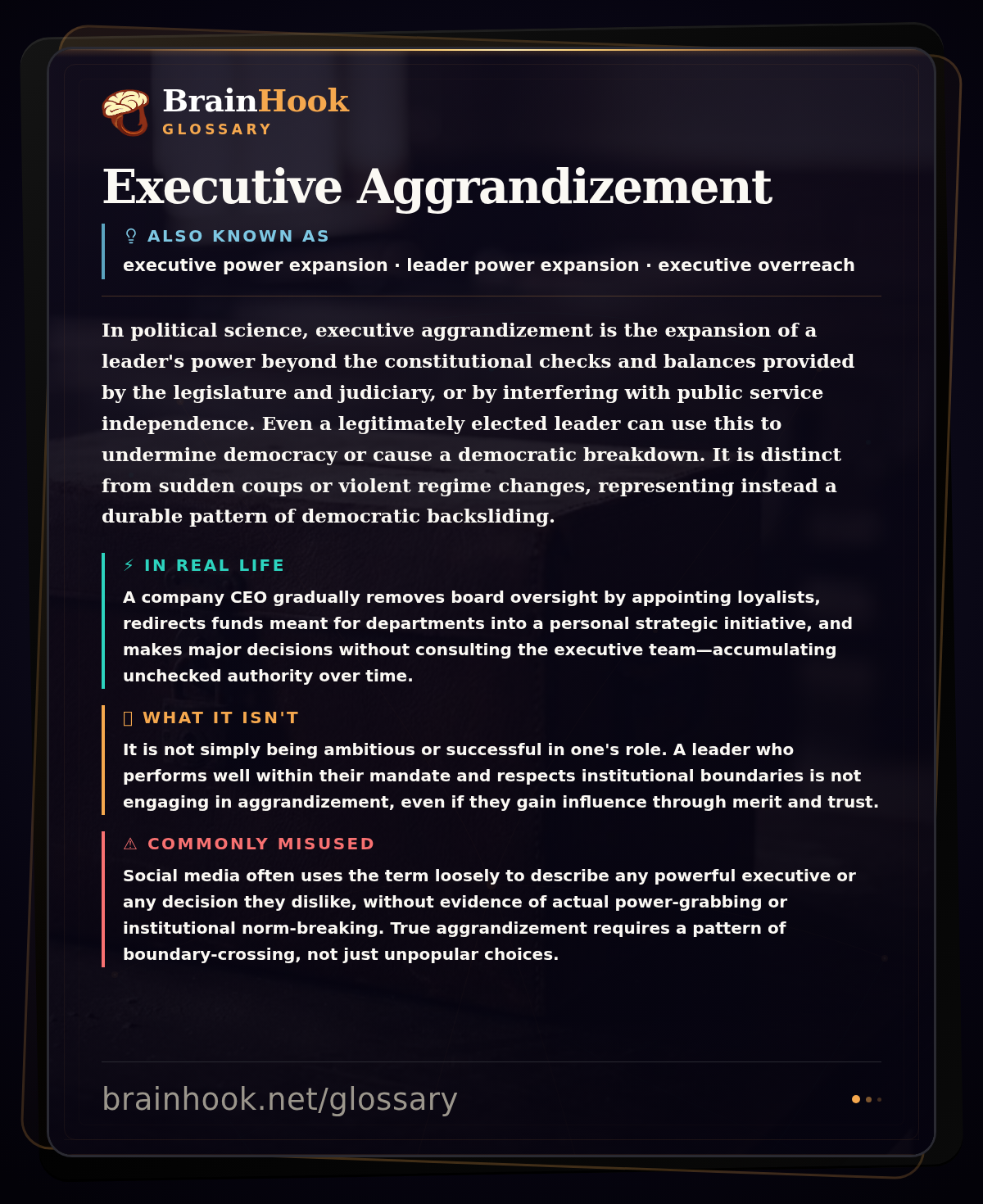
In political science, executive aggrandizement is the expansion of a leader's power beyond the constitutional checks and balances provided by the legislature and judiciary, or by interfering with public service independence. Even a legitimately elected leader can use this to undermine democracy or cause a democratic breakdown. It is distinct from sudden coups or violent regime changes, representing instead a durable pattern of democratic backsliding.
What this means in real life
A company CEO gradually removes board oversight by appointing loyalists, redirects funds meant for departments into a personal strategic initiative, and makes major decisions without consulting the executive team—accumulating unchecked authority over time.
What it isn’t
It is not simply being ambitious or successful in one's role. A leader who performs well within their mandate and respects institutional boundaries is not engaging in aggrandizement, even if they gain influence through merit and trust.
Commonly misused online
Social media often uses the term loosely to describe any powerful executive or any decision they dislike, without evidence of actual power-grabbing or institutional norm-breaking. True aggrandizement requires a pattern of boundary-crossing, not just unpopular choices.