Judicial Behavior
Judicial behavior describes how judges act and rule, often standing up to powerful figures to enforce legal principles over political preferences. It reflects the court's role as a check on executive power.
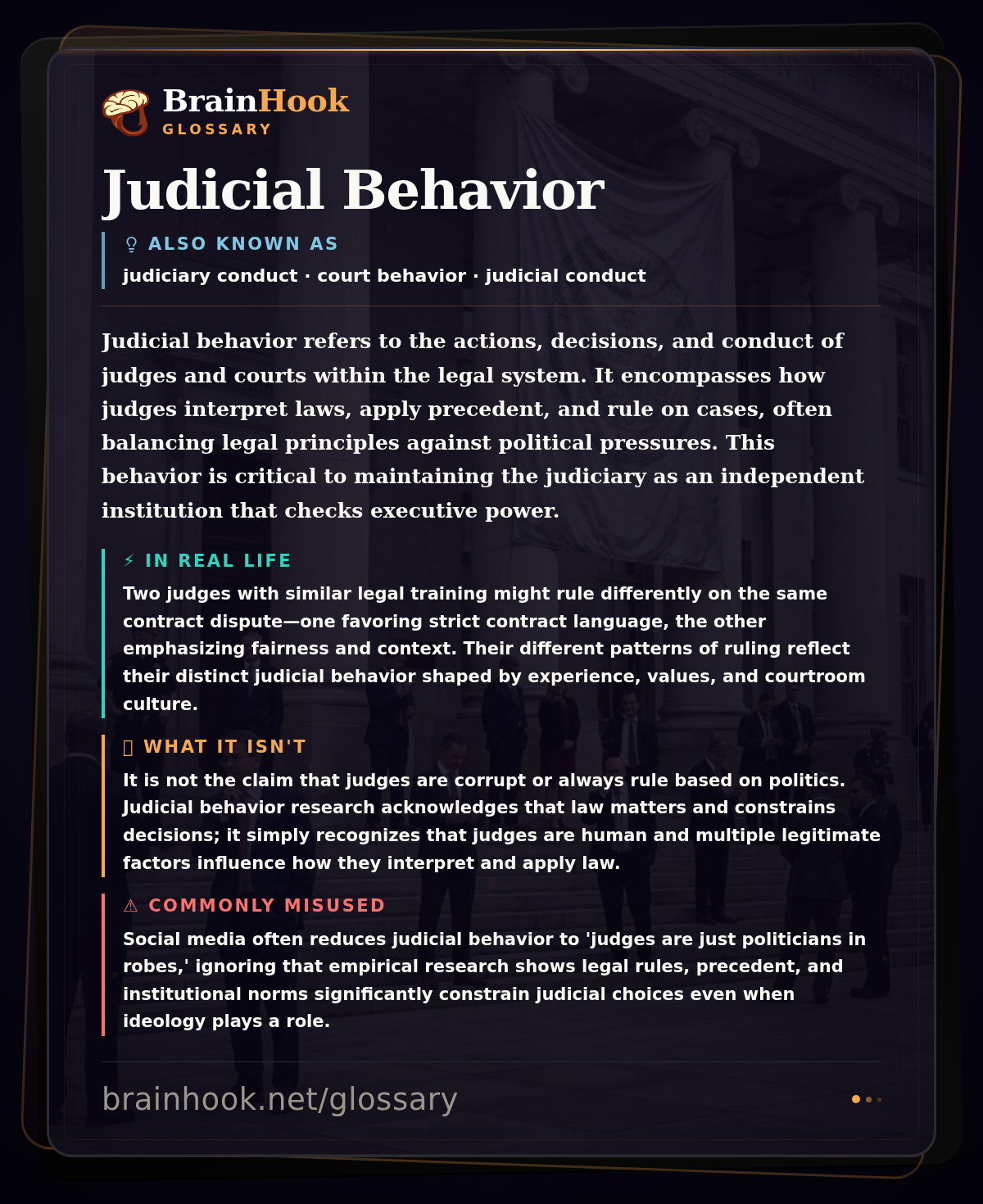
Judicial behavior refers to the actions, decisions, and conduct of judges and courts within the legal system. It encompasses how judges interpret laws, apply precedent, and rule on cases, often balancing legal principles against political pressures. This behavior is critical to maintaining the judiciary as an independent institution that checks executive power.
What this means in real life
Two judges with similar legal training might rule differently on the same contract dispute—one favoring strict contract language, the other emphasizing fairness and context. Their different patterns of ruling reflect their distinct judicial behavior shaped by experience, values, and courtroom culture.
What it isn’t
It is not the claim that judges are corrupt or always rule based on politics. Judicial behavior research acknowledges that law matters and constrains decisions; it simply recognizes that judges are human and multiple legitimate factors influence how they interpret and apply law.
Commonly misused online
Social media often reduces judicial behavior to 'judges are just politicians in robes,' ignoring that empirical research shows legal rules, precedent, and institutional norms significantly constrain judicial choices even when ideology plays a role.