What Separates People Who Follow News From People Who Actually Act on It
A new Pew survey sorted Americans into four civic types — and the gap between watching public life and actually living it is wider than you might expect.
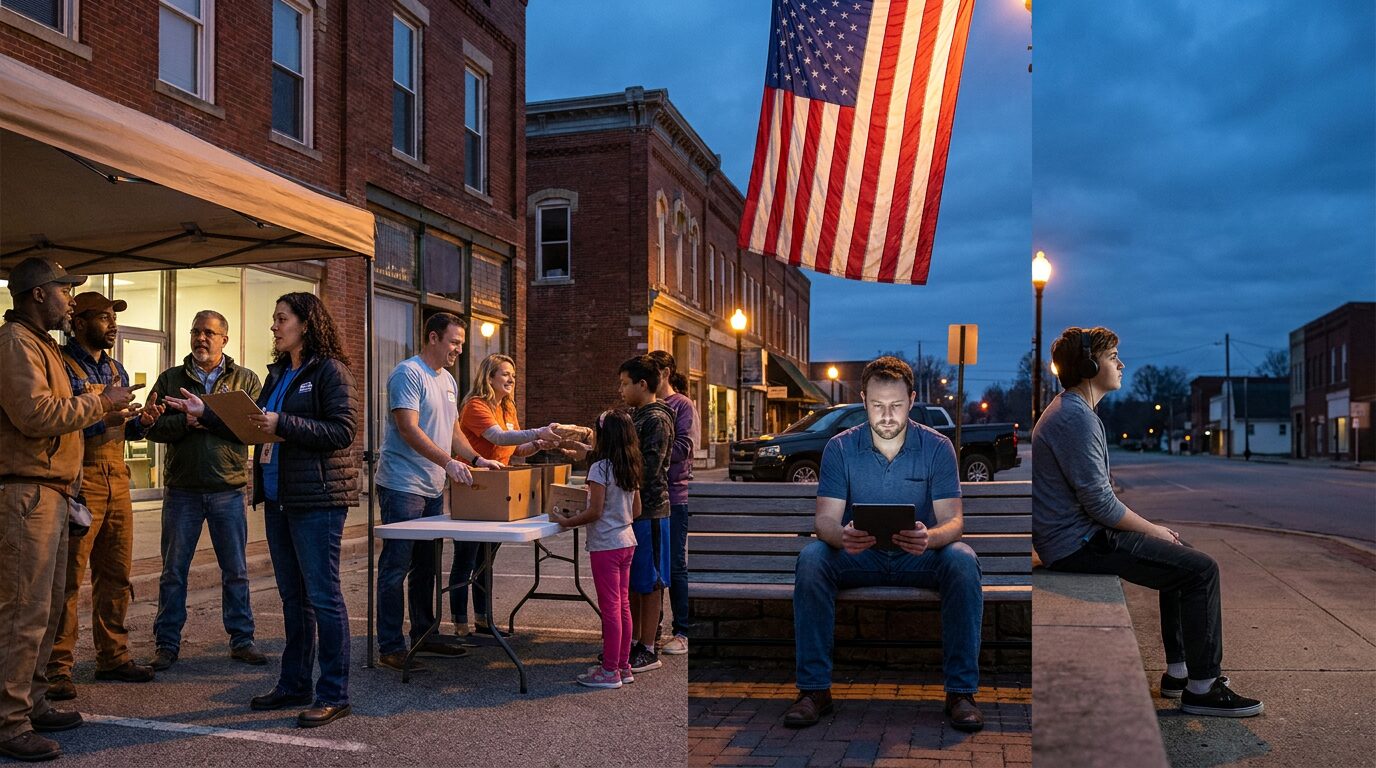
Most people who follow the news feel, in some dim way, that following the news is a form of participation. You keep up. You stay informed. You know who said what and which hearing went sideways. There is a quiet satisfaction in civic literacy, a sense that awareness itself is a kind of citizenship. What the data keep suggesting, though, is that staying informed and actually engaging are two functionally different things — and that many Americans have quietly settled into the former while telling themselves it amounts to the latter.
A new report from the Pew-Knight Initiative[2], drawing on a nationally representative survey of U.S. adults conducted between July and December 2025, tried to map exactly this terrain. Rather than asking simply whether people vote or attend church, the researchers ran a cluster analysis across 19 questions touching political activity, civic involvement, religious attendance, and news consumption. What emerged were four distinct groups — Mobilizers, Connectors, Spectators, and Outsiders — each representing a meaningfully different relationship with public life. The typology is not a moral ranking. It is something more useful: a structural description of how differently Americans actually inhabit the shared spaces of democratic life.
What you can do
- Identify your own pattern honestly — ask whether you consume news primarily or whether you also act on it in some form, however modest.
- If you recognize yourself in the Spectator profile, consider one concrete step beyond information: a local meeting, a donation, a volunteer hour — specificity matters more than scale.
- Resist the assumption that partisan identity explains civic engagement — the data show the gap between active and passive citizens cuts across party lines.
- Notice which communities around you facilitate Connector-style involvement (civic groups, religious organizations, neighborhood associations) and whether you use them.
The Four Patterns, and What They Actually Mean
Mobilizers are the most engaged cohort by virtually every measure the survey touched: political activity, community participation, news attention, civic involvement. They are not simply politically interested; they are structurally embedded in public life in ways that make action habitual rather than effortful. Connectors share some of that texture — they participate in community groups, make donations, join organizations — but they are considerably less likely than Mobilizers to be deeply immersed in political activity specifically. Their engagement is real but more socially oriented than politically oriented.
Spectators are the group that will feel most recognizable to anyone who has described themselves as "pretty informed" about current events. They follow news at high rates. By the standard consumer-of-information metric, they are paying attention. But they are substantially less likely than Mobilizers or Connectors to participate directly — in campaigns, in volunteer work, in civic institutions, in the kinds of activities that translate attention into effect. Watching is not nothing. But it is also not the same thing as doing, and the survey draws that line with some precision.
“Watching is not nothing. But it is also not the same thing as doing — and the survey draws that line with some precision.”
Outsiders sit at the far end of the engagement spectrum: less likely than the other groups to vote, to volunteer, to follow news, to participate in most of what the survey measured. This is not a profile of apathy in the cartoon sense — disengagement is itself a pattern with structure, and often with reasons. The report does not psychologize those reasons in detail, but the finding that Independents who do not lean toward either party are especially likely to fall into the Outsider group is worth sitting with. It suggests that the architecture of partisan identity may do more to pull people into civic life than is often acknowledged — not necessarily because of ideological conviction, but because belonging to a political tribe creates social infrastructure around engagement.
The Party Line That Isn't
The most counterintuitive finding in the report, given how thoroughly American political discourse has been reorganized around partisan identity, is how modest the differences between Republicans and Democrats actually are when it comes to which engagement group they fall into. The distributions shift slightly — Connectors make up a marginally larger share of the Republican Party than the Democratic Party, while the Spectator pattern skews slightly more Democratic — but these are nuances, not chasms. The real action is not between the two major parties. It is between people who identify with either party at all and those who do not: Independents without a partisan lean are disproportionately Outsiders[1], suggesting that the engagement gap in American civic life may be less a story of left versus right than of affiliated versus unaffiliated.
This matters from a psychological standpoint because it reframes the problem. If civic disengagement were primarily ideological — if Outsiders stayed out because they found both parties repellent on the merits — that would imply a different set of solutions than if disengagement is more fundamentally about social disconnection, institutional distrust, or the absence of networks that make participation feel accessible and worth attempting. The data here do not adjudicate between those explanations with full confidence, but they do point away from the comfortable assumption that engagement tracks straightforwardly with political enthusiasm.
Interest Follows Involvement, Not the Other Way Around
One of the more behaviorally interesting findings in the report is deceptively simple: Americans who are more politically and civically engaged say they are more interested in politics. This sounds obvious until you consider the directionality. The standard assumption is that interest drives engagement — that people who care more do more. But the relationship is likely bidirectional, and the engagement-first path may be the underappreciated one. Doing produces caring. Participation generates investment. People who join things, show up to things, and act on things tend to find themselves more interested in the outcomes of those things, not because they were more motivated to begin with, but because involvement itself creates stakes.
This is a recognizable pattern in behavioral psychology more broadly: motivation frequently follows behavior rather than preceding it. The person who starts exercising because they were told to often develops genuine interest in fitness; the volunteer who showed up reluctantly sometimes becomes the most committed person in the room. Civic engagement may operate on a similar logic. Waiting to feel interested enough to participate may be exactly the wrong sequence — which would help explain why the Spectator posture, however sincere, tends not to convert into the kind of engagement it seems to approximate.
It is also worth noting what the report found uniform across groups: trust in government was similarly low regardless of engagement level. Mobilizers, despite their depth of involvement, were no more likely than Outsiders to express confidence in governmental institutions. Disengagement, in other words, is not simply a response to distrust — because trust does not reliably distinguish those who act from those who do not. Something else is doing more of the explanatory work, and the typology the report constructs is a cleaner lens for seeing what that something might be: not conviction, not cynicism, but the presence or absence of structural connection to the communities and institutions where civic life actually happens. On that note, it's worth reading alongside BrainHook's look at where America's supposed religious revival actually shows up in the data — another domain where public narrative and survey evidence are telling different stories.
The four-group typology will not resolve the long arguments about what ails American democracy. But it does something more precise than most civic-health discourse manages: it separates the people who are in the game from the people watching it from the people who have walked away from the stadium entirely, and it resists the urge to flatten all three into a single population called "the disengaged." Those are different situations, with different causes and probably different levers. Knowing which one you are in seems, at minimum, like a reasonable place to begin.
References
- Democrats and Republicans engage in public life in similar ways (pewresearch.org)
Provides data showing Independents without partisan lean are disproportionately likely to be Outsiders in civic engagement. - How Americans Engage With News, Politics, Religion and Civic Life (pewresearch.org)
Provides the nationally representative survey data and cluster analysis identifying four civic engagement groups: Mobilizers, Connectors, Spectators, and Outsiders.
About Jennifer Marsden
Jennifer Marsden writes about personality structure, emotional dysregulation, attachment wounds, trauma patterns, and the science beneath behaviors people are too quick to moralize. Her work focuses especially on borderline and narcissistic traits, not as internet villains, but as complex human adaptations with real consequences.
More like this
The Quiet Way Rigged Maps Convince People Democracy Is Pointless
A new study finds that rigged district maps don't just distort who wins — they drain the public's belief that showing up matters at all.

Overthinking Isn't Problem-Solving. Your Brain Knows the Difference.
New research on rumination's timing reveals that the cognitive loop you call 'working through it' is structurally different from actual problem-solving — and your brain's confusion about which one is happening is exactly what keeps the spiral alive.
Knowing the Algorithm Is Watching You Doesn't Make You Free
Research confirms that the most algorithmically literate users are also the most ensnared — which means the platforms were never counting on your ignorance.