The Redistricting War Has a Winner. It's Not Voters.
A 2026 Supreme Court ruling reshaped the rules of political mapmaking, and the damage it's about to do runs deeper than any single congressional district.
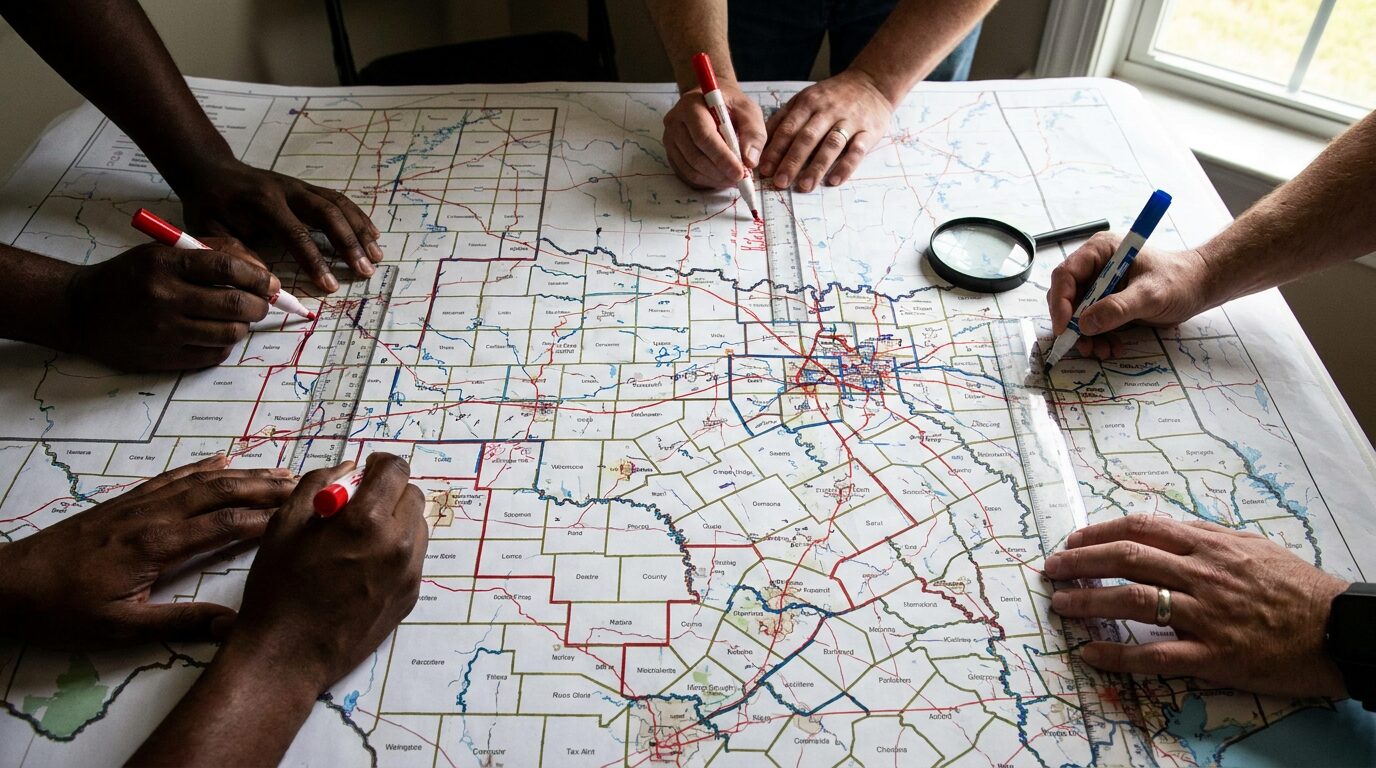
Here is a useful way to think about gerrymandering: it is not a bug in the electoral system. It is a feature that the people running the system installed deliberately, maintain aggressively, and benefit from enormously. Every few years we act surprised when the maps come out twisted. We write outraged op-eds. Good-government groups send fundraising emails. Courts issue rulings that other courts reverse. Then the maps stay twisted, and the incumbents stay safe, and everyone moves on until the next cycle's version of the same argument.
The Supreme Court's 2026 decision in Callais v. Robinson — which the Brennan Center for Justice has warned could trigger the largest contraction in Black political representation since Reconstruction[3] — is not a break from that pattern. It is the pattern, clarified and made more powerful. What the ruling does, in practical terms, is give legislatures substantially more latitude to draw race-conscious district lines under cover of partisan justification. The constitutional fig leaf is that you are sorting by party, not race. The real-world result is that you can pack or crack Black communities as long as your mapmakers write the right memos.
Understand what that means for the next round of maps. State legislatures that already had powerful incentives to protect their majorities now have expanded legal room to do it in ways that are extraordinarily hard to challenge in court. The arms race that follows is not hypothetical. It is already in motion. And the damage is not just counted in seats.
What the Courts Actually Built
To understand how we got here, you have to understand how Supreme Court doctrine on redistricting has eroded in stages — each one leaving a smaller surface for challengers to stand on. Rucho v. Common Cause (2019) was the earthquake. The Court ruled that federal courts have no authority to police partisan gerrymandering[1]. Full stop. States can draw maps that are nakedly designed to entrench one party's power, and there is no federal judicial remedy. What's left? Racial gerrymandering claims under the Voting Rights Act, and state courts applying state constitutions. The Callais ruling now tightens the first of those remaining escape valves, by making it harder for plaintiffs to disentangle racial sorting from partisan sorting when the two are correlated — as they almost always are in the American South, where Black voters vote Democratic at high rates. Proving race was the predominant factor becomes a nearly impossible evidentiary burden when the state can point to its partisan model and shrug.
This is how institutional erosion works. The building still has flags outside. The words "equal protection" are still in the Constitution. But the enforcement mechanisms have been hollowed out one ruling at a time, until the gap between the written rule and the practiced reality is wide enough to drive a redistricting commission through — if anyone bothered to create one, which most states have not.
“You can pack or crack Black communities as long as your mapmakers write the right memos.”
The Arms Race Nobody Voted For
Both parties gerrymander when they have the power to do so. That is not false balance — it is just true, and pretending otherwise makes you less useful to yourself as a citizen. Maryland Democrats have drawn some grotesque maps. Illinois Democrats have protected their majority with lines that look like they were drawn by someone having a seizure. This matters because the "Republicans gerrymander, Democrats don't" framing is exactly the kind of partisan comfort food that makes the underlying incentive structure invisible. The incentive is: if you control the state legislature when census data arrives, you can dramatically reduce your electoral risk for the next decade. That is a powerful incentive. Powerful incentives produce predictable behavior.
What Callais does is tilt the playing field further in one direction. The states where the ruling matters most — Alabama, Georgia, Louisiana, South Carolina, Texas — are states where Republicans control the legislature and where Black voters are geographically concentrated enough to be carved up with surgical precision. The ruling does not create a new tool. It dulls the main tool plaintiffs had left. In that sense it is asymmetric. One side's maps become easier to defend in court. The other side's communities become easier to dilute. Calling that symmetrical because both sides play the game misses the part where one side just changed the rules mid-game.
The Brennan Center's warning about Reconstruction-era comparisons is not rhetorical excess. Post-Reconstruction rollback of Black political power did not happen through overt disenfranchisement alone. It happened through structural manipulation: poll taxes, literacy tests, white primaries, and — crucially — district lines designed to ensure that even eligible Black voters could not translate their numbers into representation. The mechanism changes across history. The function is disturbingly consistent.
The Trust Problem That Outlasts Any Single Map
Here is the part of this story that gets undercovered. Gerrymandering's harm is not limited to the communities whose representation gets diluted, as serious as that harm is. There is a corrosive second-order effect: it destroys the sense that voting is a meaningful act, and it does so broadly, across party lines.
A UC Riverside study on gerrymandering and civic trust found that voters across partisan affiliation rate gerrymandering[2] with roughly the same moral contempt as outright bribery. Not as a lesser offense. Not as a technicality. As corruption. That finding deserves to sit with you for a moment, because it means the public understands, at an intuitive level, that this is a system being rigged against them. They just lack the institutional mechanism to do anything about it.
Civic trust is not an abstraction. It is the operating condition that makes voluntary compliance with laws, participation in elections, and acceptance of electoral outcomes possible. When people believe the count doesn't matter because the map was already fixed, they stop counting themselves in. Turnout among voters in non-competitive safe districts is measurably lower than in competitive ones. The relationship runs in both directions: safe districts produce low turnout, and low turnout makes safe districts safer. This is a feedback loop, and it is one that research on political behavior and institutional legitimacy suggests is very difficult to reverse once it's established. Understanding why polarization deepens when people feel unheard by the system helps explain why gerrymandering's cultural damage outlasts any single mapmaking cycle.
“Voters rate gerrymandering with roughly the same moral contempt as outright bribery. They just lack the mechanism to do anything about it.”
The Reform Options That Actually Exist
Independent redistricting commissions work. This is not a contested empirical point. States that use them — California, Arizona, Michigan, Colorado — produce maps that are more competitive and more representative[4] than states where legislatures draw their own lines. The opposition to them is not philosophical. It is straightforwardly about incumbents not wanting to give up the most powerful lever of self-preservation available to them. When politicians tell you independent commissions are impractical, or that the definition of "independent" is too murky, or that there's no way to take politics out of politics, what they are actually telling you is that they prefer the system where they pick their voters. Listen to what the incentive is producing.
Ranked-choice voting in multi-member districts — a structural reform with a serious body of supporting political science — is a second path. It makes gerrymandering substantially harder because it is much more difficult to surgically crack or pack communities when multiple representatives emerge from the same geographic pool based on ranked preference. Maine and Alaska have moved toward ranked-choice systems for statewide races. The resistance at the state legislative level follows the same logic: the current system benefits the people who have the power to change it.
Federal legislation could mandate standards. The John R. Lewis Voting Rights Advancement Act, which has cleared the House in various sessions and stalled in the Senate, would restore and update preclearance requirements that the Supreme Court gutted in Shelby County v. Holder (2013). Without Senate filibuster reform, it does not move. The filibuster question then becomes a redistricting question. These things are connected. They are connected deliberately.
What's Actually at Stake After Callais
The seats that stand to be redrawn in the Callais aftermath are not symbolic. They are the seats from which oversight hearings are run, from which cabinet appointments are confirmed, from which federal budgets are negotiated, from which the legislative agenda that governs 330 million people is set. The dilution of Black political representation is not a side effect of neutral mapmaking. It is the intended outcome of a legal strategy developed over decades, tested in courts, and now substantially validated by a Supreme Court majority. Call it what it is.
The arms race this ruling accelerates will produce maps in the next redistricting cycle — tied to 2030 census data — that push the limits of what's left of legal restraint. Red states will go further. Blue states that control their own legislatures will probably go further too. The courts will litigate the edges. And somewhere inside all of that procedural machinery, actual communities of actual people will have their political voice calibrated not by how many of them exist or what they believe, but by which party drew the map. That is a stupid, corrupt way to run a democracy. Voters already know it. The problem is that knowing it and being able to stop it are, by design, two entirely different things.
References
- 18-422 Rucho v. Common Cause (06/27/2019) (supremecourt.gov)
Establishes the 2019 Rucho v. Common Cause ruling that federal courts have no authority to police partisan gerrymandering. - Gerrymandering erodes confidence in democracy (news.ucr.edu)
Provides research finding that voters across partisan lines rate gerrymandering with moral contempt comparable to outright bribery. - Congress Must Respond to Callais (brennancenter.org)
Warns that the Callais ruling could trigger the largest contraction in Black political representation since Reconstruction. - The Turnout Effects of Redistricting Institutions (brennancenter.org)
Documents that states using independent redistricting commissions produce maps that are more competitive and representative than legislatively-drawn maps.
About Paul Wardell
Paul Wardell writes about politics, institutions, voters, media, class, power, polarization, and the incentives that make public life feel dumber than it needs to be. Left-leaning but stubbornly practical, his work focuses on how systems actually behave, not how partisans wish they behaved.
More like this
The Quiet Way Rigged Maps Convince People Democracy Is Pointless
A new study finds that rigged district maps don't just distort who wins — they drain the public's belief that showing up matters at all.
Democracies Don't Warn You Before They Stop Being One
Political scientists have spent two decades mapping exactly how democracies die without a coup — and the indicators they built now point at the United States.

Republicans Are Happier Under Authoritarianism. That's Not a Paradox.
A psychological concept called 'person-environment fit' explains why some voters thrive under conditions that look, from the outside, like democratic collapse.