Cognitive Category
A mental grouping or classification that the mind uses to organize and understand different types of things, people, or concepts based on shared characteristics.
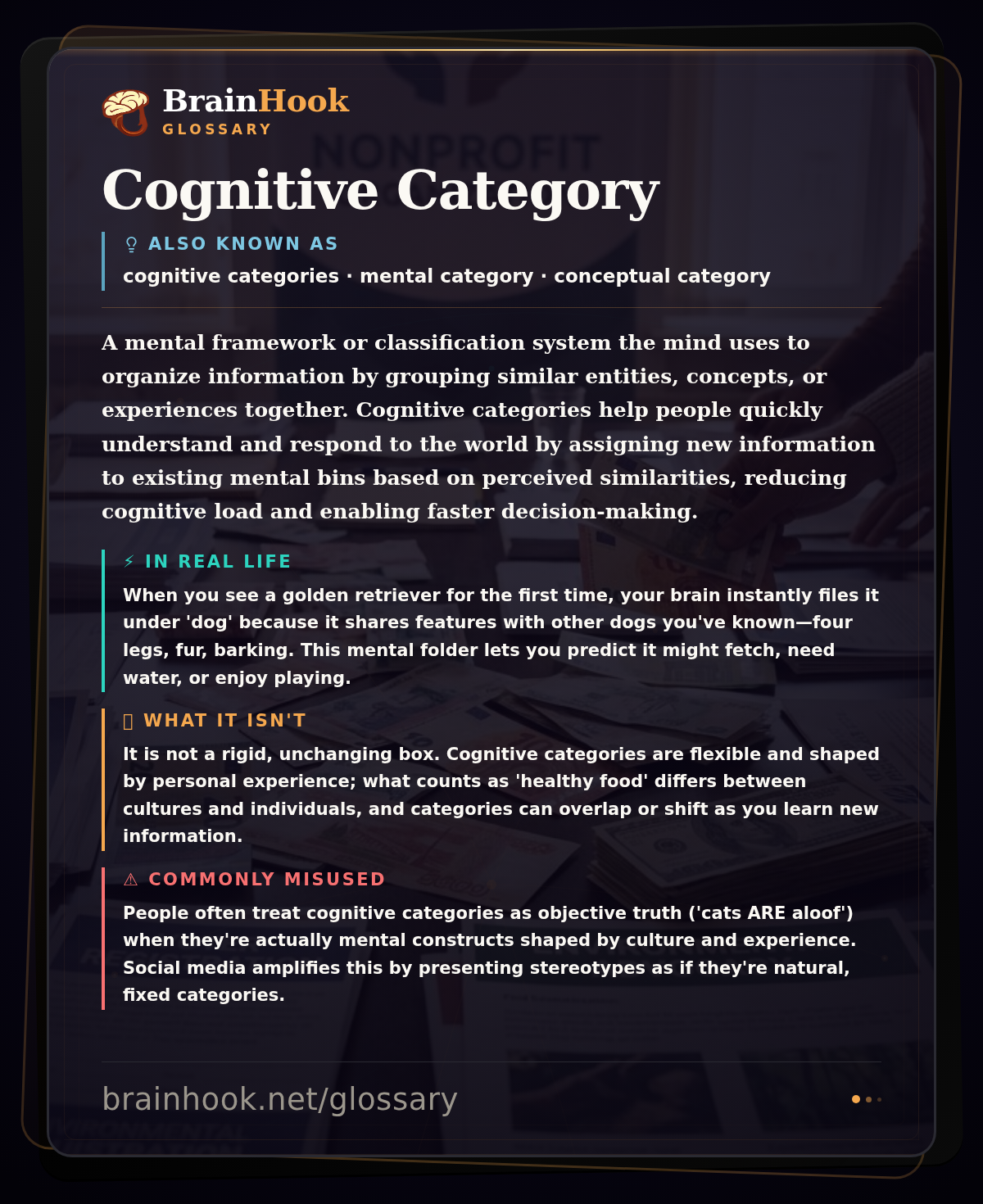
A mental framework or classification system the mind uses to organize information by grouping similar entities, concepts, or experiences together. Cognitive categories help people quickly understand and respond to the world by assigning new information to existing mental bins based on perceived similarities, reducing cognitive load and enabling faster decision-making.
What this means in real life
When you see a golden retriever for the first time, your brain instantly files it under 'dog' because it shares features with other dogs you've known—four legs, fur, barking. This mental folder lets you predict it might fetch, need water, or enjoy playing.
What it isn’t
It is not a rigid, unchanging box. Cognitive categories are flexible and shaped by personal experience; what counts as 'healthy food' differs between cultures and individuals, and categories can overlap or shift as you learn new information.
Commonly misused online
People often treat cognitive categories as objective truth ('cats ARE aloof') when they're actually mental constructs shaped by culture and experience. Social media amplifies this by presenting stereotypes as if they're natural, fixed categories.