E. Jean Carroll Waited Decades. The Supreme Court Just Made It Final.
After three years of appeals, delay tactics, and a DOJ weaponized against his accuser, the Supreme Court just shut the last door Trump had left.
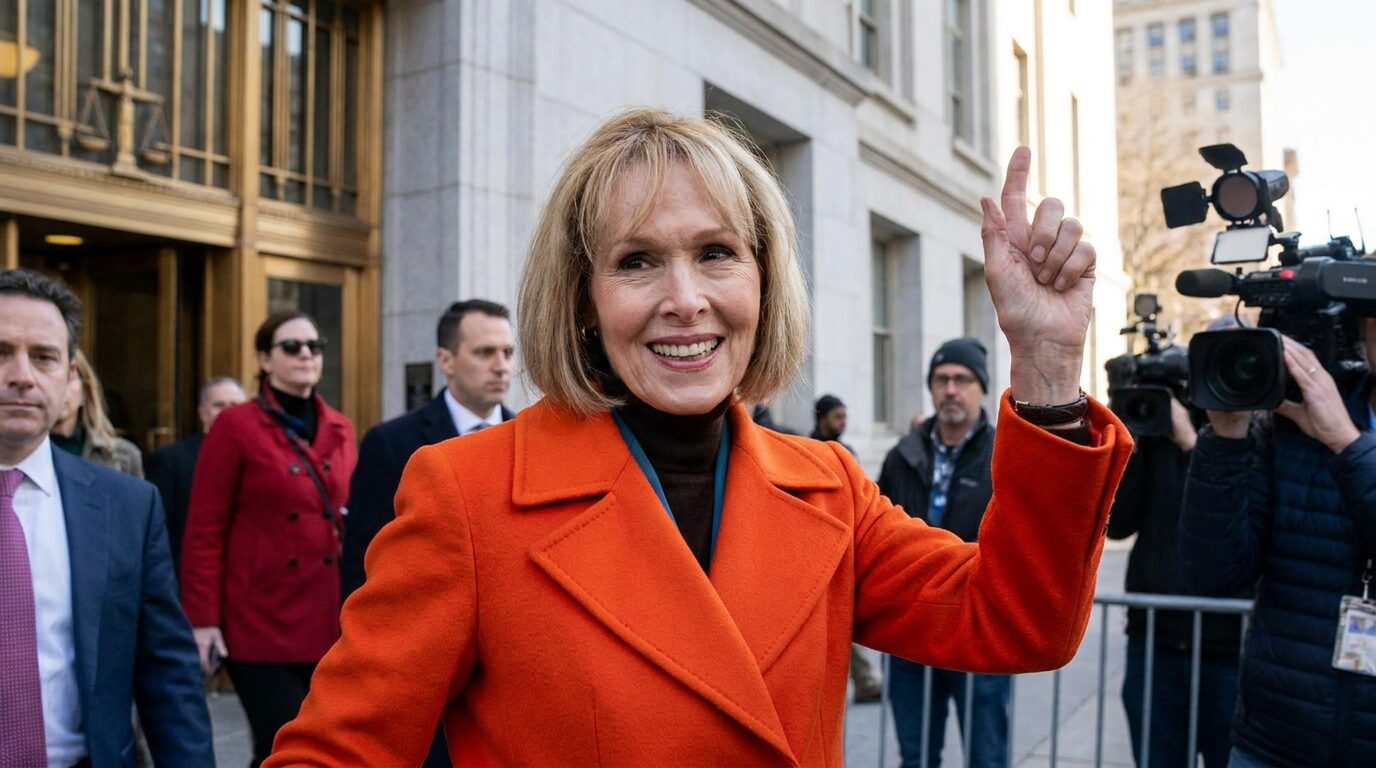
On Monday, the Supreme Court did something that has become rarer and more precious in this political moment: it refused to let a powerful man escape accountability. The Court rejected a push by President Donald Trump to throw out a jury's finding that he sexually abused the writer E. Jean Carroll at a New York City department store in the mid-1990s and later defamed her. No explanation. The high court declined to take up the case in a brief, unexplained order, as is typical[3]. It didn't need to explain. The record speaks for itself — and so does the silence.
The writer E. Jean Carroll triumphed over President Trump when the Supreme Court refused to consider overturning a jury's verdict that he was liable for sexually abusing and defaming her. Carroll celebrated the victory in a brief note on her Substack blog, writing in all capital letters, "WE WON!" "THIS WIN IS FOR EVERY WOMAN IN THE WORLD!" And she is right. Not in a sentimental way. In a structural, institutional, power-map way. This is what accountability looks like when it actually functions — not as a promise, not as a slogan, but as a legal outcome that survives every lever of influence a sitting president can pull.
Let's be precise, because precision is what Trump's machine has spent years trying to muddy. The unanimous federal jury found that a preponderance of evidence supported Carroll's claim that Trump sexually abused her during a mid-1990s encounter in a New York City department store. The jury did not return a finding of rape under New York's older, narrow statutory definition — but the trial judge, Lewis Kaplan, later wrote that the conclusion that Trump was liable for sexually abusing Carroll by forcefully inserting his fingers was an "implicit determination that Mr. Trump digitally raped her." A federal judge said that. In writing. About the sitting president of the United States.
Seven Years of Smears, Three Years of Appeals, Zero Successful Escapes
Carroll, a former Elle magazine advice columnist, testified at a 2023 trial that Trump turned a friendly run-in at the Bergdorf Goodman department store in 1996 into a violent rape after they playfully entered the store's dressing room. She went public with her story three decades later in 2019, during Trump's first term as U.S. president, in her book "What Do We Need Men For? A Modest Proposal," with an excerpt published in New York Magazine. Trump's response was immediate and vicious. He repeatedly denied Carroll's allegations, calling them "a hoax," "a lie," and insisting she was "not my type." In depositions, he referred to her as a "nut job" and "whack job," and on social media, he labeled her claims "a complete con job." That denigration, carried out while he occupied the Oval Office, became the basis for a separate defamation verdict — another $83.3 million — that is still working its way through the courts.
Trump did not attend the 2023 civil trial, and his attorneys called no witnesses before the jury awarded Carroll $5 million. The jury of six men and three women deliberated for less than three hours. Less than three hours. Then came the appeals. On December 30, three Second Circuit judges upheld the $5 million verdict[4], saying that Trump had failed to show that the district court had erred. On January 14, 2025, Trump asked the appeals court for an en banc hearing, which would be held before a full court rather than just a select panel; the request was rejected on June 13. Then came the Supreme Court petition — and then the stalling. Since then, the politically sensitive appeal had been set on the court's agenda and rescheduled 15 times. Fifteen times. Whatever the reason for the delays, the delay had benefited Trump — in part because it deferred a $5 million verdict a jury in New York awarded to Carroll more than three years ago.
“A federal judge said the verdict was an implicit determination that Trump digitally raped Carroll. That is in the record. That does not go away.”
The Machinery of Retaliation
What makes this case a political science story — not just a legal one — is everything that happened around the edges of the litigation. When a private citizen wins a civil judgment against a sitting president, what does the executive branch do? In Trump's America, it investigates her. Trump's Justice Department launched a criminal investigation targeting Carroll, as it has against several other adversaries of the Republican president[2]. The message is clear: beat us in court, and we will make you a suspect. That is not zealous legal defense. That is the state weaponized as a harassment instrument. Initial reports in May said the Justice Department was examining whether Carroll committed perjury in testimony related to the civil lawsuits she won against Trump. However, the U.S. Attorney's Office later said Carroll was not the target of a criminal investigation, and subsequent reporting indicated the inquiry was focused primarily on litigation-funding arrangements. The investigation was a shot across the bow. The shot missed. But the intent is the point.
Meanwhile, the DOJ, saying Trump had acted in his official capacity as president when he made the statements about Carroll, asked the appeals court to use the Westfall Act to substitute the U.S. as the defendant — which would immediately moot the case as the federal government cannot be sued for defamation. Read that again slowly. The Department of Justice tried to have the United States government substituted as the defendant in a sexual abuse and defamation case — so that the case would disappear entirely. The court rejected the request and later noted that "both Trump and the government waived any right to now move for substitution by failing to request substitution after the case returned to the District Court following earlier appellate proceedings." Every trick. Every angle. Every delay. All of it failed. For readers who want the broader context of how immunity arguments have been weaponized to shield Trump from accountability, we covered the structural logic of those claims when the Court handed down its presidential immunity ruling two years ago.
What Trump Said. What the Record Shows.
Trump wrote on Truth Social that he was "surprised" the Supreme Court declined to review a "Fake Case" brought by "a woman I never met." The problem with that, as courts have repeatedly established, is that there is a photograph of them together from 1987. Trump referred to Carroll as a "woman I never met (Decades old celebrity photo line, standing with her husband, does not count!)," referring to a picture that emerged of him and Carroll after he first said he'd never met her. Trump's insistence he'd never met her was a part of Carroll's defamation case, and a jury sided with her. His own legal argument — that he was defamed by her accusation — collapsed under his own demonstrable lie. He said he never met her. There's a photo. Juries notice things like that.
His lawyers argued, with apparent seriousness, that Carroll's account of what happened in that Bergdorf Goodman dressing room was implausible because it matched the plot of a Law & Order episode. "Notably, Carroll's allegations are a story that precisely matches the plotline from an episode of one of admittedly her favorite TV shows, 'Law & Order,'" the petition says. That was their argument. To the Supreme Court. About the sitting president's sexual conduct. The Court, apparently, was unimpressed. We wrote previously about the DNA evidence Trump fought to suppress in this very case — and about what the pattern of his psychology tells us about men who call every accuser a liar.
The Fight Is Not Over — But One Door Is Permanently Closed
Trump's attorneys are expected to appeal the $83 million verdict to the Supreme Court in coming days. So this is not the end of the legal war. But it is the end of this fight — and the Supreme Court was Trump's last hope of overturning the case. Trump transferred $5.5 million to a court-controlled account in 2023 following the jury verdict, so Carroll is likely to receive the cash relatively quickly. As for the $83 million defamation verdict, in March 2026, the Second Circuit paused payment of that award pending the outcome of the appeal, provided that Trump posted a $100 million bond[1]. That fight continues. "As observed by the district court, the conduct here supports a significant punitive damages award — it involved malice and deceit, caused severe emotional injury, and continued over at least a five-year period," a three-judge panel said. "The record in this case supports the district court's determination that the 'degree of reprehensibility' of Mr. Trump's conduct was remarkably high, perhaps unprecedented.'"
“Every trick. Every delay. Every Westfall Act gambit. Every Law & Order theory. All of it failed.”
"Today's Supreme Court decision affirms once and for all the jury's unanimous verdict that President Donald J. Trump sexually assaulted and defamed E. Jean Carroll," Carroll's lawyer, Roberta Kaplan, said. "His multiple efforts to appeal that verdict have all failed and today's ruling ends his quest to avoid accountability for his actions." That language — "ends his quest to avoid accountability" — is the institutional summary of what just happened. A man with all the power of the American executive branch behind him, with loyalists at the DOJ, with a Supreme Court he helped shape, with a media apparatus that calls every critic a witch-hunt partisan — and a nine-woman, six-man jury still found him liable in under three hours, and every court above them agreed. The system worked, this time, in this case, against this man. That is not nothing. That is, in fact, the whole fight.
References
- E. Jean Carroll Hails Supreme Court Victory Over Trump: 'Win is for Every Woman' (newsweek.com)
Provides Trump's Truth Social response calling the case 'Fake' and the Supreme Court decision an 'Injustice,' and confirms Carroll's Substack celebration of the ruling. - Exclusive: Justice Department launches a criminal investigation into Trump accuser E. Jean Carroll (cnn.com)
Documents that Trump's Justice Department launched a criminal investigation into Carroll focused on whether she committed perjury in her civil lawsuit testimony. - Supreme Court rejects Trump's push to toss $5 million verdict in E. Jean Carroll sexual abuse case (pbs.org)
Confirms the Supreme Court declined to take up Trump's appeal of the $5 million verdict in a brief, unexplained order. - Trump must pay E. Jean Carroll $5 million after Supreme Court denies his appeal of sexual abuse verdict (cnn.com)
Provides context that Carroll filed two separate lawsuits: one in 2019 for defamation and one in 2022 for defamation and battery after New York law changed.
About Rafael Tomlin
Rafael Tomlin writes about current politics from a fiercely populist perspective: pro-worker, pro-renter, anti-billionaire capture, anti-authoritarian, and deeply hostile to the machinery that turns public life into cruelty for profit. His work focuses on power, policy, class, democracy, corruption, and who actually pays when political theater becomes law.
More like this
Trump's DNA, Carroll's Dress, and the Machinery of Institutional Revenge
Trump spent years stonewalling a DNA test that could have cleared his name — and now, owing $88 million in civil judgments, his Justice Department has opened a criminal probe into the woman who asked for it.
Trump's Name Was Redacted Dozens of Times. Here's What the Shape of That Silence Tells Us.
The released Epstein documents don't prove a conspiracy — but the architecture of what's been withheld is its own kind of evidence.
The Supreme Court Just Removed the Judiciary's Last Guardrail Against Presidential Power
Trump v. CASA was framed as a boring procedural dispute — it was actually a structural transfer of power from the courts to the executive branch, and it will outlast this presidency.