Why a Parasitic Bug Turned Your Sleep into Its Delivery System
Chagas disease doesn't kill you loudly — it colonizes your heart in silence, and the bug that delivers it has a deeply unsettling feeding strategy.
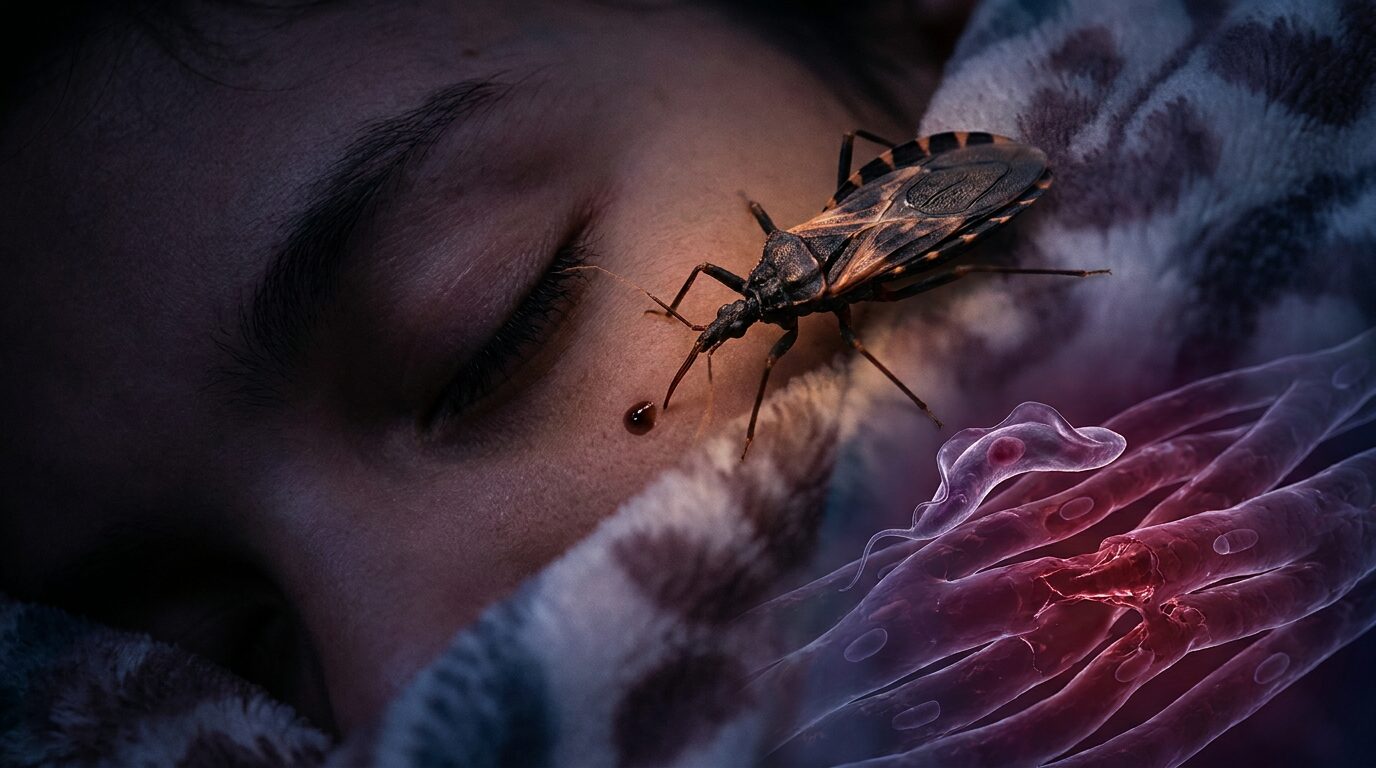
The triatomine bug does not bite you where you would notice. It finds exposed skin — usually your face, your lips, the thin membrane of your eyelid — and feeds while you sleep. 'Kissing bug' sounds almost affectionate until you understand the mechanism: it defecates near the wound while it feeds, and when you scratch or rub in your sleep, you work the feces into the bite site yourself. The parasite, Trypanosoma cruzi, doesn't even bother with the bite directly. It waits in the bug's excrement for you to do the rest.
This is not a fringe pathogen in some remote corner of the world. According to the CDC[1], roughly 8 million people globally are living with Chagas disease[1], including an estimated 280,000 in the United States — the majority of them unaware they carry it. The disease is most common in rural areas of Mexico and Central and South America, but it has traveled with its hosts. And unlike the dramatic symptom profiles we associate with serious parasitic disease, Chagas disease often offers almost nothing in the way of warning. That near-silence is, biologically speaking, its most dangerous feature.
A Parasite That Looks Like Nothing, Then Looks Like a Heart Attack
In its acute phase — the weeks and months immediately following infection — Chagas disease can cause fever, fatigue, body aches, rash, or swelling at the infection site. One of its more distinctive early signs is something called Romaña's sign: a unilateral swelling of the eyelid that occurs when the parasite enters through the eye or is rubbed into the conjunctiva. It is a strange, lopsided puffiness that looks like a stye's more ambitious cousin. But many people never develop obvious symptoms at all. The body mounts what feels like a competent immune response, the acute phase subsides, and the infection slips into something quieter.
The chronic phase is where T. cruzi does its real work. The parasite preferentially invades cardiac and smooth muscle cells, and over years or decades, the immune damage accumulates. The CDC notes[1] that chronic infection can lead to serious heart and digestive system complications — potentially cardiomyopathy, arrhythmias, and heart failure. On the digestive side, the parasite can destroy the nerve cells that coordinate peristalsis, the muscular wave-action that moves food and waste through the gut. When those neurons go, things stop moving. Swallowing becomes difficult. Chronic constipation sets in. The gut, like the heart, has been quietly rewired by a passenger that arrived silently, years or decades earlier.
“The parasite doesn't even bother with the bite directly. It waits in the bug's excrement for you to do the rest.”
55% of the Bugs You Find Are Carrying It
Scientists at Texas A&M University who run a community kissing bug reporting program[2] — through which the public has submitted more than 7,000 bugs since 2012 — have found that roughly 55% of the kissing bugs they've tested carry Trypanosoma cruzi[2]. That is not a small proportion. Kissing bugs are not rare in the American South and Southwest; they range across more than half the continental United States, feeding on rodents, opossums, raccoons, and occasionally humans. Dogs are particularly vulnerable, and can become infected simply by eating a kissing bug. The parasite circulates in wildlife reservoirs and moves fluidly between animals and people whenever the opportunity presents itself — which makes eradication a functionally impossible goal.
The bug isn't the only route. T. cruzi can also be transmitted through blood transfusion, organ transplant, or from a pregnant woman to her fetus. Contaminated food and drink — specifically, fresh-squeezed juice from fruits like guava or açaí that have come into contact with infected kissing bugs or their feces — have been documented as sources of infection. This is not a pathogen with one tidy vector and a clean chain of transmission. It has multiple routes, an enormous wildlife reservoir, and a long incubation between exposure and serious disease.
Neglected, on Purpose and by Accident
Here is the part that deserves more attention than it gets: there are only two drugs approved to treat Chagas disease, benznidazole and nifurtimox, and both are fairly toxic. More striking still, no new medications have been developed to treat the disease in the past 40 to 50 years. Chagas disease is formally classified as a neglected tropical disease — a designation that reflects something real about how pharmaceutical development priorities are set. Diseases that disproportionately affect poor and rural populations in lower-income countries tend not to attract the drug development investment that would move treatment forward. The result is a disease affecting 8 million people globally, with treatment options that haven't changed in half a century and no vaccine on the horizon.
Early treatment, when it happens, does matter. According to the CDC[1], antiparasitic treatment works best when started early and can be lifesaving — but it requires first knowing you're infected, which most people don't. A disease that produces no obvious symptoms for years, in populations that may have limited healthcare access, and that carries social stigma in some communities, is a disease that largely goes undiagnosed. The silence of the acute phase is not just a biological feature; it is a public health problem with structural roots.
“No new medications have been developed to treat Chagas disease in the past 40 to 50 years — and there is no vaccine.”
What Disgust Can't Do Here
Disgust, as an evolved system, is reasonably good at steering us away from visible contamination — rotting food, visible parasites, fecal matter. It is useless against Trypanosoma cruzi, which offers no smell, no visible bloom, no texture to recoil from. The bug that carries it looks like a large assassin bug, easy to confuse with other insects, and often feeds without waking you. The parasite itself is a single-celled flagellate, invisible and odorless, replicating quietly inside cardiac muscle while you go about your life. Our instinctive biological alarm systems were not built for this kind of threat.
What is actually disturbing about Chagas disease is the precision of its patience. Trypanosoma cruzi does not need to kill quickly. It needs only to persist — in your muscle cells, in wildlife populations, in the gut of a kissing bug pressed against your sleeping face. The decades-long slow damage to the heart and digestive system is not a flaw in the parasite's strategy. It is the strategy. By the time Chagas disease becomes visible, it has often been present and accumulating for most of a human lifetime. That is a profoundly effective design, if a horrifying one, and it is the reason this particular piece of biology deserves a great deal more noise than it currently gets.
References
- About Chagas Disease (cdc.gov)
Confirms Chagas disease is caused by Trypanosoma cruzi, spreads via triatomine bugs, and chronic infection causes heart and digestive complications. - Kissing Bugs and Chagas Disease in the U.S. (kissingbug.tamu.edu)
Provides the 55% infection rate of kissing bugs tested and documents over 7,000 bugs submitted to the program since 2012.
About Phoebe Lark
Phoebe Lark writes about the biology and chemistry your body and home would rather you didn't examine too closely — odors, fluids, microbes, parasites, infestations, and the quietly industrious rot happening on and around you right now. She follows disgust down to the mechanism underneath, where the gross thing almost always turns out to be a system doing exactly what it evolved to do.
More like this
A Parasite in 30–60% of Human Brains Is Making People More Impulsive. We've Been Ignoring This.
Toxoplasma gondii has been quietly altering human behavior for millennia — and the mechanism it uses is more precise, and stranger, than anyone wants to admit.
Why Candida in Your Gut Can Suddenly Turn Deadly
Fungi have always been part of your gut's ecosystem — but a wave of drug-resistant strains is revealing just how little medicine understood them.