Heritage, Not History: The Realignment Republicans Refuse to Remember
Republicans love pointing out that the KKK and the Confederacy belonged to the Democrats — so why are they the ones screaming when those statues come down?
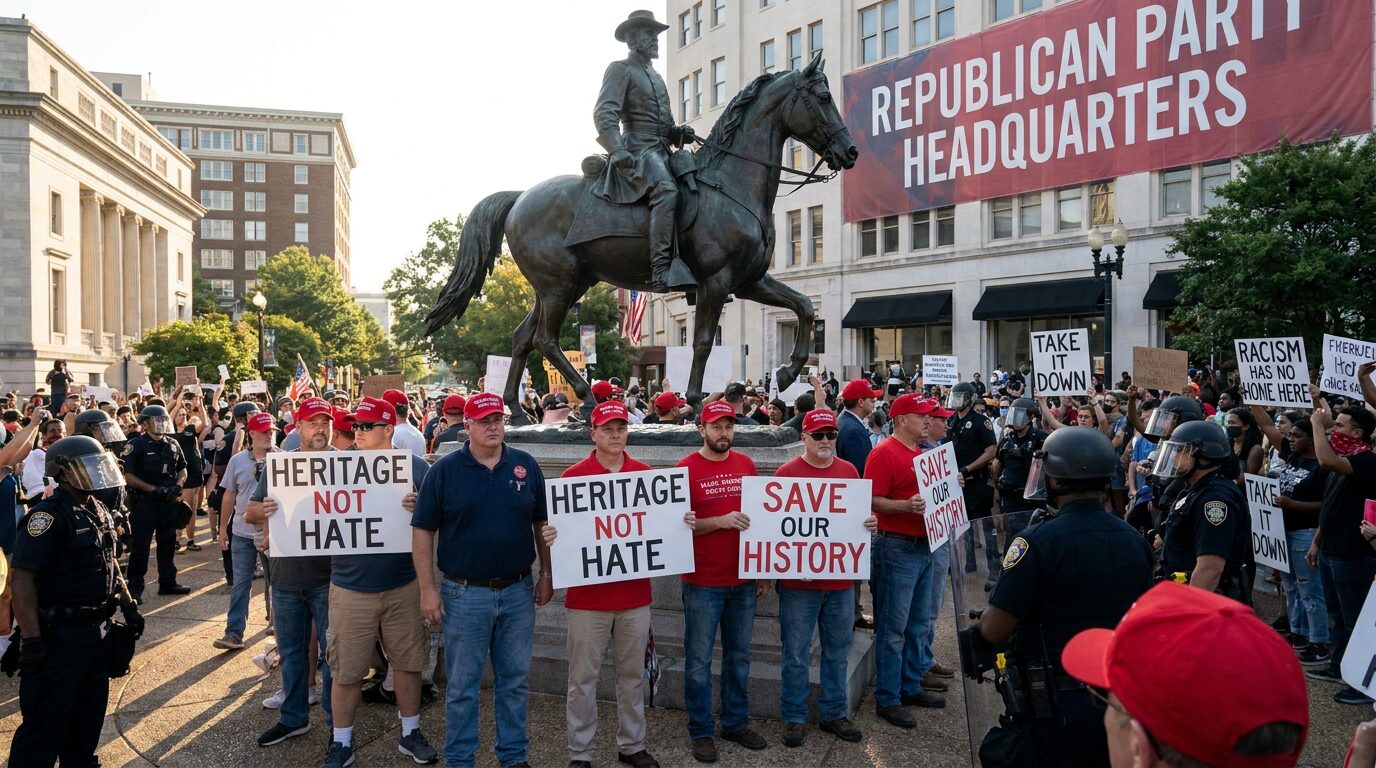
Here is a political argument you will hear constantly in certain corners of the American right: "The Democrats started the KKK. The Democrats owned slaves. The Democrats built the Confederacy. They should be ashamed." Fine. Stipulated. Broadly accurate, as a matter of 19th-century history. Now here is the follow-up question those same people cannot answer without breaking into a cold sweat: if all of that is true — if the Confederacy was a Democratic project, if those statues honor Democratic traitors — then why in the living hell are Republicans the ones losing their minds when Democrats try to take those statues down?
That contradiction is not a gotcha. It is a map. It tells you exactly where the political realignment actually landed, who inherited what, and why the "Democrats are the real racists" argument collapses the second anyone applies five seconds of historical follow-through. The argument is designed to be deployed fast and forgotten faster. It cannot survive a single question about what happened between 1865 and 1980. And that gap — that century-long gap the argument simply skips — is the entire story.
The Realignment That Actually Happened
Let's be precise, because imprecision is what the "Democrats started the KKK" crowd is counting on. There was not a single overnight "party switch" where Democrats and Republicans swapped platforms; rather, a long, regionally driven realignment unfolded from the 1930s through the 1960s and beyond as civil‑rights policy, migration, and strategic politics reshaped party coalitions. This is not a liberal talking point. It is the settled consensus of political historians. The parties did not teleport. The voters, the elites, and the incentive structures moved — gradually, measurably, and with a very clear engine: race.
The major Democratic-sponsored national civil rights legislation of the 1960s — the Civil Rights Act of 1964 and the Voting Rights Act of 1965 — were vehemently opposed by Southern Democrats and are frequently cited as the immediate cause of the South's shift of allegiance from the Democratic to the Republican Party. When Lyndon Johnson signed that legislation, he reportedly told aide Bill Moyers[1] that he thought Democrats had "just delivered the South to the Republican party for a long time to come" — and it was an accurate prediction. The white Southern voters who had kept the Confederacy's political tradition inside the Democratic Party did not simply vanish. They moved. And the Republican Party — running what historians call the Southern Strategy — went and got them.
The Southern strategy was a Republican Party electoral strategy to increase political support among white voters in the South by appealing to racism against African Americans[3]. As the civil rights movement and dismantling of Jim Crow laws visibly deepened existing racial tensions, Republican politicians such as Richard Nixon and Barry Goldwater developed strategies that successfully contributed to the political realignment of many white, conservative voters in the South who had traditionally supported the Democratic Party. This is not fringe revisionism. In 2005, Republican National Committee chairman Ken Mehlman formally apologized to the NAACP on behalf of the party for its historical exploitation of racial polarization to win elections. The party's own leadership said it out loud.
“The voters who kept the Confederate tradition inside the Democratic Party didn't vanish. They moved. And the Republican Party went and got them.”
Who Built Those Statues, and When, and Why
Now let's talk about the statues, because the timeline here is genuinely damning. The "heritage" framing implies these monuments are solemn, immediate memorials to the Civil War dead — granite grief, erected in the years after Appomattox by a weeping South. That is not what the data shows. The majority of Confederate monuments weren't erected until after 1900, decades after the Civil War ended in 1865. The construction of Confederate monuments peaked in the 1910s and 1920s, when states were enacting Jim Crow laws, and later in the 1950s and 1960s, amid the Civil Rights Movement[4].
The timing is not coincidental. The first spike lasted well into the 1920s, a period that saw a dramatic resurgence of the Ku Klux Klan. The second spike began in the early 1950s and lasted through the 1960s, as the civil rights movement led to a backlash against desegregationists. These are not grief monuments. They are political monuments — erected at the precise moments when white supremacist power felt most threatened, to send a message about who was still in charge. "These statues were meant to create legitimate garb for white supremacy," said James Grossman, executive director of the American Historical Association. As historian David Goldfield notes, "The Confederate statues you see all around were primarily erected by Democrats."
Yes. Democrats. Southern Democrats. The exact same Southern Democratic political tradition that then migrated into the Republican coalition after 1964. The KKK used to be Democrats, and now they aren't — not after the effects of the Solid South switch and the Southern Strategy. That is not a liberal spin on history. That is the history. The statues were built by Democrats, the Democrats who built them became Republicans, and now Republicans defend the statues. The chain of custody is not complicated.
The Vote That Settles the Argument
If you want to know which political coalition actually inherited the Confederate tradition, skip the genealogy debates and just look at the 2021 House vote on removing Confederate statues from the U.S. Capitol. The House voted to remove all Confederate statues from public display in the U.S. Capitol[2]. The measure passed 285–120. All Democratic members supported the legislation; all "no" votes came from Republican members. Every single vote to keep those statues in place came from a Republican.
Some Republicans did cross over — 67 Republicans voted in favor of the bill. But a number of GOP representatives condemned the move as "cancel culture" and Democrats pushing Critical Race Theory. In 2023, Florida Republican Dean Black filed legislation that would punish any lawmakers who vote to remove "historical monuments and memorials" — under the bill, local lawmakers voting for removal could be fined or removed from office by the governor. The party that keeps insisting the Confederacy was a Democratic institution is also the party deploying its legislative machinery to protect the Confederacy's physical monuments. You genuinely cannot make this up.
“Every single vote to keep Confederate statues in the U.S. Capitol came from a Republican. Every one.”
What the Argument Is Actually Doing
The "Democrats are the real racists" argument is not a historical claim. It is a rhetorical one — a political maneuver designed to disrupt accountability before it lands. It works by freezing the party labels at a point before the realignment and refusing to let them move forward in time. It is the political equivalent of insisting your grandfather's house is still yours because he built it, even though the deed transferred sixty years ago. The address is the same. The ownership is not.
What makes this particularly useful as a rhetorical weapon is its surface plausibility. It's technically true that the KKK was founded by Democrats. It's technically true that the Confederacy was a Democratic project. That true-enough foundation gives bad-faith actors just enough cover to wave away the century of realignment that followed — the Dixiecrat bolt, the Civil Rights Act, the Southern Strategy, the wholesale migration of white racial grievance from one party coalition to the other. The argument needs you to stop at 1870 and never ask what happened next. The moment you ask what happened next, the argument falls apart completely.
Political identity works through coalitions, incentives, and signals — not through logo continuity. The party that campaigns on racial grievance, defends Confederate imagery, and votes to protect Confederate statues in the national Capitol has inherited the Confederate political tradition, regardless of what the party was called when that tradition began. Coalitions migrate. Power structures follow the voters who carry them. The Southern strategy is generally believed to be the primary force that transformed the "Democratic South into a reliable GOP stronghold in presidential elections." That transformation didn't happen by accident, and it didn't leave the political furniture behind.
So the next time someone throws "the Democrats founded the KKK" at you like it's a trump card — ask them one question. If those statues honor Democrats, why are you so upset that Democrats want them gone? The silence that follows is not confusion. It's the sound of someone realizing their argument just confessed everything they were trying to deny.
References
- LBJ Champions the Civil Rights Act of 1964 (archives.gov)
Documents LBJ's statement to aide Bill Moyers that the Civil Rights Act would deliver the South to Republicans, supporting the article's claim about the immediate political realignment. - The House Votes To Remove Confederate Statues In The U.S. Capitol (npr.org)
Documents the 2021 House vote to remove Confederate statues, with all Republican votes against removal, providing the evidence the article uses to show which party now defends Confederate monuments. - Southern strategy (en.wikipedia.org)
Defines the Southern Strategy as Republican appeal to white Southern voters' racial grievance, establishing the mechanism by which the article explains the party realignment. - Striking graphic reveals the construction of Confederate monuments peaked during the Jim Crow and civil rights eras (theweek.com)
Provides data showing Confederate monuments peaked in the 1910s–1920s during Jim Crow and the 1950s–1960s during the Civil Rights era, supporting the article's claim about their political timing.
About Paul Wardell
Paul Wardell writes about politics, institutions, voters, media, class, power, polarization, and the incentives that make public life feel dumber than it needs to be. Left-leaning but stubbornly practical, his work focuses on how systems actually behave, not how partisans wish they behaved.
More like this
The Redistricting War Has a Winner. It's Not Voters.
A 2026 Supreme Court ruling reshaped the rules of political mapmaking, and the damage it's about to do runs deeper than any single congressional district.