Strongman Voters Aren't Fooled. They Know Exactly What They're Voting For.
A landmark 2025 study broke authoritarian populism apart from the anti-establishment kind — and what it found destroys the polite theory that strongman voters are just frustrated democrats who got lost.
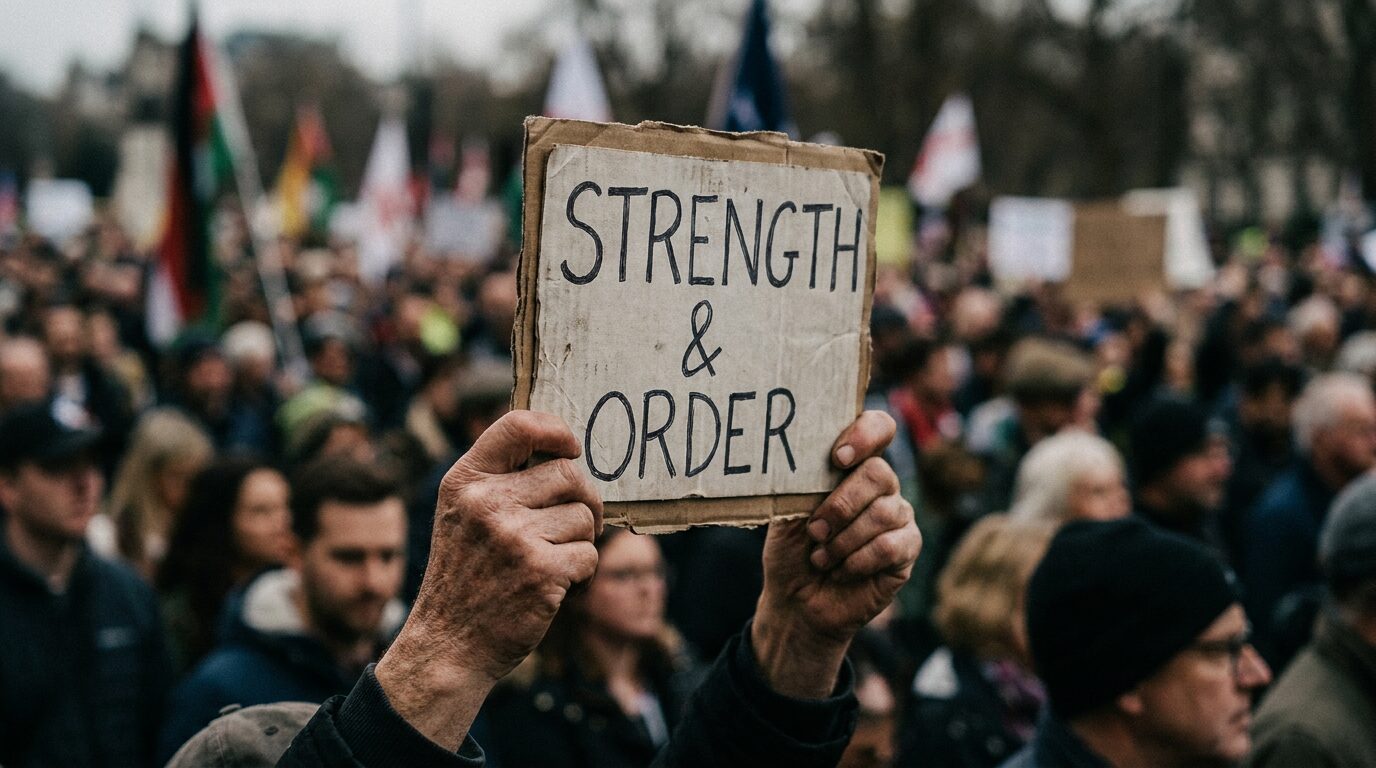
The liberal explanation for Trumpism, Bolsonarismo, and the Meloni surge has always had a certain mercy built into it. These voters are economically anxious, the story goes. They feel left behind. They want disruption, not domination. Give them better jobs, a fairer shake, something to believe in, and they'll come back to democratic norms on their own. The strongman is just the populist packaging they picked up at the only store open in their town. It's a theory that flatters everyone: the voters aren't authoritarian, just desperate; the institutions aren't at risk, just temporarily unfashionable; the problem is economic, solvable, maybe even bipartisan if someone would just speak the right language. It is also, according to a significant new body of research, largely wrong.
A 2025 study[1] published in Frontiers in Political Science has done something researchers had been circling for years without quite landing: it operationally separated anti-establishment populism from authoritarian populism at the demand level — meaning not in the rhetoric of politicians, but in the measurable preferences of voters themselves. The distinction matters enormously. Anti-establishment populism is the real thing: a genuine, historically recurring frustration with corrupt elites, unresponsive institutions, and systems that work for the connected and grind down everyone else. Authoritarian populism is something different in kind, not degree. It is an active, affirmative preference for concentrated power, weakened checks, a leader unconstrained by courts or legislatures or norms — and a willingness to punish perceived enemies through that power. The study found that voters supporting figures like Trump, Bolsonaro, and Meloni are not confused anti-establishment populists. They are authoritarian populists. They know what they want, and what they want is the strongman.
This is not a semantic distinction. It has direct consequences for how we understand democratic erosion, how opposition movements should respond, and what it means that tens of millions of people in wealthy, formally democratic countries are affirmatively demanding rule by a single powerful figure with minimal institutional interference. As I've written before, democracies rarely announce their own endings — they tend to dissolve through accumulated small concessions, each one justified by the crisis of the moment. What this research adds is a harder and less comforting finding: a significant portion of the electorate is not merely tolerating that dissolution. They are the demand driving it.
For anyone who has spent years watching the liberal response to authoritarian electoral victories — the endless op-eds about 'reaching' voters, the pivot to economic messaging, the quiet hope that better GDP numbers would do what political organizing couldn't — this research lands like a cold glass of water. It doesn't mean economic anxiety is fake, or that class grievances don't exist, or that left-populist economics has no role to play. It means the diagnosis has been dangerously incomplete. And an incomplete diagnosis produces the wrong medicine.
Two Populisms, One Ballot
Political scientists have long known that 'populism' is a slippery term — loose enough that Bernie Sanders and Viktor Orbán can both be called populists in the same sentence without anyone flinching. The academic consensus, going back at least to the foundational framework of Cas Mudde[2], treats populism as a 'thin ideology' that attaches to other ideological hosts: left or right, democratic or authoritarian, agrarian or nationalist. On that view, the authoritarianism of a Bolsonaro is just the right-wing host ideology talking, not something inherent to populism itself. Plenty of observers took that framework as evidence that authoritarian populist voters were really just populist voters who'd been handed a bad vehicle. Fix the vehicle, reach the driver, and the authoritarian piece falls away.
The 2025 Frontiers study[1] challenges that optimism at its root. By surveying voters across multiple countries and using validated scale instruments designed to separately measure anti-establishment sentiment and authoritarian preference, the researchers found that these are empirically distinct voter profiles — not a single spectrum where more populism automatically means more authoritarianism. Voters with high anti-establishment populist scores did not reliably show authoritarian preferences. But voters who backed the named authoritarian-populist figures consistently did. The researchers controlled for economic variables, education, and ideological self-placement. The authoritarian preference remained. It was not a proxy for economic insecurity. It was its own thing.
“The authoritarian preference wasn't a proxy for economic insecurity. It was its own thing.”
This matters because it tells us that lumping all populist voters together has been analytically catastrophic. A working-class voter who wants Medicare for All, strong unions, and a government that stops letting corporations write their own regulations is expressing something real and healthy in democratic terms. A voter who wants the president to be able to ignore courts, punish journalists, and govern without the friction of opposition is expressing something categorically different — something that, historically, ends in a very different place. Treating those two voters as variations on the same frustrated-citizen theme is not just analytically sloppy. It has real political consequences, because the interventions that might reach the first voter will not reach the second.
The Permission Structure for Wanting a Strongman
If authoritarian populist voters aren't primarily driven by economic displacement, what are they driven by? Here the research aligns with a substantial body of work in political psychology. Authoritarian preference at the voter level is reliably associated with a cluster of psychological orientations: high need for cognitive closure, strong in-group/out-group identity salience, tolerance for inequality when it falls on perceived out-groups, and a specific relationship to threat — where perceived social and cultural threat activates deference to strong authority rather than calls for collective solidarity. None of these orientations are fixed or inevitable, and none of them are reducible to stupidity or moral failure. They are patterns in how certain people process political information under conditions of social anxiety. But they are also not the same as bread-and-butter economic populism, and they respond to very different stimuli.
What authoritarian populist politicians offer is a specific emotional transaction. They tell voters: the system is rigged against you, the elites who run it deserve contempt, and the solution is to give total power to someone strong enough to destroy the rigged system and punish the people who built it. This framing does something clever. It parasitizes genuine anti-establishment sentiment — co-opts the legitimate anger about institutions that actually do serve the donor class over everyone else — and redirects it toward a demand for unchecked executive power. The voter gets to feel like a revolutionary while voting for a mechanism that will make them less powerful, not more. The strongman gets the mandate. The donor class gets the deregulation. The voter gets the theater of watching their enemies get punished. That transaction only works if the voter actually wants the strongman piece. And the research says: many of them do.
“The voter gets the theater of watching their enemies punished. The donor class gets the deregulation.”
Why the 'Misdirected Populist' Theory Was So Useful
It's worth asking why the 'they just want disruption' theory became so dominant in liberal and center-left political circles. Part of the answer is that it's genuinely partially true — there really are disaffected voters at the edges of authoritarian coalitions who are less ideologically committed, more volatile, more reachable. But the theory also served some powerful institutional interests. If authoritarian voters are just misguided economic populists, then the solution is economic centrism with better messaging, not a fundamental reckoning with what is being demanded. It lets mainstream parties dodge the harder question: why are tens of millions of people in functioning democracies affirmatively attracted to the idea of dismantling the institutional constraints on executive power? Answering that question honestly requires naming things that make institutional politics uncomfortable — the real failures of center-left governance to deliver material improvements, the way austerity and deregulation under nominally center parties hollowed out public trust, and the specific ways that loss of status and relative decline (not just absolute poverty) fuels authoritarian receptivity.
The misdirected populist theory also let liberal commentators be generous about their political opponents in a way that felt sophisticated. Dismissing authoritarian voters as simply racist or fascist was crude and politically unproductive. Explaining them as economically desperate felt more nuanced, more sociologically serious, more persuadable. The problem is that being generous about the wrong diagnosis is its own form of intellectual failure. Acquiescence to rising authoritarianism is never just a philosophical problem — it has a mechanism, and the mechanism here is partly a refusal by democratic institutions and mainstream political parties to name what they are actually facing.
What Survives the Diagnosis
None of this means class politics is irrelevant. Far from it. The pipeline from economic precarity and institutional betrayal to authoritarian receptivity is real and well-documented: when governments fail to deliver material security, when institutions are visibly captured by the wealthy, when the social contract repeatedly promises and fails to perform, trust in democratic systems erodes, and the population of people open to authoritarian alternatives grows. A consistent finding across political psychology research is that authoritarian appeals become more potent in contexts of felt powerlessness — not just poverty, but the specific experience of institutions that are supposed to work for you not working for you. That means strong labor protections, genuine housing security, healthcare that doesn't bankrupt you, and public institutions that actually function are not just good policy on their own terms. They are also structural defenses against authoritarian recruitment.
But here is what the new research insists we stop doing: treating the committed authoritarian populist voter as someone who primarily needs better economic messaging. They don't. They have made a choice — sometimes slowly, sometimes enthusiastically, but in either case a real choice — to prefer a politics of domination over a politics of shared power. That choice is legible, coherent, and resistant to being explained away. Trying to out-disrupt the strongman on his own terms — being tougher, angrier, more contemptuous of institutions — does not work either, because it concedes the authoritarian frame. The actual counter, where it exists, is making democratic institutions work visibly and materially for ordinary people while refusing to launder the authoritarian demand as something more innocent than it is.
What You Call It Determines What You Fight
“You cannot build a defense against authoritarian politics if you keep diagnosing it as something softer and more manageable.”
The researchers behind the 2025 Frontiers study are not arguing that democracy is doomed, or that authoritarian voters are irredeemable, or that the only response is political war without end. What they are arguing — methodically, through data — is that the conceptual separation matters. Anti-establishment populism is a legitimate democratic phenomenon. Authoritarian populism is a demand for a specific political architecture in which one leader holds unchecked power, institutional constraints are treated as illegitimate obstacles, and out-groups are targets rather than citizens. You can't develop an accurate response to a thing you keep mislabeling. And the mislabeling has been going on for long enough that it has become its own kind of political failure — a form of motivated reasoning by people who found the true diagnosis too uncomfortable to hold.
The voters who pulled the lever for Trump in 2024, for Bolsonaro in 2022, for Meloni in 2022 — a significant portion of them were not confused. They were not crying out for better healthcare policy delivered with the right working-class accent. They looked at a man or woman who promised to govern without the friction of courts, opposition, or constitutional limits, and they said yes. That is the fact democratic movements have to hold, even when it's ugly. Especially when it's ugly. Because you cannot build a defense against authoritarian politics if you keep diagnosing it as something softer and more manageable than it actually is — something that will dissolve on its own once the economy turns, the messaging improves, or the right candidate finally speaks to their pain. Some political demands are exactly what they look like. This one is.
References
- Anti-establishment versus authoritarian populists and support for the strong(wo)man (frontiersin.org)
Supplies the core 2025 research finding that authoritarian preference in voters is empirically distinct from anti-establishment sentiment and not reducible to economic insecurity. - Cas Mudde - Populism in the Twenty-First Century: An Illiberal Democratic Response to Undemocratic Liberalism (amc.sas.upenn.edu)
Establishes the foundational academic framework treating populism as a thin ideology that attaches to different ideological hosts.
About Rafael Tomlin
Rafael Tomlin writes about current politics from a fiercely populist perspective: pro-worker, pro-renter, anti-billionaire capture, anti-authoritarian, and deeply hostile to the machinery that turns public life into cruelty for profit. His work focuses on power, policy, class, democracy, corruption, and who actually pays when political theater becomes law.
More like this

Republicans Are Happier Under Authoritarianism. That's Not a Paradox.
A psychological concept called 'person-environment fit' explains why some voters thrive under conditions that look, from the outside, like democratic collapse.

Democracies Don't Warn You Before They Stop Being One
Political scientists have spent two decades mapping exactly how democracies die without a coup — and the indicators they built now point at the United States.

The Surveillance State Didn't Come for You. It Came for the Protesters First.
Across three countries with very different governments, AI-powered facial recognition is being deployed against protesters first — and the political science research on why that sequence matters should scare you.