The Anxious Conformist and the Defiant One Are Both Running From Rejection
New research shows that fearing rejection and expecting rejection produce opposite behaviors in children — and the adult lives they build look nothing like each other.
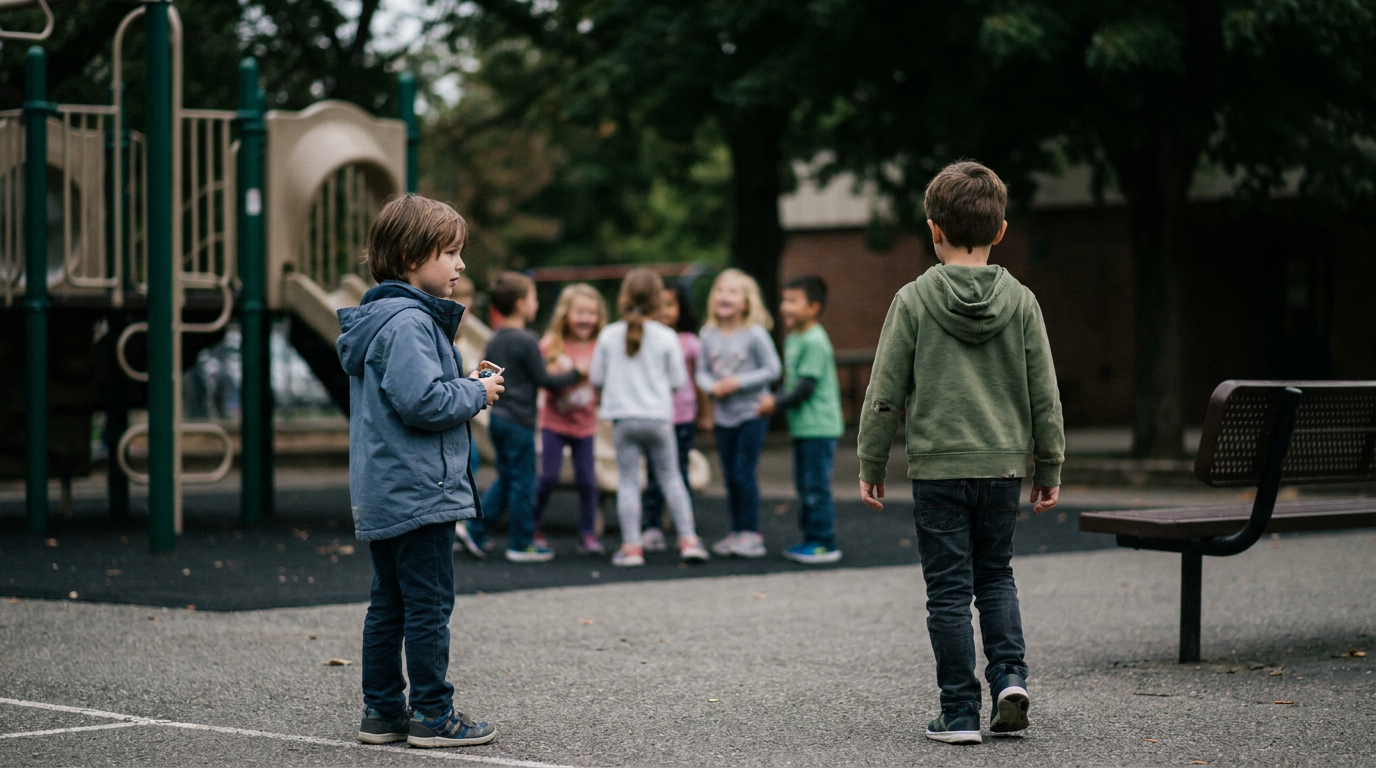
Think of two children on the edge of a school group. One watches the others carefully, figures out what the group wants, and then becomes exactly that — agreeable, helpful, almost frictionless. The other child watches for a moment, reads the situation differently, and walks away before anyone has the chance to leave first. To outside observers, these children can look like opposites: one social, one withdrawn; one eager, one indifferent. In most frameworks, they would be treated as very different kinds of kids. They may not be.
Both of those children may be running a rejection-avoidance strategy. They have simply calibrated to different threat models. One believes rejection is possible and therefore tries to prevent it through compliance. The other believes rejection is likely and therefore cuts the experience short. The surface behavior is inverted, but the engine underneath — a nervous system that has learned to treat social exclusion as a significant danger — is recognizably the same.
A 2025 study out of the University of Georgia[3] drew exactly this distinction. Researchers examining rejection sensitivity in children found that the construct, long treated as a relatively unified trait, splits along a meaningful developmental fault line. Children who fear rejection — anxious about the possibility — respond by over-conforming socially, bending toward what the group seems to want. Children who expect rejection — for whom exclusion feels more like an anticipated outcome than a dreaded possibility — respond by withdrawing from social engagement altogether. Same underlying sensitivity. Opposite behavioral signatures.
This is more than a research footnote. It reframes a pattern that developmental psychologists have wrestled with for decades, and it has real implications for the adult versions of both those children — the ones who people-please their way through decades of relationships and the ones who preemptively exit before anyone has the chance to disappoint them.
Rejection Sensitivity Was Never One Thing
The concept of rejection sensitivity has roots going back to clinical psychology research in the 1990s, where it was initially framed as a disposition to anxiously expect, perceive, and overreact to rejection[1]. From the start, researchers noted that it was associated with interpersonal difficulty, emotional dysregulation, and relationship instability. But the working model for much of that era treated rejection sensitivity largely as a single dimension — you had more of it or less of it — and the behavioral consequences were assumed to follow a relatively common path.
The Georgia research complicates that model at the level of mechanism. What the study suggests is that rejection sensitivity contains at least two distinct emotional orientations[3] — anxious and expecting — that are related but functionally different. Anxious rejection sensitivity is characterized by fear: rejection is possible, the stakes are high, and the behavioral response is one of vigilant social effort. Expecting rejection is something closer to resigned anticipation: exclusion feels like a probable outcome, and the behavioral response is protective withdrawal rather than effortful engagement. These are not simply more and less severe versions of the same thing. They appear to produce children who behave, socially, in nearly opposite ways.
“Same underlying sensitivity. Opposite behavioral signatures.”
This distinction has a developmental logic. Fear activates approach-oriented behavior, because there is still the possibility of a different outcome. A child who fears rejection believes, at some level, that the rejection can be avoided — that if they perform correctly, stay agreeable enough, read the social room well enough, they can keep the group on their side. That belief, however exhausting it becomes, keeps them in the game. Anticipated rejection is cognitively different. When exclusion feels like something that is already probably going to happen, the rational move — at least to a child's nervous system — is to control when and how the hurt arrives. You leave before you get left.
Where These Patterns Come From
Neither of these orientations arrives fully formed. They develop, and they develop in relationship — with caregivers first, then siblings, then peers. Temperament is part of the equation: children vary in how much social threat registers as salient, how quickly their nervous systems respond to cues of disapproval, and how long those responses linger. But temperament interacts with environment, and the environment shapes which version of rejection sensitivity a child is more likely to develop.
Children who grow up in environments where approval feels achievable but conditional — where warmth is present but shifts with behavior, where acceptance seems to require ongoing performance — often develop the anxious flavor. The relationship between effort and acceptance is established early in those homes, even when no one explicitly teaches it. A child learns that if they manage themselves carefully, they can usually keep the people around them close. That is not a bad lesson in moderation. Taken to an extreme, or applied repeatedly across environments that are less predictable than the child's effort can actually manage, it can become a chronic strategy — over-conforming, monitoring, accommodating, self-erasing.
Children who develop the expecting orientation have often had a different experience. Exclusion or criticism in their early social environments — from family dynamics, from peer relationships, from a mismatch between their temperament and the social world they were handed — may have been less contingent on their behavior. Rejection came even when they tried. Or it came from adults whose responses felt genuinely unpredictable, not just demanding. When the link between social effort and social outcome is broken enough times, it stops making sense to invest in the effort. The withdrawal that follows is not indifference. It is a child's mind updating its internal working model[2]: social bids are risky, and the return is uncertain.
“You leave before you get left — and eventually, you forget that leaving was a choice you made for protection.”
What the Conforming Child Grows Into
The over-conforming child tends to be the one adults reward. They are cooperative, they read the room, they smooth over conflict. Teachers often love them. Peer groups often find them frictionless. The cost is largely invisible from the outside, which is part of what makes it stick so long.
By adulthood, the anxious rejection-sensitive person has often developed a sophisticated set of tools for managing other people's comfort at the expense of their own. They apologize quickly — sometimes before anyone has asked for an apology. They change their position in conversations with unusual speed when they sense disagreement brewing. They are skilled at detecting emotional weather in a room and adjusting accordingly. None of this is calculated manipulation; it is old training, running reliably in newer circumstances. The problem is that these same skills can prevent the thing they are ostensibly protecting: genuine closeness. When someone never stops adjusting, the people around them have a hard time knowing what they are actually getting.
Relationships can become sites of low-grade surveillance. A partner's quiet mood reads as early warning. A friend taking longer than usual to text back lands somewhere between discomfort and alarm. The anxious rejection-sensitive adult does not usually experience this as irrational — the monitoring feels useful, even necessary. What they may not fully register is that the threat level has changed since the system was calibrated. The original environment required that degree of vigilance. Most current environments do not.
What the Withdrawing Child Grows Into
The child who expects rejection and withdraws is easier to misread as an adult. They may come across as self-sufficient, even self-contained. They may genuinely prefer solitude — partly because solitude stopped feeling like loss a long time ago and started feeling like safety. But there is often something more active underneath that preference: a kind of preemptive social accounting, where the math of connection is run early and the conclusion is reached before the experience actually plays out.
This can look like avoidant attachment in adulthood, and the overlap is real — though rejection sensitivity and attachment style are not the same thing, they share developmental tributaries. The expecting-rejector may resist letting relationships develop to the point where real exclusion is possible. They do not typically experience this as fear. By the time the pattern is well-established, it often feels more like pragmatism, or privacy, or simply knowing themselves. The belief that closeness is likely to end in disappointment is not held as a belief so much as a background fact about how things tend to go.
The particularly quiet consequence of this path is that it is self-confirming. When someone withdraws before connection can deepen, they rarely receive information that contradicts the model. The people who might have stayed — who would have demonstrated that persistence and reliability are possible — never get the chance, because the door was closed before the test could run. The original expectation remains intact, protected from revision by the very behavior it produced.
Two Paths, One Underlying Alarm
What makes the Georgia findings useful is not just that they split rejection sensitivity into two types — it is that splitting them reveals something about the internal logic of each. The anxious child and the withdrawing child are not responding to rejection the same way. But they are responding to the same core problem: social belonging feels fragile, and its loss feels significant enough to organize behavior around. The strategies diverge precisely because the two groups have arrived at different conclusions about whether their effort can actually affect the outcome.
“The anxious conformist still believes performance can hold rejection at bay. The withdrawing child has already decided it cannot.”
That distinction matters for how adults recognize these patterns in themselves. The over-conformer often knows something is wrong — they feel tired of performing, frustrated by how quickly they abandon their own position, confused by how rarely their agreeableness seems to generate the security they are working toward. The withdrawer may have a harder time seeing the pattern, because the story they carry — I'm just private, I don't need much closeness, I've never been a people person — is coherent and does not obviously feel like fear. It takes a certain precision to recognize that independence can sometimes be a very old form of self-protection rather than a stable preference.
Updating an Old Calibration
Recognizing which path you are on does not instantly change the destination. These are patterns built over years of emotional learning, reinforced by real experiences, and maintained by the fact that they have often worked — not perfectly, but well enough to survive on. The over-conformer's vigilance has probably prevented some real conflict. The withdrawer's early exits have probably prevented some real pain. Calling these strategies irrational misses the point. They were not irrational when they formed. They may simply be outdated.
The developmental literature on rejection sensitivity consistently points to a few mechanisms that matter for change. One is what researchers sometimes call corrective social experience — relationships and interactions that provide genuine evidence against the working model. For the anxious conformer, this means discovering — slowly, repeatedly — that expressing disagreement does not automatically cost the relationship. For the expecting withdrawer, it means allowing connection to develop far enough that the anticipated rejection does not arrive on schedule, and noticing that. Neither of these is a single conversation. They are accumulations. The internal working model updates on evidence, but the evidence has to actually land, which requires staying in situations long enough to collect it.
There is also something clarifying about simply knowing which version of this you are living. The anxious conformer who understands that their agreeableness is partly a protective reflex rather than a pure character trait has a different relationship to their own people-pleasing — not necessarily an easier one, but a more honest one. The withdrawer who recognizes that their preference for solitude has roots in anticipated rejection rather than purely in temperament is not obligated to become a different person. But they may find it easier to choose, consciously, whether the door closes — instead of discovering, later, that it already did.
References
- Implications of rejection sensitivity for intimate relationships. (doi.org)
Provides the foundational 1990s clinical psychology definition of rejection sensitivity as anxiously expecting, perceiving, and overreacting to rejection. - Social rejection sensitivity and its role in adolescent emotional disorder symptomatology (pmc.ncbi.nlm.nih.gov)
Supplies the concept of 'internal working model' used to explain how children update their beliefs about social risk based on repeated rejection experiences. - The Role of Rejection Sensitivity and Relational Victimization Within the Friendship Group on Conformity Intentions (doi.org)
Provides the 2025 study distinguishing anxious rejection sensitivity from expecting rejection sensitivity as two distinct emotional orientations producing opposite behaviors.
About Mara Ellison
Mara Ellison writes about childhood patterns that echo into adult life, including attachment, temperament, rejection sensitivity, emotional learning, family roles, and the early social scripts people keep reenacting without realizing it. Her work focuses on developmental psychology with nuance, clarity, and unusual emotional precision.
More like this

The Kid Who Conformed to Survive Is the Adult Who Can't Disagree
Research on rejection-sensitive adolescents reveals a pattern more insidious than shyness: the systematic suppression of their own judgment — and it doesn't stop when childhood does.

Rejection Sensitivity Doesn't Start with a Broken Heart. It Starts with a Worried Child.
New research on rejection sensitivity's environmental roots reveals something most adults who carry it were never told: it wasn't a flaw they were born with, it was a strategy they built.

The Good Child Learned to Disappear. They're Still Doing It.
Research on rejection-sensitive children who conform to belong is revealing how early disappearing acts become so practiced they stop feeling like acts at all.