Uncertainty Tolerance
Uncertainty tolerance is your ability to handle not-knowing without distress. Low tolerance means the anticipation of bad news feels worse than the actual event, a key driver of anxiety.
Not to be confused with: Ambiguity Tolerance
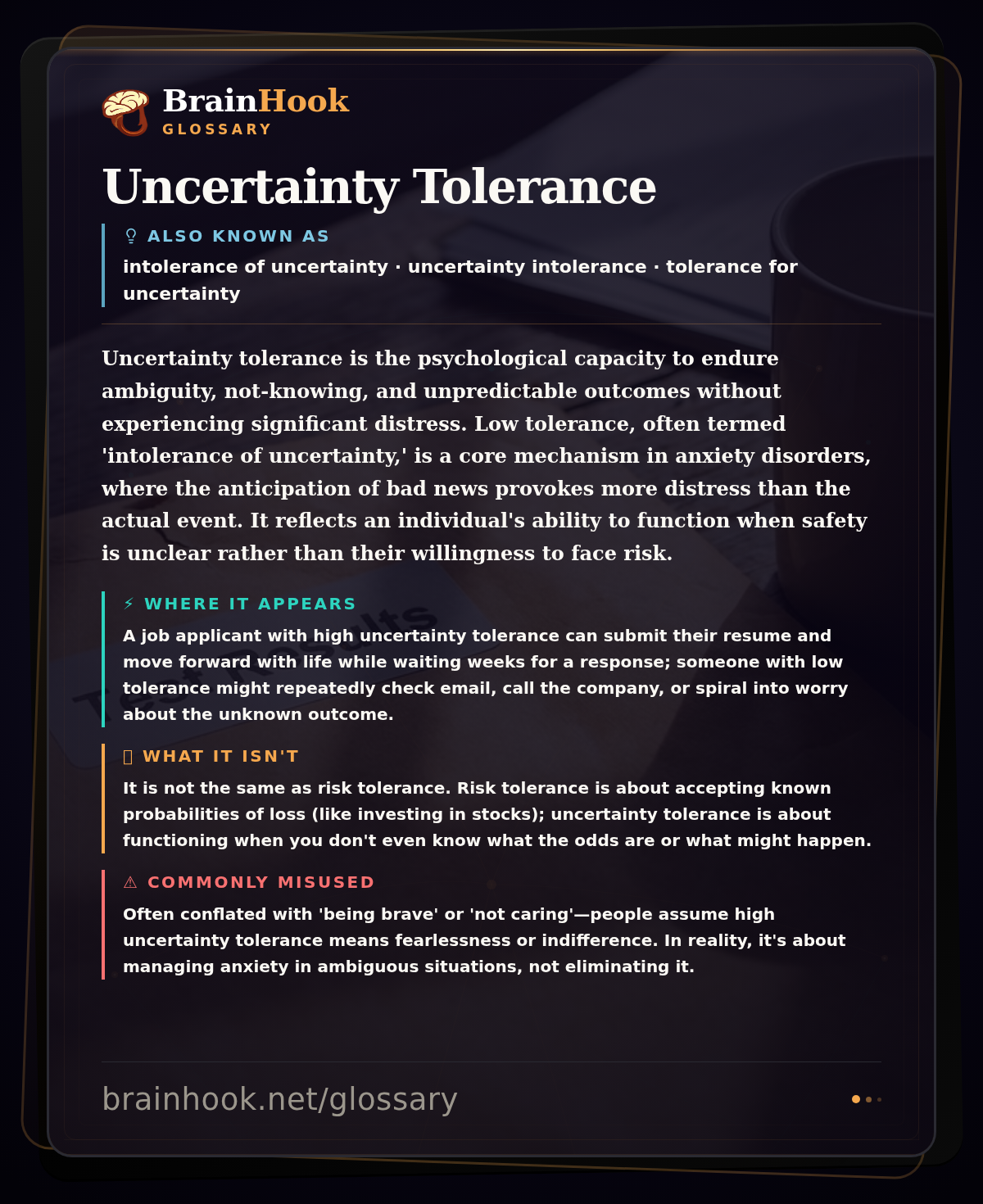
Uncertainty tolerance is the psychological capacity to endure ambiguity, not-knowing, and unpredictable outcomes without experiencing significant distress. Low tolerance, often termed 'intolerance of uncertainty,' is a core mechanism in anxiety disorders, where the anticipation of bad news provokes more distress than the actual event. It reflects an individual's ability to function when safety is unclear rather than their willingness to face risk.
What this means in real life
A job applicant with high uncertainty tolerance can submit their resume and move forward with life while waiting weeks for a response; someone with low tolerance might repeatedly check email, call the company, or spiral into worry about the unknown outcome.
What it isn’t
It is not the same as risk tolerance. Risk tolerance is about accepting known probabilities of loss (like investing in stocks); uncertainty tolerance is about functioning when you don't even know what the odds are or what might happen.
Commonly misused online
Often conflated with 'being brave' or 'not caring'—people assume high uncertainty tolerance means fearlessness or indifference. In reality, it's about managing anxiety in ambiguous situations, not eliminating it.
Based on 3 reference sources, including NIH material. Last verified July 12, 2026.