Noise Floor
The minimum level of background signal or interference that obscures weaker signals in a measurement system, setting the threshold below which data becomes unreliable.
Not to be confused with: Detection Threshold
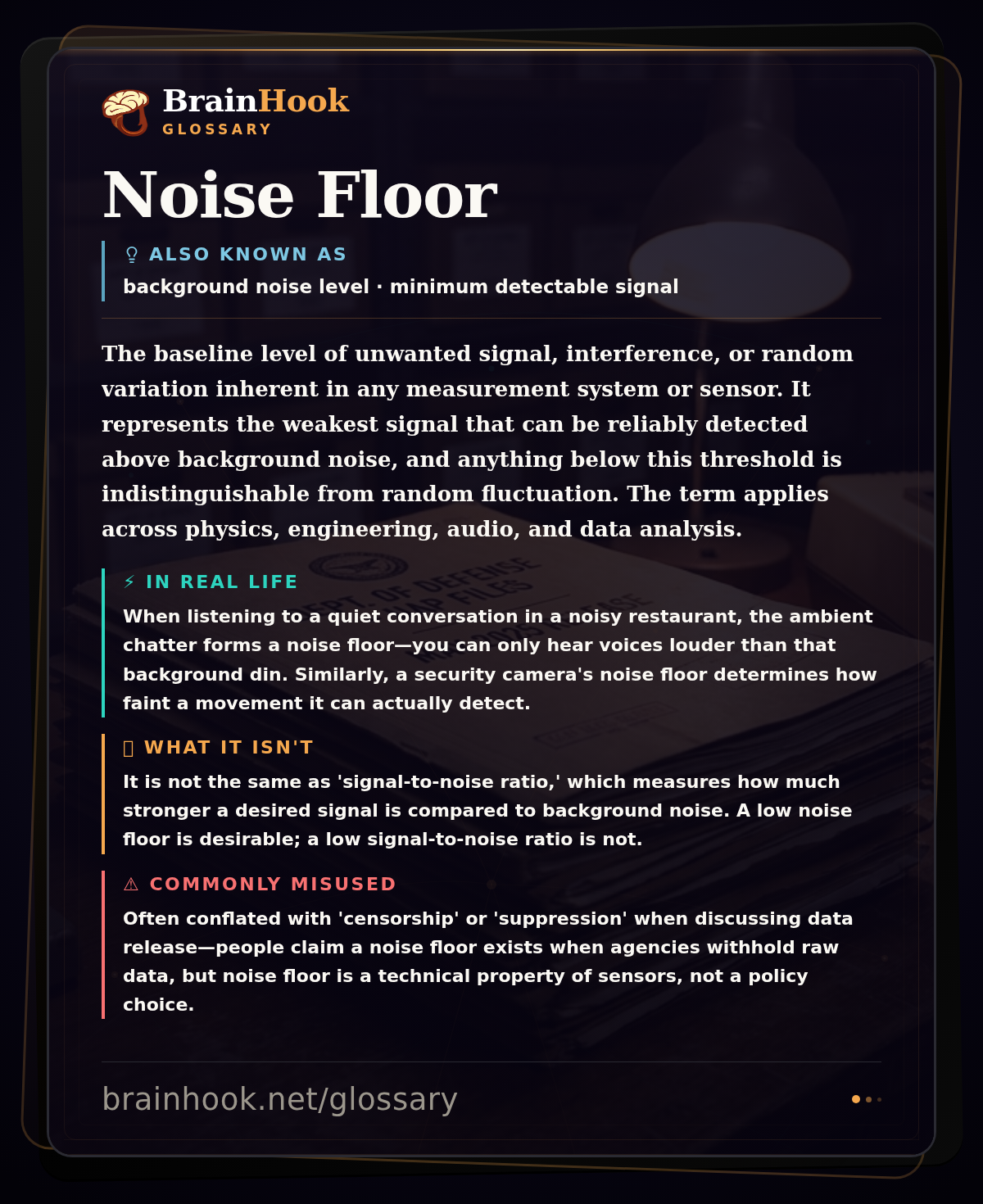
The baseline level of unwanted signal, interference, or random variation inherent in any measurement system or sensor. It represents the weakest signal that can be reliably detected above background noise, and anything below this threshold is indistinguishable from random fluctuation. The term applies across physics, engineering, audio, and data analysis.
What this means in real life
When listening to a quiet conversation in a noisy restaurant, the ambient chatter forms a noise floor—you can only hear voices louder than that background din. Similarly, a security camera's noise floor determines how faint a movement it can actually detect.
What it isn’t
It is not the same as 'signal-to-noise ratio,' which measures how much stronger a desired signal is compared to background noise. A low noise floor is desirable; a low signal-to-noise ratio is not.
Commonly misused online
Often conflated with 'censorship' or 'suppression' when discussing data release—people claim a noise floor exists when agencies withhold raw data, but noise floor is a technical property of sensors, not a policy choice.