Cognitive Tax
The hidden mental energy spent evaluating complex choices, which depletes the brain's capacity for future reasoning and often leads to unsmart delays.
Not to be confused with: Cognitive Load
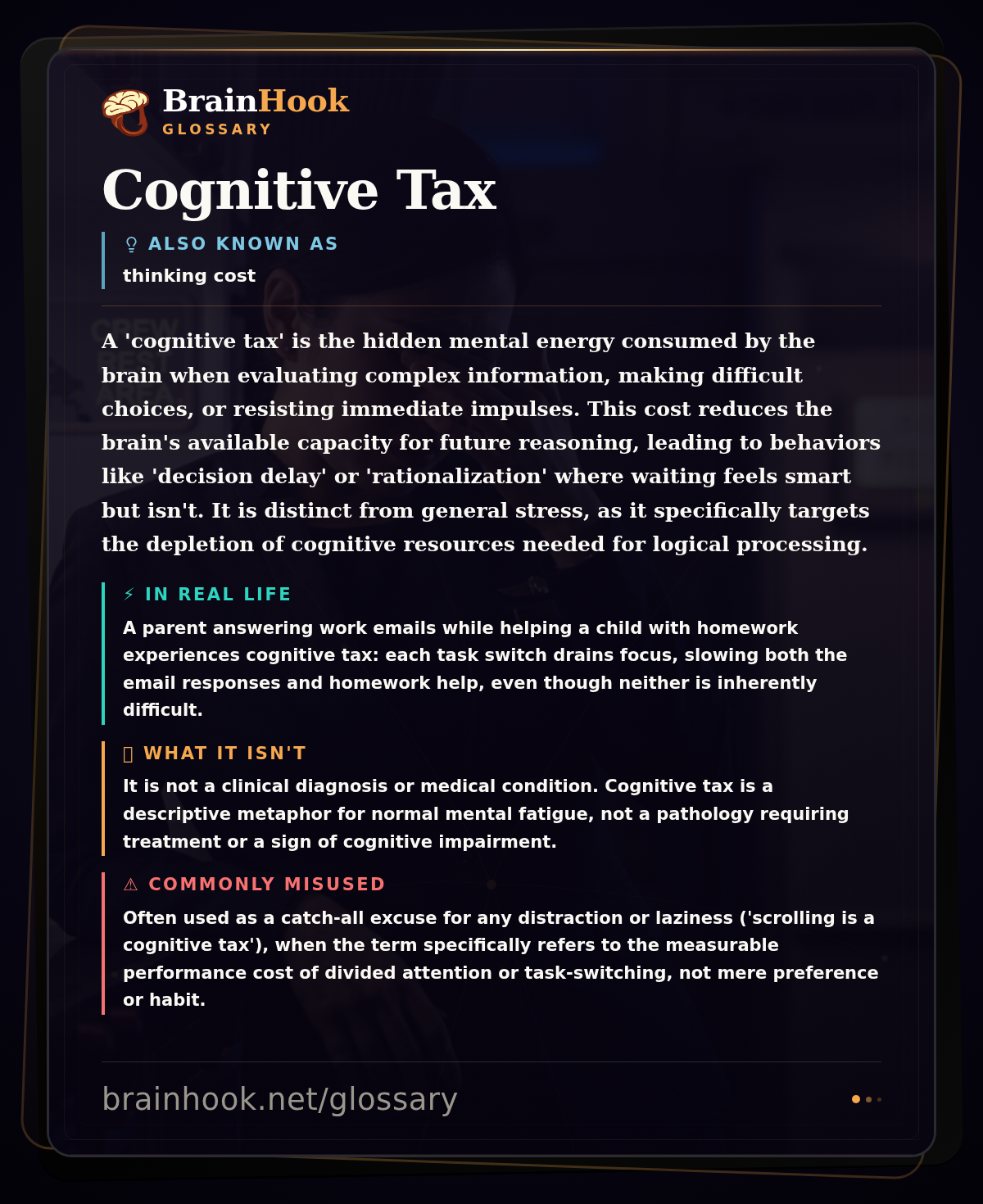
A 'cognitive tax' is the hidden mental energy consumed by the brain when evaluating complex information, making difficult choices, or resisting immediate impulses. This cost reduces the brain's available capacity for future reasoning, leading to behaviors like 'decision delay' or 'rationalization' where waiting feels smart but isn't. It is distinct from general stress, as it specifically targets the depletion of cognitive resources needed for logical processing.
What this means in real life
A parent answering work emails while helping a child with homework experiences cognitive tax: each task switch drains focus, slowing both the email responses and homework help, even though neither is inherently difficult.
What it isn’t
It is not a clinical diagnosis or medical condition. Cognitive tax is a descriptive metaphor for normal mental fatigue, not a pathology requiring treatment or a sign of cognitive impairment.
Commonly misused online
Often used as a catch-all excuse for any distraction or laziness ('scrolling is a cognitive tax'), when the term specifically refers to the measurable performance cost of divided attention or task-switching, not mere preference or habit.