Your Favorite Anime Is Great. The Jiggle Physics Are Not a Coincidence.
When a genuinely good anime can't stop sexualizing its own characters, that's not a creative failure — it's a revenue model you're watching in real time.
Here is the thing about Shiboyugi: Playing Death Games to Put Food on the Table. The show is, by most reasonable measures, working. It mixes drama, suspense, and horror in a way that draws comparisons to Squid Game, and the animation has been called absolutely top-tier. What stands out from the opening sequence onward is the deliberate, patient pacing — not just in the writing, but in the cinematography, with the camera seeming almost to slow-blink its way from one scene to the next. There is a genuinely striking artistic decision at its core: close shots render characters in highly detailed, traditional anime style, while establishing shots drop all linework and reduce figures to clusters of colored blocks against painterly, richly detailed backgrounds. It is a show that has made real visual choices for real expressive reasons. And then — mid-tension, mid-dread — the camera finds its way to a body.
This is not a review, and Shiboyugi is not a target. It is a case study in something the anime industry has been doing so long that most audiences have stopped noticing it as a decision at all. The sexualization of female characters in otherwise serious or ambitious anime is frequently framed as a cultural quirk, a genre convention, an authorial choice — something that just happens to be there, the way weather happens to be there. But it is not weather. It is infrastructure. And once you see the economic and audience logic underneath it, the jiggling becomes much harder to unsee.
The Audience That Actually Buys the Merchandise
To understand why fanservice persists in anime that does not seem to need it, you have to understand what anime actually sells — and to whom. The cultural assumption is that anime is for teenagers. The economic reality has always been messier. Since the early days of the anime, manga, and gaming eras, the people who actually had money to buy these works — whether manga volumes, games, or light novels — were usually middle-aged "salarymen." The paradox is that younger fans often do not have enough money to buy these products. Teenagers drive conversation. Adults drive revenue. Fanservice is largely designed with that second group in mind.
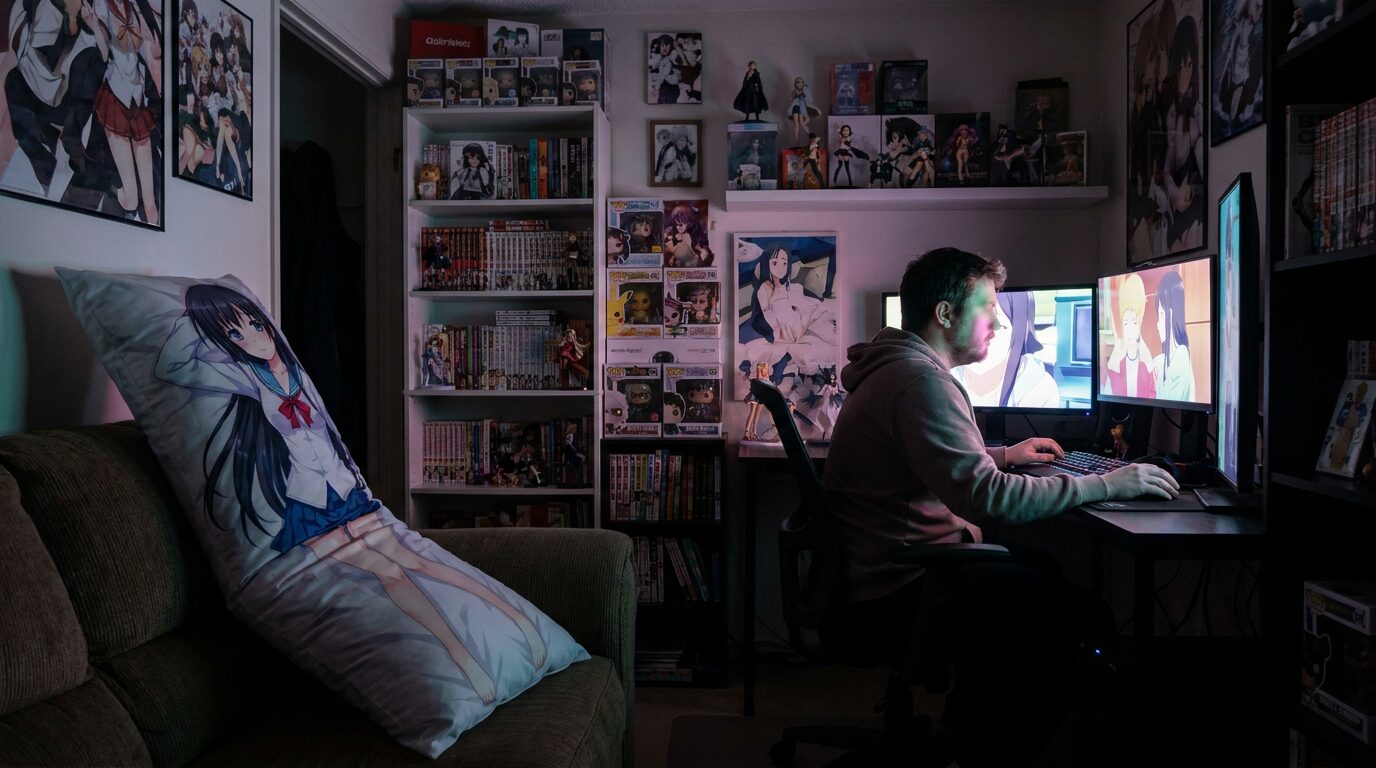
Fanservice increases attention, social sharing, and merchandise tie-ins — figures, posters, swimsuit artbooks. For many mid-tier productions, it is a cost-effective way to boost visibility and preorders. This is the part the discourse around anime fanservice tends to skip. The argument is usually framed as a moral question: is it objectifying? Is it harmful? Is it feminist or anti-feminist? Those are real questions with real stakes. But the prior question, the structural one, is simpler: who is buying the body pillow, and why does the studio know they will?
“Fanservice is not a creative failure. It is a revenue model you are watching in real time, dressed in plot clothing.”
Studios know that a well-timed beach episode — often occurring around episode seven or eight — can spike ratings and merchandise sales, even if it pauses the main plot. As one industry observer summarized it: "The industry realized that while casual viewers watch for the story, hardcore fans buy the Blu-rays for the characters. Fanservice became a way to secure those sales in a competitive market." The beach episode is not a detour. It is a product catalog delivered in animation form.
The Asymmetry Problem: Why Her Body, Not His
The question the original assignment raises — why is the camera fixated on women specifically, and why can focusing on male characters feel like a commercial risk — is not paranoia. It maps onto a real and documented asymmetry in how anime fanservice is produced and received. The root of the fanservice dilemma is deeply entwined with the reinforcement of sexist tropes. Depictions of men include ripped muscles, shirts off, and macho tendencies of the "ideal man" — none of which are discussed as detrimental to a show's success, and are even supported by fans. Meanwhile, female characters face the brunt of unnecessary sexualization.
This asymmetry exists because the dominant purchasing audience for merchandise and home releases has historically been assumed to be heterosexual men — and producers have designed accordingly. A large portion of fanservice is created for a male audience, meaning the "sexy" scenes mostly feature female characters. This leads to an important question: is there any fanservice made specifically for women? There is, technically — male homoeroticism, such as accidental kisses, is a common feature of fanservice for women and has been described as "easier to get away with" in terms of censorship than fanservice for males. But the budget spent on it, the screen time given to it, the camera angles constructed around it — these are not equivalent. The female body in anime is a commercial asset in a way the male body is not yet normalized to be, and that imbalance shows up frame by frame.
This is what film theorist Laura Mulvey called the male gaze[1] — a framework she developed in 1975 to describe how media depicts women from a masculine, heterosexual viewpoint. Anime is frequently cited as a prime example of this dynamic. When female characters are consistently framed as decoration, it sends a message that their value lies in their appearance, not their agency. What is different in the anime context is that the gaze has been industrialized. It is not the private predilection of a given director. It is a production committee calculation, baked into budgets, episode structures, and character design briefs before a single frame is drawn.
The Risk Calculation: Why Skipping It Feels Dangerous
The franchise logic here is worth sitting with, because it explains why even a genuinely ambitious show might keep the fanservice it does not need. Certainly, there are ways to succeed without it, but the cost is usually incredibly high — you would need to produce endless high-quality animation or refine the plot multiple times. As the question goes: if you were the director or the lead producer, and there was a "spice" available that could help ensure high sales, would you truly abandon it in favor of a path that costs significantly more time and money? Fanservice is, from the production committee's perspective, insurance. A show with strong story beats but no fanservice risks being rewarded only with good reviews. A show with both gets the reviews and the merchandise preorders and the Blu-ray uncut editions.
Reliance on proven fanservice tropes reduces willingness to experiment with narrative forms, character types, and non-sexualized aesthetics. Risk-averse committees favor formulas that sell predictable attention. In a medium where a single production season can make or break a studio, predictable attention is not nothing. It is survival. The cruelty of the system is that the audience who loves a show for its story often has no idea they are partly subsidizing it through a fanservice economy aimed at a different buyer.
The Cracks Are Starting to Show
The fanservice-as-revenue model is not invincible. The data is starting to complicate the assumption that you need it to succeed. Ultimately, the audience is voting with their wallets. Fullmetal Alchemist: Brotherhood presents its female characters practically, directs equivalent visual attention at male and female bodies, and remains one of the highest-rated anime ever produced. Vinland Saga treats its women as historical participants rather than visual rewards. Attack on Titan built one of the most merchandised franchises of the past decade largely without the voyeuristic camera work that defines the fanservice genre. None of these series died commercially for the omission. The massive success of Demon Slayer and Frieren sends a clear message to producers: you don't need the "Gainax Bounce" to make a billion dollars anymore. You just need a good story. These are not niche critical darlings. They are the biggest commercial anime events of recent years — and they are not built around upskirt angles.
The shift is also being driven by the platform through which anime now reaches global audiences. Western audiences are pushing back against tropes they find uncomfortable, demanding better gender representation. Streaming giants like Netflix and Crunchyroll have different standards than Japanese late-night TV, creating a push-and-pull effect. Creators are now balancing the demands of local tradition with an international audience that often craves more nuanced storytelling. Shiboyugi itself is streaming on both Crunchyroll and Netflix simultaneously — meaning its fanservice is being evaluated by audiences who have seen the post-Squid Game appetite for sophisticated death-game narratives, and who may not be buying the swimsuit artbooks.
“The camera knows who it is serving. The question is whether that audience is still the same one watching.”
Unlike its Korean counterpart, in Shiboyugi all participants in the death games are pretty girls — a design that gives the anime a unique edge, as viewers of the in-universe games not only want to see girls in terrifying scenarios but also in uncomfortably strange outfits. That detail is the show's thesis accidentally laid bare. The sexualization is not incidental to the fiction. Inside Shiboyugi's own narrative, an audience is watching young women be endangered and dressed provocatively for entertainment. The real audience is watching the in-fiction audience watch. Whether that framing is a deliberate critique of the very system it operates within — or just a convenient narrative excuse to include the content — is a question the show has not yet fully answered.
What is not a question is the mechanism. Fanservice in anime, particularly the kind that interrupts a genuinely good show to linger on a female character's body in a way that serves no narrative function, is not primarily a story choice. It is a financial product embedded in story clothing. It persists because the people who purchase physical media and character merchandise are not the same people driving streaming numbers — and production committees are, rationally, trying to capture both. The show can be brilliant. The camera can still know who is paying for the Blu-ray. Those two things coexist more easily than they should, and the audience that loves the show for its writing is, usually, the last to notice.
References
- Fan service (en.wikipedia.org)
Defines fan service as intentionally added material to please audiences, often sexual in nature and depicting characters in revealing outfits or situations.
About Noah Chen
Noah Chen writes about internet culture, digital identity, fandom, parasociality, creator economies, algorithms, and the ways media platforms reshape attention, status, belief, loneliness, and selfhood. His work follows culture where it increasingly lives: inside feeds, fandoms, comment sections, recommendation systems, online movements, and synthetic relationships, without reducing digital life to either moral panic or technological inevitability.
More like this

Getting a Million Followers Doesn't Feel Like Winning. It Feels Like a New Trap.
Researchers now have a name for the emotional captivity that sets in once a creator's following gets large enough — and it explains why so many people at the top of the algorithm feel the least free.

The Algorithm Knows You're Browsing Aimlessly. That's When It Owns You.
Researchers have a name for what happens to your judgment the moment you open an app without a goal — and it turns out platforms have been quietly engineering for it.

Talking About Money Is Embarrassing. It's Also the Most Effective Fix.
A new study found that talking about money — not managing it better — significantly cuts financial anxiety, and the reason why exposes something uncomfortable about how control actually works.