The Child Who Managed Your Parent's Feelings Is Still Managing Everyone's
Emotional parentification isn't just about doing too much as a kid — it rewires the boundary between your feelings and everyone else's, and the rewiring follows you into every room you enter as an adult.
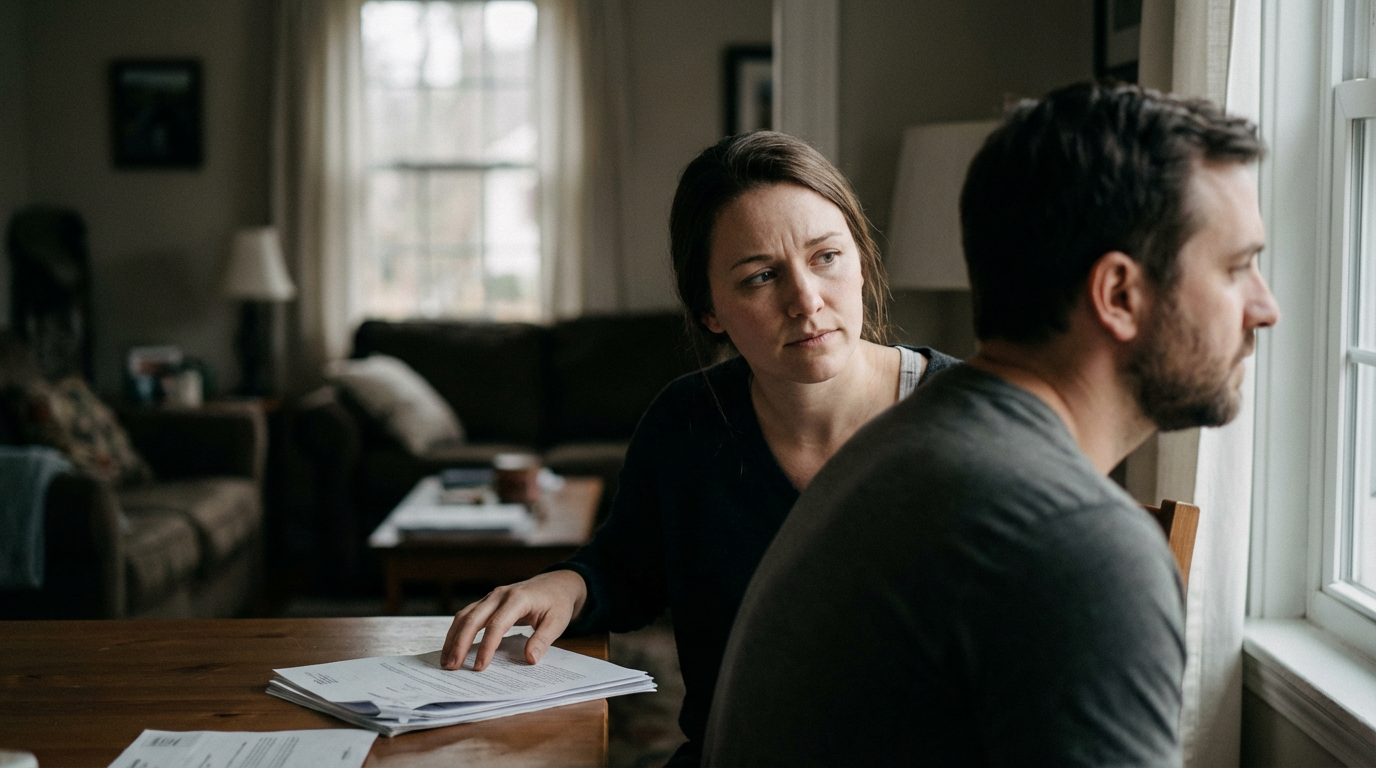
She notices the shift before he says anything. A slight slackening around his eyes, maybe. A pause that lands a half-beat too late. She puts down what she was doing — the task, the thought, whatever she was midway through — and begins the quiet, practiced work of reading him. Is he tired or is he hurt? Is he hurt at her specifically? What would make this easier? By the time he finally speaks, she has already run through several versions of the conversation and pre-adjusted her tone for each one. This is not a failure of self-possession. It is an old skill, precise and automatic, applied to a relationship that did not require it.
Emotional parentification — a term researchers use to describe children who functioned as their parent's primary emotional regulator — is one of the more quietly consequential dynamics in developmental psychology, and one of the harder ones to recognize from inside it. A recent synthesis in Clinical Psychology Review has worked to distinguish this specific form of role reversal from other kinds of childhood caretaking: doing chores, raising siblings, managing logistics. Emotional parentification is different in kind. It involves a child learning to track, absorb, soothe, and manage a parent's internal emotional state, often at a level of attunement more appropriate between adults in therapy than between a parent and a six-year-old. The child becomes, in a sense, the regulation system the parent never had.
What the research is beginning to sketch out is a recognizable adult profile that emerges from this particular childhood role: compulsive caregiving[1], a near-automatic movement toward soothing others, and — most significantly — a persistent difficulty locating where another person's emotional experience ends and their own begins. People who grew up in this role often describe something that is not quite empathy, or not only empathy. It is more like porousness. A bad mood in the room lands somewhere in their body. Someone else's disappointment feels like an emergency they are somehow responsible for managing.
None of this is a disorder or a diagnosis. It is, at its root, an intelligent adaptation — a child learning the rules of the emotional environment they inhabited, developing real and sophisticated skill at reading people, and surviving by becoming indispensable in a specific way. The difficulty is that adaptations do not come with expiration dates. The skill stays sharp long after the original environment is gone.
What Emotional Parentification Actually Is
Parentification as a concept has been in the clinical literature for decades, but it tends to get lumped together in ways that flatten meaningful differences. Instrumental parentification — taking on physical household labor, cooking, managing finances, caring for younger siblings[3] — is meaningfully distinct from its emotional counterpart[2], and the two do not always co-occur. A child can carry enormous practical household responsibility without being asked to serve as a parent's emotional anchor. And a child can live in a materially comfortable home, do no cooking, and still spend years functioning as the primary site of a parent's emotional regulation.
Emotional parentification typically involves one or more of the following: a parent routinely sharing adult-level anxieties, grievances, or emotional pain with the child; the child learning that a parent's mood is something they are partly responsible for managing; the child becoming the first person a parent turns to for comfort, reassurance, or validation; and — crucially — the emotional cost of not performing this role being high enough that the child organizes themselves around avoiding it. Sometimes the cost is a parent's visible distress or withdrawal. Sometimes it is subtle: approval contingent on attentiveness, closeness tied to usefulness. The child learns the equation early. They become extraordinarily good at the math.
“The child does not become a caretaker because they are naturally selfless. They become one because the emotional environment made self-erasure feel like safety.”
What makes this developmental pattern particularly sticky is that it is often invisible to the family system itself. The emotionally parentified child is frequently seen — and may see themselves — as unusually mature, empathetic, or close to the parent. The role can feel meaningful. It often generates real warmth between parent and child, and the child may experience genuine satisfaction in being needed. This is important to hold onto: the pattern is not straightforwardly traumatic in its texture, which is partly why it is so hard to examine later. It does not feel like injury. It feels like identity.
The Skill Set That Doesn't Turn Off
Children who manage a parent's emotional world become, over years of practice, remarkably good at reading people. This is not a metaphor. Repeated attunement to another person's subtle emotional signals — tone, facial microexpressions, posture, the emotional weather of silence — produces real neural patterning. The child who spent years scanning a parent's face for signs of brewing distress develops a finely calibrated system for detecting and anticipating other people's emotional states. In adulthood, this can look like extraordinary emotional intelligence. In many contexts, it functions as exactly that.
The catch is in what the skill was organized around. The original purpose of all that attunement was not connection for its own sake but protection — protecting the parent from distress, protecting the relationship from rupture, protecting the child from the consequences of a parent in emotional freefall. When the same skill runs in adult relationships without that original threat present, it tends to generate behavior that puzzles even the person doing it. The partner who is fine gets asked seventeen times if they are fine. The friend who seems slightly off in a text message produces a wave of anxious interpretation. A colleague's brief silence in a meeting becomes something to decode and mentally manage. The nervous system is still working, faithfully, at a task that no longer needs to be done at that intensity.
Researchers studying this profile describe a phenomenon sometimes called compulsive caregiving[1] — an orientation toward others' emotional states that has the quality of compulsion precisely because it is not fully chosen. It activates before the person decides to activate it. Emotional cues from others function almost like a trigger rather than an invitation: someone in the room is sad, and the movement toward that person, the repositioning of one's own needs out of the way, happens with a speed and automaticity that bypasses reflection. It is only afterward, often much later, that the person notices they are tired, or that they gave something they did not have, or that they have no idea what they were feeling before they started attending to someone else.
Where Do You End and They Begin
“This is not empathy run amok. It is a boundary that was never allowed to form.”
One of the more specific findings that developmental research on emotional parentification keeps returning to is the impairment in what psychologists sometimes call self-other differentiation — the basic capacity to know whose feelings are whose. For most people, this is so fundamental it is invisible. You feel sad; I notice you feel sad; I may feel something in response, sympathy or concern or discomfort, but I carry a background awareness that your sadness is yours and mine is mine. For someone whose early role required them to experience a parent's distress as their own problem, this boundary can remain genuinely blurred.
This is not empathy run amok. It is a boundary that was never fully allowed to form. The child who learned that a parent's unhappiness was something they were emotionally responsible for did not get the conditions in which a clean self-other distinction could develop. Their emotional regulation was practiced mainly in the service of someone else's emotional state. Their own feelings — when they registered at all — were secondary information, often inconvenient, sometimes actively threatening to the caregiving role. A child who is busy managing a parent's anxiety does not have a lot of room to be anxious themselves, at least not out loud. So the child's own emotional signals get quieted, delayed, or routed around. This does not make those feelings disappear. It makes them harder to locate.
Adults with this history often describe a particular confusion: they are good at knowing how other people feel, and poor at knowing how they themselves feel in any given moment. They may notice their own emotional state only in its physical form — a tightness in the chest, a fatigue with no obvious source, a low-grade dread that they cannot quite name or attribute. They may find that their moods track other people's moods in ways that feel less like sensitivity and more like something is happening to them without their consent. In close relationships especially, the differentiation problem intensifies: when the person you love is distressed, there is almost no experience of witnessing it from a distance. Their distress is incoming, it is yours to resolve, and your own emotional ground seems to disappear in the process.
The Self-Erasure That Feels Like Virtue
Part of what makes this pattern genuinely difficult to examine — as opposed to just difficult to live with — is that many of its expressions look admirable from the outside and feel meaningful from the inside. Being attuned to others is a social good. Caregiving is valued in almost every culture. Putting other people's needs first has been historically coded, particularly for women, as character rather than conditioning. The person who always knows how to read a room, who never makes things about themselves, who keeps showing up when everyone else has given up — this person is often celebrated. The fact that they cannot remember the last time they sat with their own discomfort without immediately trying to fix someone else's is not visible at the dinner table.
The self-erasure that grows from emotional parentification is not experienced as suppression, usually. It is more like absence — an absence of practice, of habit, of permission to be the one in the room whose emotional needs are primary even briefly. Many people with this history report a strange difficulty with being cared for: when someone attends to them with real attention, the discomfort is almost physical. The role reversal feels wrong, amateur, like watching someone else try to do a job that only you know how to do correctly. Some avoid closeness in the specific form of being genuinely known. It is not that they do not want intimacy. It is that the version of intimacy they internalized runs in only one direction.
What Changes and What Persists
“The insight that a pattern came from somewhere does not dissolve the pattern, but it does change your relationship to it — and that is where most real change begins.”
Naming this history does something and cannot do everything. Understanding that you developed a particular relationship to others' emotional states because the original environment made that development logical is genuinely useful — not because it explains everything, but because it shifts how the pattern is held. What felt like character, like just being who you are, becomes legible as a learned orientation. And learned orientations can be, slowly and imperfectly, unlearned, modified, added to. The person who compulsively moves toward others' distress is not broken. They are working from an old map in a new territory, and maps can be updated.
What the research makes clear is that the specific features of emotional parentification — the porousness, the compulsive caregiving, the self-other confusion — respond to the same interventions that help with other forms of anxious attachment and emotional learning history: building the capacity to locate and stay with one's own emotional signals, practicing receiving care without fleeing it, developing the tolerance to let another person be upset without immediately organizing one's whole self around resolution. None of this is quick, and none of it is simple, and none of it requires the kind of extended backward excavation that some people assume is necessary. What it does require is noticing, repeatedly, the moment the old move begins — that fast, almost involuntary repositioning of yourself around someone else's weather — and pausing long enough to ask what is actually needed here, by whom, and whether you have a choice about how to respond.
The child who learned to manage a parent's feelings was doing something real and something costly, and usually both at once. They were buying safety with self-knowledge, purchasing closeness with the currency of their own needs going untracked. That exchange made sense in the original environment. It tends to be expensive everywhere else — and the strangest part is that the bill often goes unfelt for years, because the person doing the paying got so good, so early, at not noticing what they were spending.
References
- Parentification Among Young Carers: A Concept Analysis (pmc.ncbi.nlm.nih.gov)
Defines parentification as role reversal where children assume adult roles and responsibilities, establishing the foundational concept the article builds upon. - Parentification Vulnerability, Reactivity, Resilience, and Thriving: A Mixed Methods Systematic Literature Review (pmc.ncbi.nlm.nih.gov)
Establishes through systematic review that emotional and instrumental parentification are meaningfully distinct phenomena with different outcomes. - The positive and negative aspects of parentification: An integrated review (sciencedirect.com)
Provides research evidence that instrumental parentification, such as caring for younger siblings, is distinct from emotional parentification.
About Mara Ellison
Mara Ellison writes about childhood patterns that echo into adult life, including attachment, temperament, rejection sensitivity, emotional learning, family roles, and the early social scripts people keep reenacting without realizing it. Her work focuses on developmental psychology with nuance, clarity, and unusual emotional precision.
More like this

The Child Who Became the Family's Emotional Caretaker Didn't Choose It
Children who manage their parents' emotional lives don't just lose a childhood — they inherit a relational blueprint that can quietly run their adult relationships for decades.

The Child Who Raised the Adults Never Learned to Need Anyone
New research on parentification shows that the survival strategies emotionally burdened children build don't retire when childhood ends — they just find subtler places to run.

The Family Caretaker Grew up. Now They're Exhausted in a Different House.
Adults who grew up managing their parents' emotional worlds don't leave that job behind — they import it into their marriages, and new research is finally tracing exactly how.