Podcasts: Alone in Your Car, Genuinely Glad Two Strangers Care About Each Other
Ensemble podcasts do something no other parasocial medium quite manages — they let you feel compersion for a relationship you're not in, and then they close the loop just enough to make it feel earned.
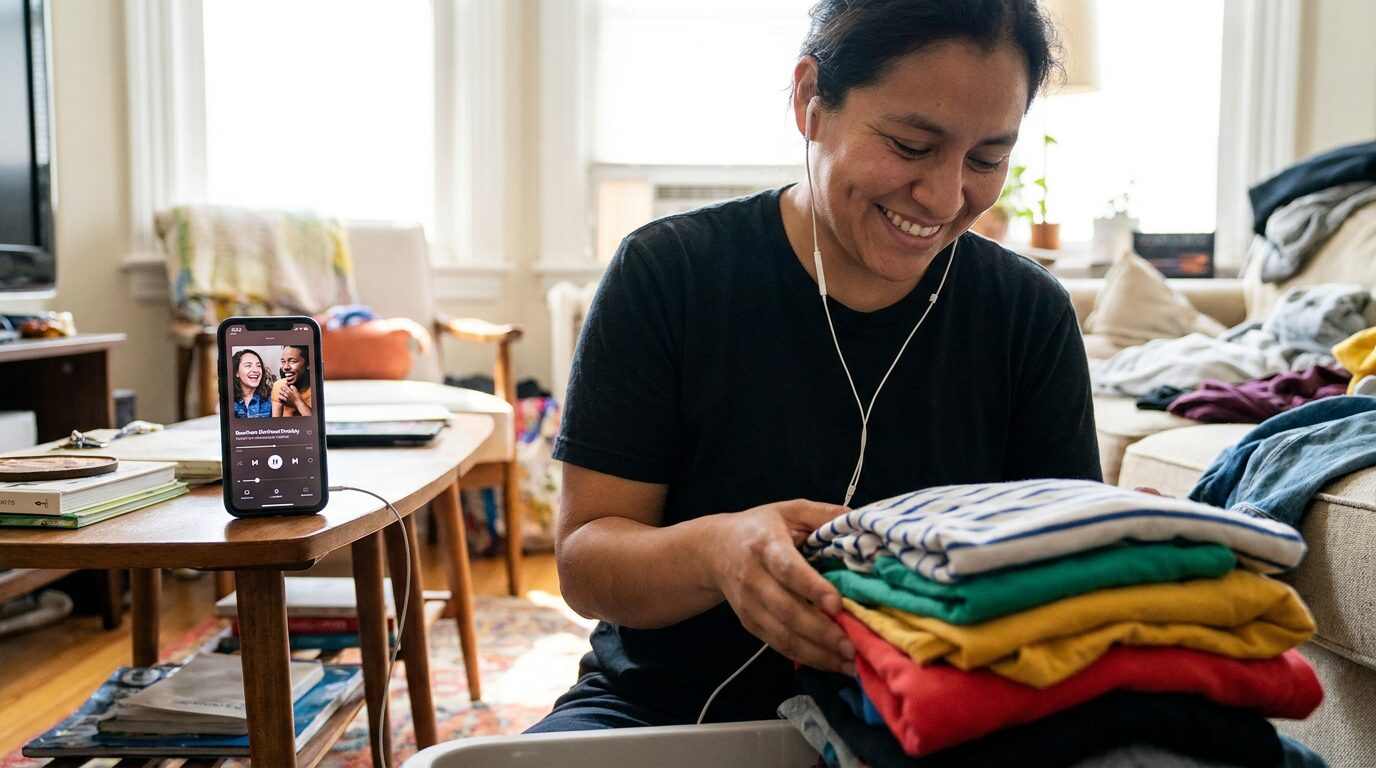
There is a specific feeling that arrives when two podcast hosts finish each other's sentences, one of them laughs before the punchline lands, and you — alone in your car, or folding laundry, or walking a route you have walked a hundred times — feel a quiet, warm swell of something that is not quite happiness for yourself and not quite envy. It is closer to the feeling of watching two people you love be good to each other. You are not a part of what is happening. But you are genuinely glad it is happening. In polyamorous communities, there is a word for this: compersion[8]. The joy you feel at witnessing affection flourish somewhere that does not include you.
Compersion in its original context — as the polyamory community coined it, first through the Kerista Commune in San Francisco[4] — describes the emotion a person feels when their partner experiences love or pleasure with someone else. It is often described as a counterpart to jealousy — in the sense that it is outward-facing: it is about the other person's joy, not your own. The feeling is more specific than altruism and less complicated than self-sacrifice. It requires no loss on your part. You are just genuinely glad the warmth exists. As I've written elsewhere about its limits within actual relationships, compersion is not the price of admission to ethical nonmonogamy — but it is a real and recognizable emotion, and once you have a name for it, you start noticing it in places its inventors never intended. Ensemble conversational podcasts are one of those places.
The question worth asking is why podcasts, specifically. Not television, where parasocial attachment is well-documented, or YouTube, or Instagram. Something is structurally different about the format, and it matters both for what listeners feel and for whether that feeling is warranted.
What Makes Podcast Chemistry Different
Audio research has a term for the banter-heavy conversational format: "chumcasts." One audio editor, quoted in podcast studies literature, called these back-and-forth exchanges between hosts "chumcasts" because they are "talkier" than narrative-style podcasts[1] — and it is exactly this chattiness that creates the relational texture listeners respond to. When hosts disagree about something small and then find their way back to warmth, when they tease each other about a recurring habit, when one of them is clearly having a bad week and the other gently absorbs it without making it a whole thing — you are observing a relationship unfurl in real time. The intimacy of the audio format amplifies this. There is no camera, no lighting, no outfit. A familiar voice in your ear can feel more personal than a thousand likes on a screen.[7]
Research on what makes podcast hosts feel authentic to listeners points to a cluster of specific traits: listeners perceived their favorite podcast hosts as authentic based on characteristics including ordinariness, immediacy, similarity, spontaneity, imperfection, and confessions[3]. Each of these markers reads, in relational terms, as evidence that a real bond exists between the hosts. Imperfection is the tell. A curated TikTok performance does not stumble. A YouTuber executing a planned script does not contradict themselves mid-thought and laugh about it. But a conversational podcast host — especially in dialogue with a co-host — produces something that registers to the listener's nervous system as an actual relationship, with actual texture. And watching an actual relationship, even from outside it, can generate something very close to compersion.
“You are not a part of what is happening between them. But you are genuinely glad it is happening. That's the whole mechanism.”
The Loop That Other Formats Don't Close
Here is what separates podcast parasociality from the sealed-glass experience of watching a celebrity's Instagram grid: podcasters close the loop. They read listener mail on air. They give shoutouts. They develop in-jokes with their audience that span years of episodes. They respond to community feedback in real time, adjusting a bit, correcting a claim, addressing a complaint from a listener who sent a voice memo. Research on podcast listener behavior found that a dedicated segment for "listener mail" — in which listeners write in to add to the conversation or express how the show has influenced their life — is a key mechanism for parasocial relationship development[1]. It is not just that the hosts acknowledge the audience exists. They invite the audience into the ongoing narrative of the show.
Example: Critical Role and the Audience That Became Part of the Story
Critical Role makes this dynamic unusually legible, partly because it runs long enough for the relationships inside it to age. Across the Vox Machina and Mighty Nein campaigns, each unfolding over hundreds of hours, audiences were not merely following fictional characters through a story. They were watching a real group of friends improvise under pressure, recover from emotional tangles, turn private jokes into public mythology, and remain visibly delighted by one another’s choices even after years at the same table.
The pleasure arrived on two registers at once: investment in what the characters were doing and genuine warmth toward the people creating them. You cared about Keyleth’s grief, and you also cared that Marisha Ray was the person carrying it. The fictional and relational layers became difficult to separate, which is part of what makes Critical Role feel less like a conventional show and more like witnessing a friendship that happens to be telling a story.
The audience did not remain completely outside that loop. Fan art was showcased during broadcasts and circulated through the wider community. Community jokes migrated into the cast’s vocabulary. Viewer reactions fed into aftershows, discussions, and the evolving mythology surrounding the campaigns. The cast gave the audience a shared name, “Critters,” not merely as a marketing label but as recognition that the people gathering around the table had become part of the culture forming around it.
Most Critters would never sit in that room or steer a campaign. But they were not treated as an invisible mass whose only purpose was to generate streaming numbers. Their creativity, their grief at character deaths, and their joy at unlikely alliances were repeatedly acknowledged and reflected back by the people at the center of the show.
That is the loop at its clearest: a group’s bond generates warmth in its audience, and the audience’s warmth helps sustain and enlarge the world growing around that bond.
Compersion for People Who Never Existed
The format adds another layer that standard parasocial analysis often misses. The audience is not only watching real people maintain real relationships. They are watching real people maintain those relationships while playing fictional people who are building bonds of their own. Both layers carry emotional weight simultaneously.
Viewers were not simply invested in whether Percy survived or Keyleth could forgive herself. They were also genuinely glad, in the quiet way you can be glad for something that has nothing to do with you, when Vex and Percy became honest with each other, when Vax sat with his twin in the dark, or when Scanlan returned and the table cracked open with relief.
The pleasure in those moments is not necessarily self-insert fantasy. You do not have to imagine replacing anyone at the table to feel warmth at their closeness. You can simply want that intimacy to exist because it made their world richer.
That is compersion lifted out of its original romantic context and translated into narrative form: joy at witnessing affection flourish between people whose relationship does not include you, and who, in this case, do not technically exist.
Fandom often carries that impulse further through shipping. Fans imagine relationships the story never confirmed, extend brief moments of chemistry into entire emotional histories, or build versions of a bond that the characters themselves never get to inhabit on screen.
They do not simply observe fictional intimacy. They collaborate with it.
They build headcanons, write alternate timelines, create art, and sometimes imagine themselves inside the relational web as a friend, lover, rival, caretaker, or missing member of the party. The resulting attachment can contain several emotions at once: compersion for two characters finding each other, longing to be included in what they have, and creative pleasure in imagining a version of the relationship that feels more complete than canon allowed.
The bond is fictional, but the emotional rehearsal is not.
At its most honest, shipping allows people to test which forms of closeness feel desirable, safe, possible, or worth protecting. It gives them a private laboratory for attachment, intimacy, conflict, repair, and belonging, even when the people involved never existed.
That movement from witnessing a bond to imaginatively participating in it matters because different media offer audiences very different routes into the relationships they observe. Most leave you pressed against the glass.
Conversational podcasts are built with something closer to a door.
That door is what separates ensemble podcasts from more conventional broadcast relationships. A YouTuber with five million subscribers speaks into a camera. An Instagram influencer publishes a carefully chosen frame. Even though large creators invite comments, the responses they respond to are usually curated: selected because they reinforce the creator’s brand, serve the content’s marketing, extend a joke, or make the exchange legible to everyone else watching. Ensemble podcasts more often make the audience’s responses part of the show itself. Podcasters — especially those working in conversational groups — create what researchers have described as an "inverse parasocial relationship"[2]: the hosts are also imagining a listener, speaking toward someone, and deliberately shaping intimacy in that direction. They do not know you personally, but they are talking to you, or more precisely, to a version of you they have constructed and come to care about. That care is structurally present in how they speak. Listeners may see podcasters as more trustworthy because the hosts care for listeners' wellbeing.[1] The reciprocity may be asymmetric, but it is not absent. That distinction matters enormously for the quality of what the listener feels. I call that compersion, although other researchers may disagree with me.
The Difference between Podcasts and Other Influencers
Contrast this with what algorithmic social platforms are actually optimizing for: engagement, not connection. The feed surfaces content calibrated to hold attention, which is not the same thing as generating the sense that someone, somewhere, is aware of you and invested in your wellbeing. A podcast that has been running for four years, where the hosts have watched their audience go through divorces and job losses and moves and new relationships, all of it reflected back in listener mail they read aloud on air — that is a community with a memory. The compersion listeners feel for the hosts' chemistry is earned, at least partially, because the hosts have been present for the listener in a way that most media figures simply have not.
What This Does for Lonely People Specifically
A study published in PLOS One found that forming a parasocial relationship with podcast hosts was associated with a heightened sense of social engagement and relatedness — the psychological need for belonging and connection — with those who developed stronger parasocial bonds reporting feeling less lonely[5]. The genre of podcast didn't change this. What mattered was the depth of the bond and the hours of listening. For people who are isolated — whether by illness, geography, social anxiety, or the quiet structural erosion of adult friendship — this is not nothing. A household where two podcast hosts are mid-conversation about something ridiculous that happened to one of them last Tuesday is a household that has other voices in it. That counts for something real.
The compersion dimension amplifies this specifically. When you watch two hosts who clearly like each other — who have built something together over years, who have run on in-jokes and recovered from genuine tension and circled back to warmth — you are witnessing what attachment security looks like in public. There is no zero-sum logic to it. Their bond does not diminish anything available to you. And because the format has invited you into the community, however peripherally, you are not an outsider looking through a window. You are more like someone at a party who doesn't know the guests of honor well, but has been attending for years, knows all the stories, and finds genuine pleasure in watching the friendship hold.
The Asymmetry That Remains
None of this should be romanticized into something it is not. The intimacy that podcasting produces scales to thousands of people while feeling personal to each one[2]. The hosts are imagining a listener — singular, specific, ideal — and that imagined listener overlaps with you only partially and by coincidence. Research by Vilceanu (2025) found that even small changes to a podcast — a new host, a shift in content — can destabilize the parasocial trust and intimacy listeners have built, triggering reactions closer to grief than preference[6]. That kind of reaction is data. It tells you how real the attachment felt. It also tells you how one-directional the vulnerability in that attachment ultimately was.
Most listeners are never the one whose mail gets read, you're not usually the one plucked out of a Discord voice channel to say what you want on air. The in-joke that makes you feel seen was also heard by eighty thousand other people who felt exactly the same way. The shoutout you are waiting for — the acknowledgment that you specifically exist in the listener community — will not come for most of you, ever. What you have, is a genuine seat at the table. But it is at the far end, in a section that can be cleared away when the hosts decide to restructure the show, pivot the format, take a hiatus, or simply stop. The relationship is real in its effects. It is not symmetrical in its structure.
“The compersion is grounded enough to be genuine. The intimacy is real enough to lose. Both of those things are true.”
What podcasting offers, at its best, is a form of witnessed warmth that asks very little of you and delivers something genuine. You do not have to perform for it, disclose anything, or manage the anxiety of being known. You just listen to a few people who are good to each other, who have been good to you in the way broadcast can be good to you — consistently, over time, with attention — and you feel the warmth of their bond as if it were partly yours. In a lonelier world than most of us expected to be living in, that is worth naming honestly. Not as a replacement for the messy, reciprocal, vulnerable work of actual relationship. But as evidence that the capacity to feel joy at someone else's closeness — compersion, in its loosest and most portable form — does not require a romantic entanglement to activate. Sometimes it just requires a couple of people who clearly like each other, a microphone, and the structural decision to remember that somewhere, someone is listening.
References
- pdxscholar.library.pdx.edu (pdxscholar.library.pdx.edu)
Defines 'chumcasts' as back-and-forth conversational exchanges between hosts that are chattier than narrative-style podcasts. - “It’s between me and myself”: Inverse parasocial relationships in addressing (imagined) podcast listeners (journals.sagepub.com)
Provides the academic framework of 'inverse parasocial relationships' that the article uses to describe podcast listener dynamics. - “One of Us”: Examining the Authenticity and Parasocial Relationships of Stand-Up Comedian Podcast Hosts (tandfonline.com)
Provides research identifying six traits—ordinariness, immediacy, similarity, spontaneity, imperfection, and confessions—that make podcast hosts feel authentic to listeners. - Compersion: All About the ‘Opposite of Jealousy’ (psychcentral.com)
Establishes that the Kerista Commune in San Francisco first coined the term 'compersion' within polyamorous communities. - Listening to Podcasts Might Help People Fulfill Their Social Needs, Study Finds (theswaddle.com)
Reports PLOS One study finding that parasocial relationships with podcast hosts correlate with heightened social engagement, relatedness, and reduced loneliness. - Parasocial Intimacy, Change, and Nostalgia in Podcast Listener Reviews (cogitatiopress.com)
Provides research showing that small podcast changes like new hosts trigger grief-like reactions, demonstrating the depth of parasocial trust listeners develop. - Parasocial Relationships and the Science of Trust in Podcasting: Authenticity in the Age of AI (rss.com)
Supports the article's claim that a familiar voice in podcasts feels more personal than other digital media formats. - Polyamory (en.wikipedia.org)
Defines polyamory and establishes the foundational concept of ethical non-monogamy that the article references when introducing compersion.
About Iri Yanamadala
Iri Yanamadala writes about relationships - specifically, attachment styles, polyamory, nonmonogamy, jealousy, agreements, communication, metamours, hierarchy, repair, and the emotional architecture of loving more than one person honestly. Her work is poly-affirming without being anti-monogamy, grounded in consent, clarity, and the unglamorous logistics that keep desire from becoming collateral damage.
More like this
Compersion Is Not the Price of Admission
Polyamory culture treats compersion like proof of evolution — but real ethical nonmonogamy has room for grief, neutrality, and the slow, unglamorous work of just getting okay.

AI Companions Are Engineered to Feel Like Friends. That's Precisely the Problem.
AI companions are designed to make you feel deeply understood — and the mechanism behind that feeling may be quietly replacing the thing it imitates.
Getting a Million Followers Doesn't Feel Like Winning. It Feels Like a New Trap.
Researchers now have a name for the emotional captivity that sets in once a creator's following gets large enough — and it explains why so many people at the top of the algorithm feel the least free.