Threat Sensitivity
The degree to which an individual or group is predisposed to detect and respond to potential dangers or negative changes. It is the foundational trait that influences how fear spreads during crises, requiring a community to already possess this heightened awareness before fear can cluster around specific external threats.
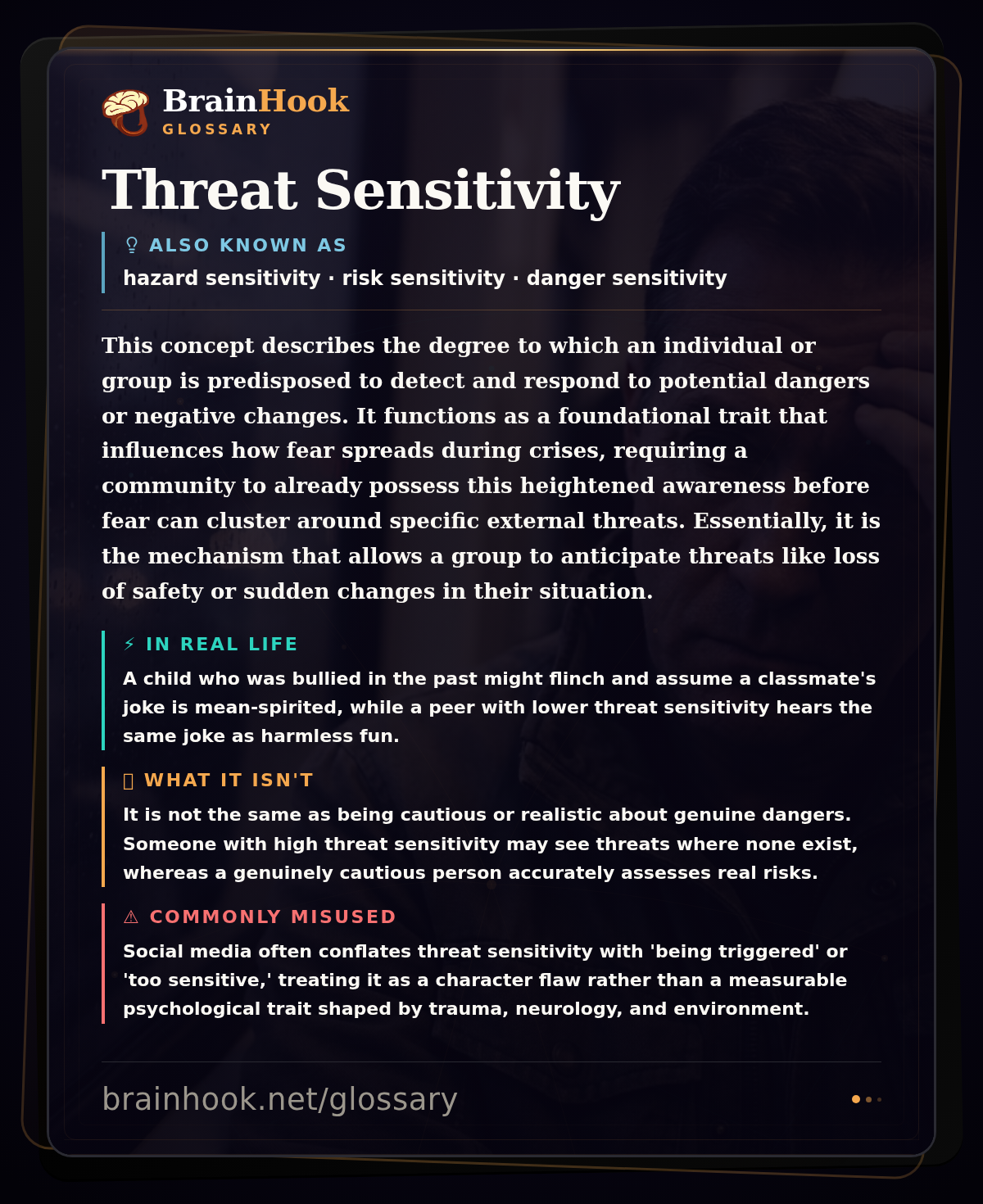
This concept describes the degree to which an individual or group is predisposed to detect and respond to potential dangers or negative changes. It functions as a foundational trait that influences how fear spreads during crises, requiring a community to already possess this heightened awareness before fear can cluster around specific external threats. Essentially, it is the mechanism that allows a group to anticipate threats like loss of safety or sudden changes in their situation.
What this means in real life
A child who was bullied in the past might flinch and assume a classmate's joke is mean-spirited, while a peer with lower threat sensitivity hears the same joke as harmless fun.
What it isn’t
It is not the same as being cautious or realistic about genuine dangers. Someone with high threat sensitivity may see threats where none exist, whereas a genuinely cautious person accurately assesses real risks.
Commonly misused online
Social media often conflates threat sensitivity with 'being triggered' or 'too sensitive,' treating it as a character flaw rather than a measurable psychological trait shaped by trauma, neurology, and environment.