Substitution Cipher
A substitution cipher encrypts text by swapping each letter or symbol for a different one according to a fixed rule, changing character identity while keeping the sequence intact—a classic method used since ancient times.
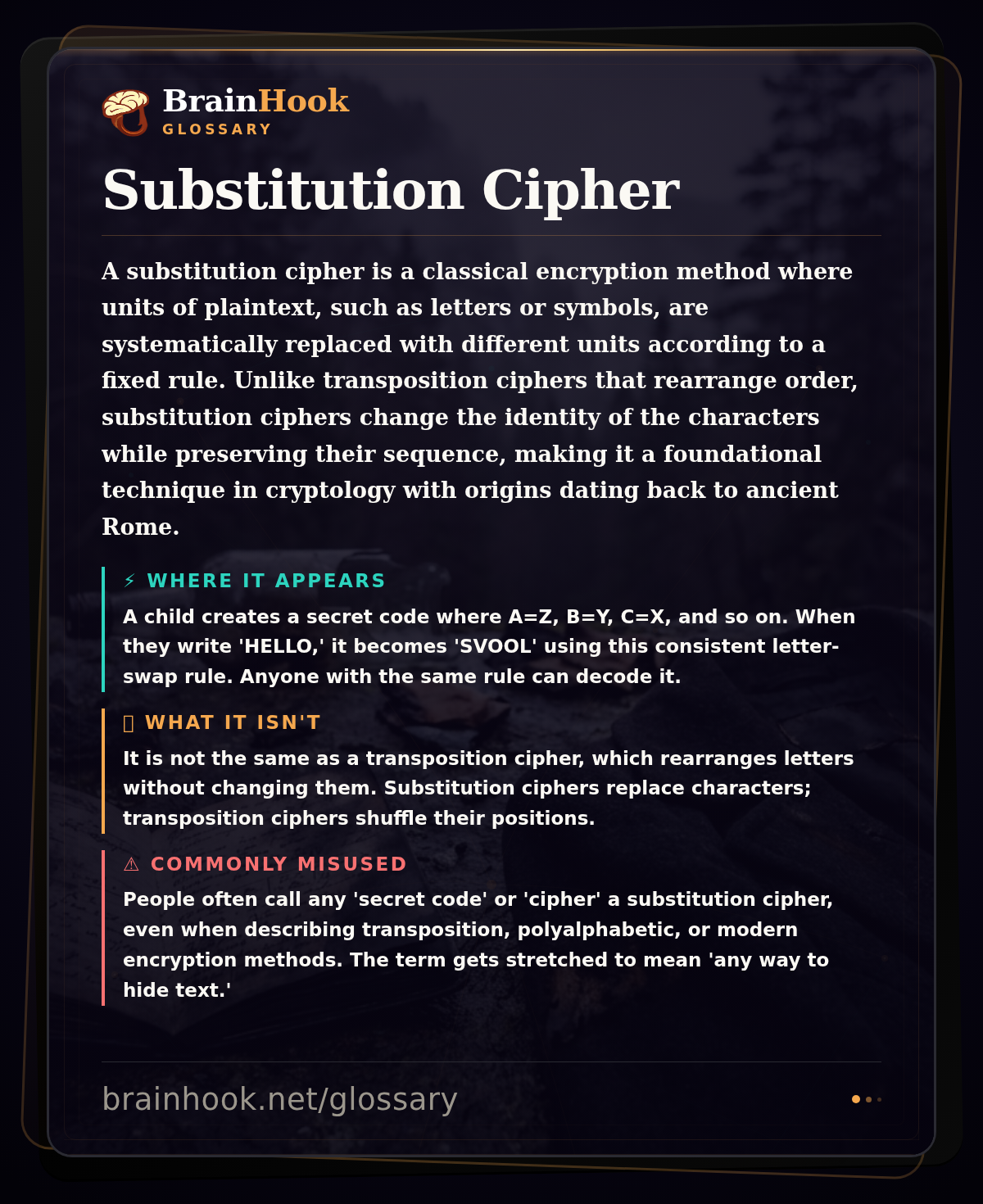
A substitution cipher is a classical encryption method where units of plaintext, such as letters or symbols, are systematically replaced with different units according to a fixed rule. Unlike transposition ciphers that rearrange order, substitution ciphers change the identity of the characters while preserving their sequence, making it a foundational technique in cryptology with origins dating back to ancient Rome.
What this means in real life
A child creates a secret code where A=Z, B=Y, C=X, and so on. When they write 'HELLO,' it becomes 'SVOOL' using this consistent letter-swap rule. Anyone with the same rule can decode it.
What it isn’t
It is not the same as a transposition cipher, which rearranges letters without changing them. Substitution ciphers replace characters; transposition ciphers shuffle their positions.
Commonly misused online
People often call any 'secret code' or 'cipher' a substitution cipher, even when describing transposition, polyalphabetic, or modern encryption methods. The term gets stretched to mean 'any way to hide text.'