Social Comparison
'Social comparison' is when you judge your own value or status by looking at how others are doing. It often happens on social media, where checking metrics or others' posts quietly triggers a sense of whether you're 'enough' or 'behind.'
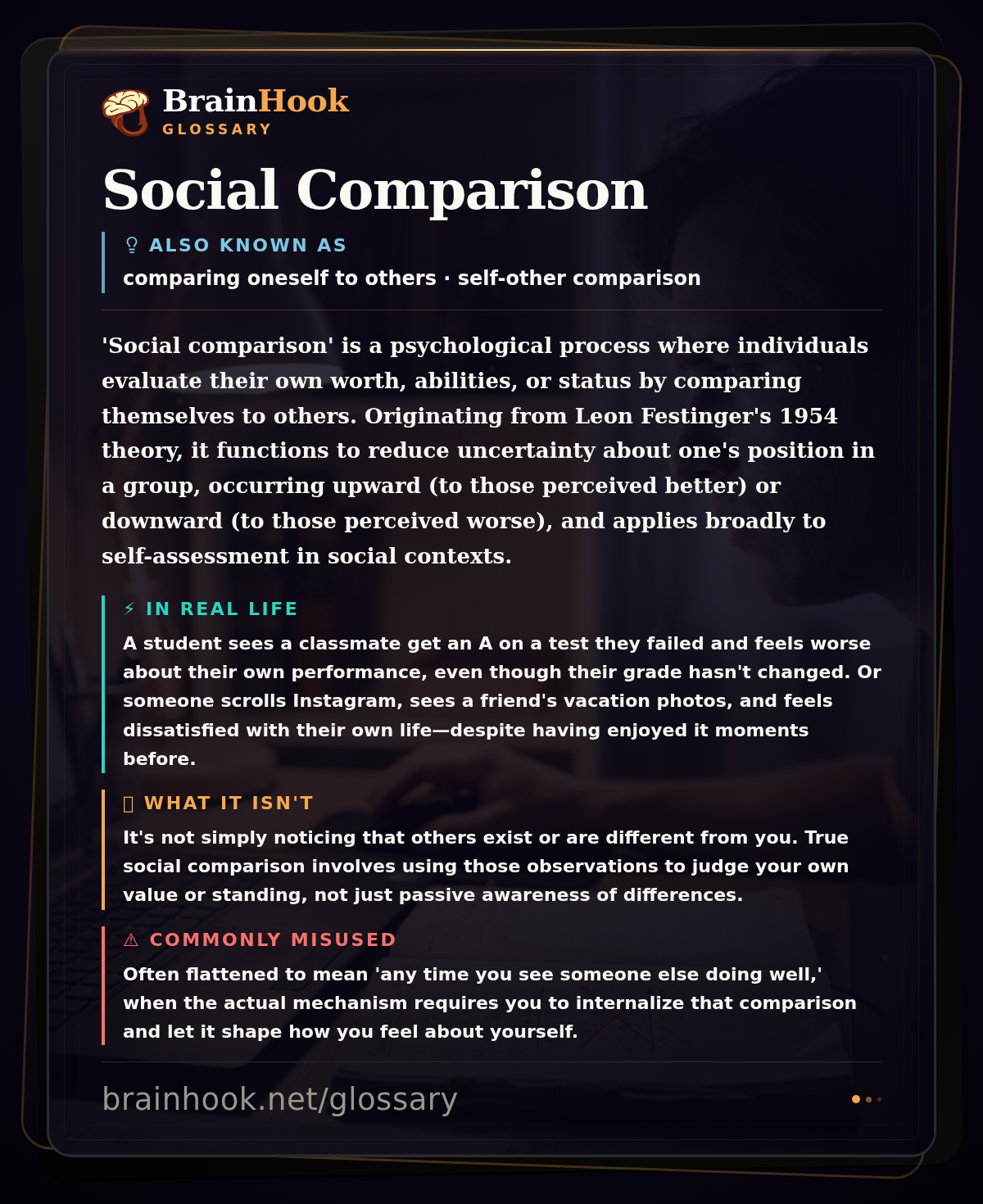
'Social comparison' is a psychological process where individuals evaluate their own worth, abilities, or status by comparing themselves to others. Originating from Leon Festinger's 1954 theory, it functions to reduce uncertainty about one's position in a group, occurring upward (to those perceived better) or downward (to those perceived worse), and applies broadly to self-assessment in social contexts.
What this means in real life
A student sees a classmate get an A on a test they failed and feels worse about their own performance, even though their grade hasn't changed. Or someone scrolls Instagram, sees a friend's vacation photos, and feels dissatisfied with their own life—despite having enjoyed it moments before.
What it isn’t
It's not simply noticing that others exist or are different from you. True social comparison involves using those observations to judge your own value or standing, not just passive awareness of differences.
Commonly misused online
Often flattened to mean 'any time you see someone else doing well,' when the actual mechanism requires you to internalize that comparison and let it shape how you feel about yourself.
Based on 2 reference sources, including NIH material. Last verified July 12, 2026.