Return Period
The average time between occurrences of an event of a certain magnitude—here, how often extreme April heat like 2026's is expected to happen.
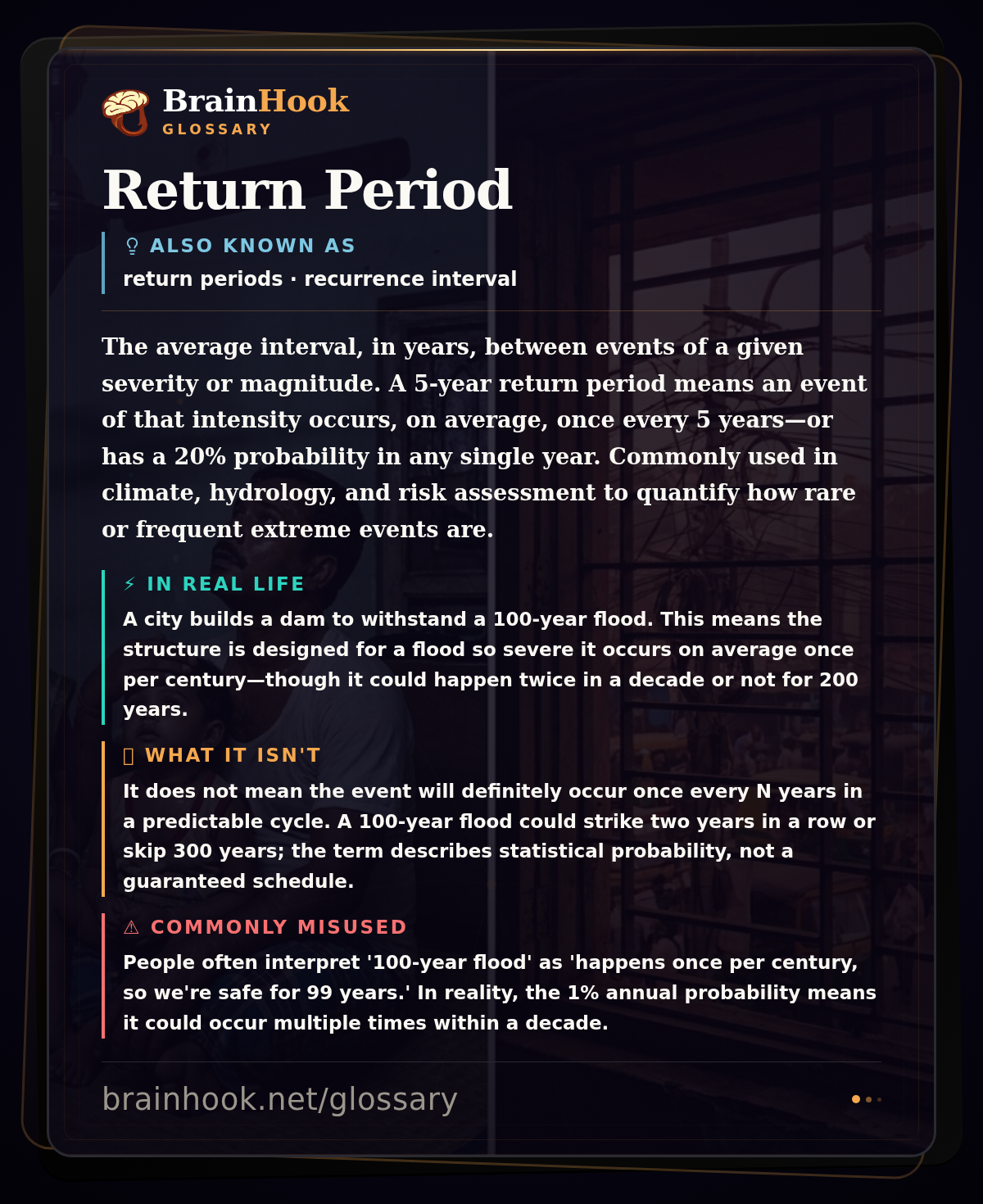
The average interval, in years, between events of a given severity or magnitude. A 5-year return period means an event of that intensity occurs, on average, once every 5 years—or has a 20% probability in any single year. Commonly used in climate, hydrology, and risk assessment to quantify how rare or frequent extreme events are.
What this means in real life
A city builds a dam to withstand a 100-year flood. This means the structure is designed for a flood so severe it occurs on average once per century—though it could happen twice in a decade or not for 200 years.
What it isn’t
It does not mean the event will definitely occur once every N years in a predictable cycle. A 100-year flood could strike two years in a row or skip 300 years; the term describes statistical probability, not a guaranteed schedule.
Commonly misused online
People often interpret '100-year flood' as 'happens once per century, so we're safe for 99 years.' In reality, the 1% annual probability means it could occur multiple times within a decade.