Recursive Feedback Loops
A system where output feeds back into input to amplify or dampen behavior across multiple cycles, creating self-regulating or self-amplifying patterns that evolve over time.
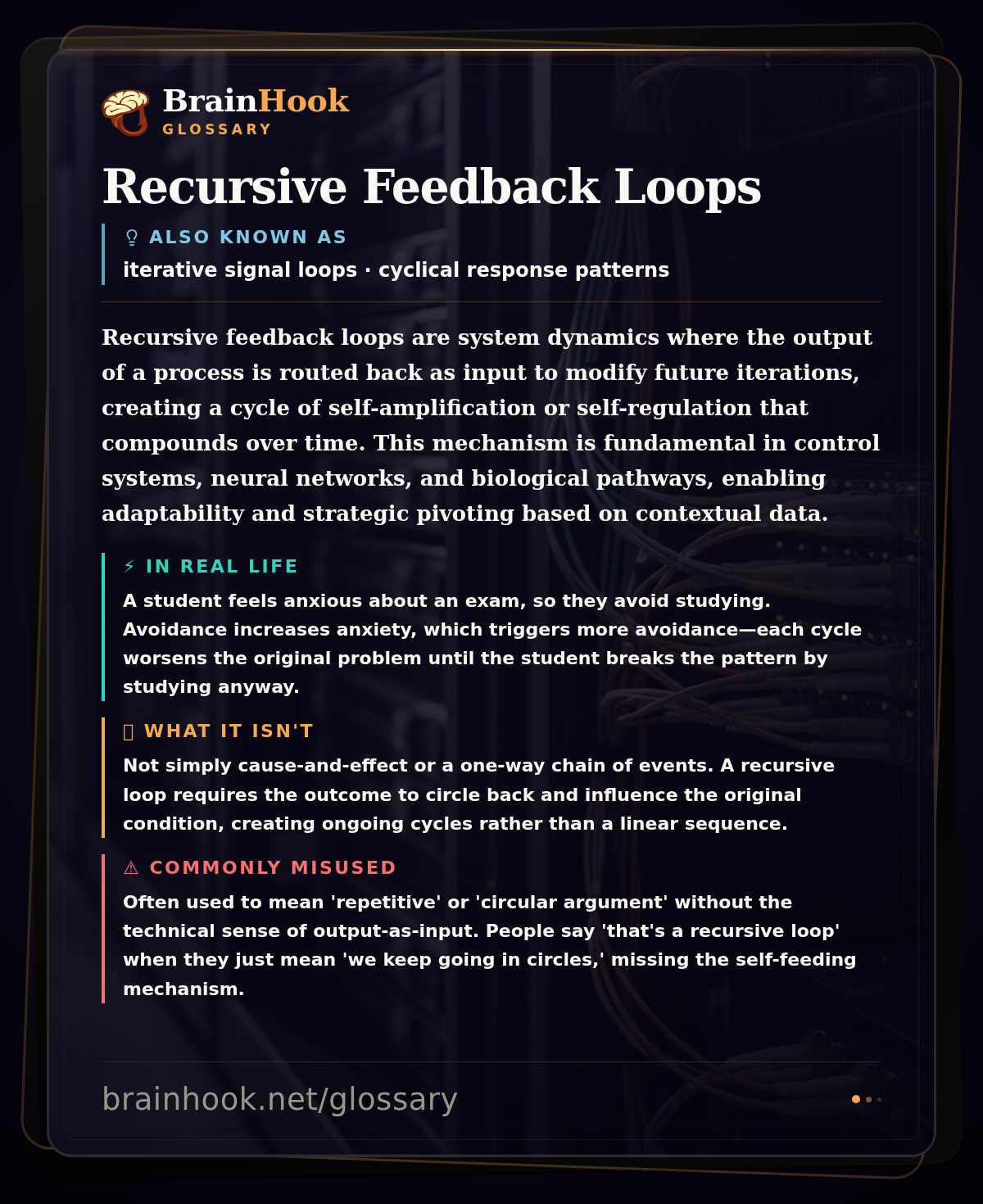
Recursive feedback loops are system dynamics where the output of a process is routed back as input to modify future iterations, creating a cycle of self-amplification or self-regulation that compounds over time. This mechanism is fundamental in control systems, neural networks, and biological pathways, enabling adaptability and strategic pivoting based on contextual data.
What this means in real life
A student feels anxious about an exam, so they avoid studying. Avoidance increases anxiety, which triggers more avoidance—each cycle worsens the original problem until the student breaks the pattern by studying anyway.
What it isn’t
Not simply cause-and-effect or a one-way chain of events. A recursive loop requires the outcome to circle back and influence the original condition, creating ongoing cycles rather than a linear sequence.
Commonly misused online
Often used to mean 'repetitive' or 'circular argument' without the technical sense of output-as-input. People say 'that's a recursive loop' when they just mean 'we keep going in circles,' missing the self-feeding mechanism.