Photosynthesizing
When hotter and drier, trees photosynthesize less efficiently because water stress disrupts the tension gradient needed to pull water from roots to leaves, limiting carbon fixation.
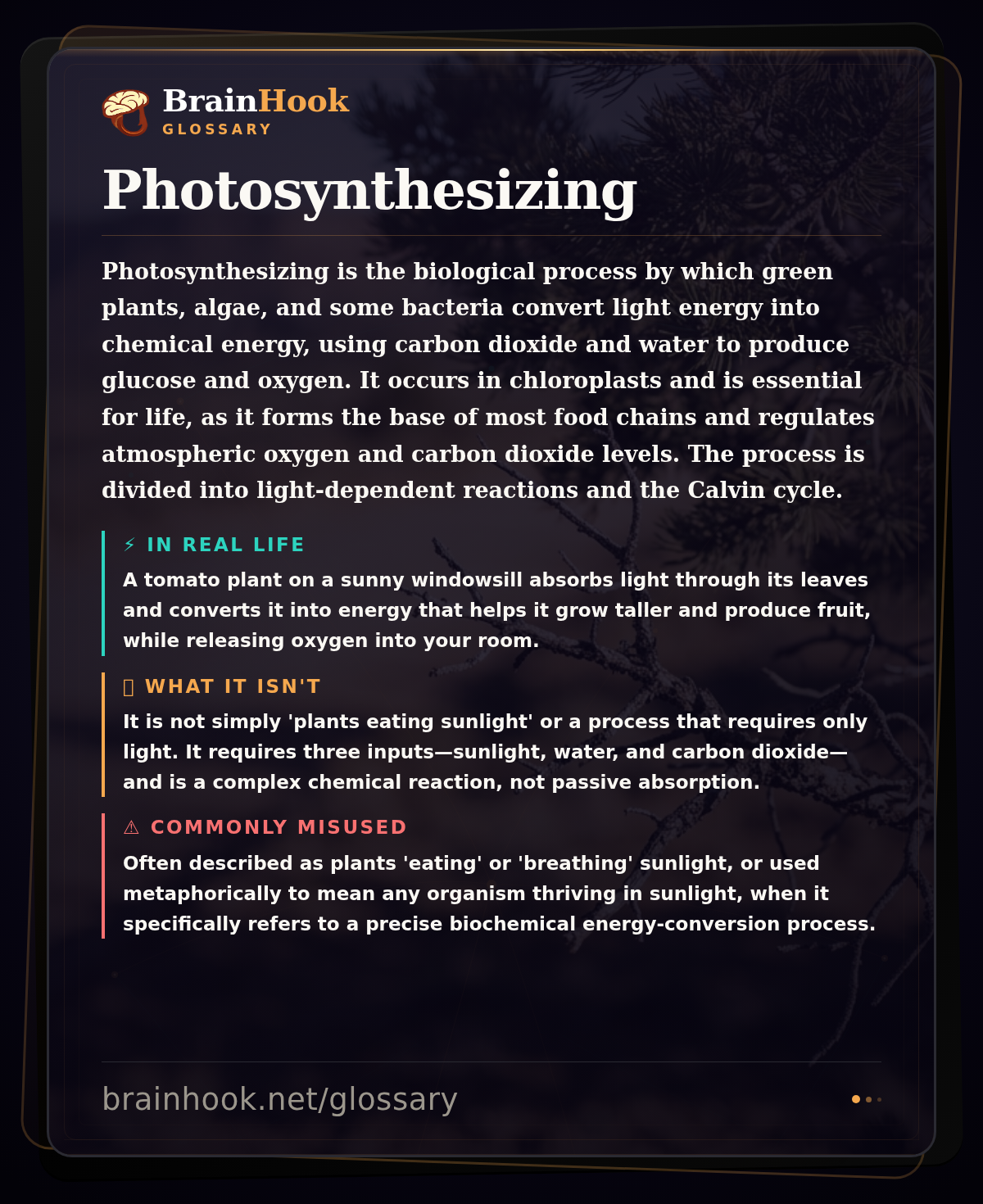
Photosynthesizing is the biological process by which green plants, algae, and some bacteria convert light energy into chemical energy, using carbon dioxide and water to produce glucose and oxygen. It occurs in chloroplasts and is essential for life, as it forms the base of most food chains and regulates atmospheric oxygen and carbon dioxide levels. The process is divided into light-dependent reactions and the Calvin cycle.
What this means in real life
A tomato plant on a sunny windowsill absorbs light through its leaves and converts it into energy that helps it grow taller and produce fruit, while releasing oxygen into your room.
What it isn’t
It is not simply 'plants eating sunlight' or a process that requires only light. It requires three inputs—sunlight, water, and carbon dioxide—and is a complex chemical reaction, not passive absorption.
Commonly misused online
Often described as plants 'eating' or 'breathing' sunlight, or used metaphorically to mean any organism thriving in sunlight, when it specifically refers to a precise biochemical energy-conversion process.
Based on 2 reference sources, including primary sources. Last verified July 12, 2026.